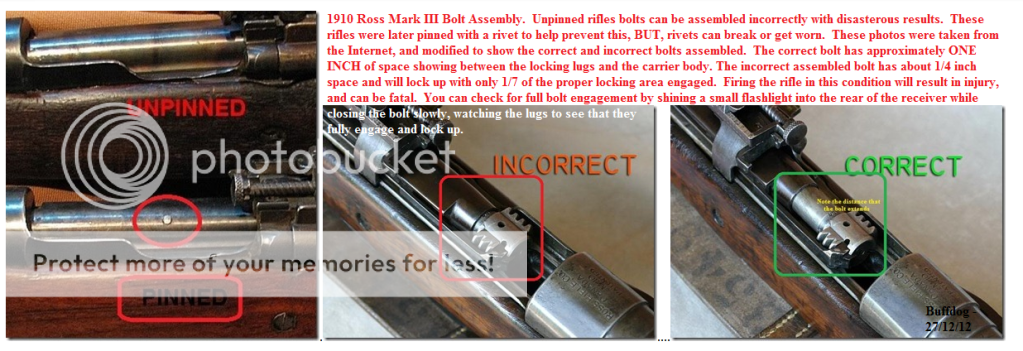
The Ross Mk. III/M-10 could have its bolt assembly incorrectly asssembled so that the bolt would not rotate to locked position.
This could not be done with earlier models like the Mk. I which failed during Mounted Police use. That was a defective rifle. The Mk. I had serious problems. Or with the Mk. II rifles. If the bolt has two lugs, it cannot be mis-assembled..
The rivet alteration was introduced during WW2, and applied to some Mk. III rifles that were still in use for training.
For a rifle to be placed in the dangerous condition, the bolt assembly must be manipulated to create the situation, while out of the rifle. It cannot just happen. When a Mk. III action is being closed, the bolt can be observed to rotate to locked.
There are extensive photo spreads here and elsewhere.
If a bolt is mis-configured, the rifle may fire unlocked. It may also misfire. It may take more than one try to get it to fire unlocked.
Ross rifles were chambered for Cdn. manufactured issue ball ammunition. Some British contract ammunition early in the war had thick rims. It jammed rifles and machineguns. Both the Ross and the Lee Enfield had their chamber dimensions revised. It was standard practice for Canadian machinegunners using the Colt Browning machinegun to run every last cartridge through the T slot of a breechblock before loading the rounds into the belts.
Ross rifles are safe to shoot, provided the shooter has some really basic knowledge about how the rifle works.