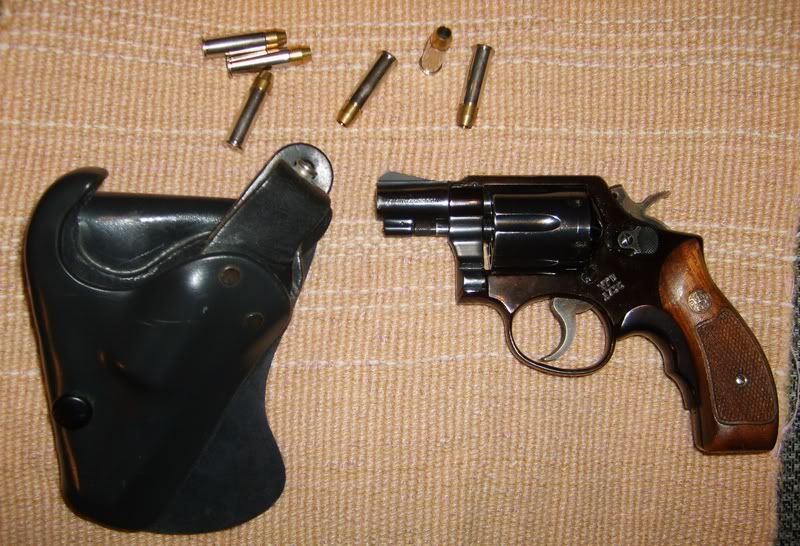
S&W M 13 Alum framed 38 Sp ???

dingus

CGN Ultra frequent flyer
Rating - 98.9%
363   4   0
Location
B.C
I found something i did not know existed at collectors sorce theres a Deact 38 Sp S&W m13 emergency revolver to be placed in aircraft.
Whats intresting is the frame is made of Alum and the cylinder were made of alum frist then steel.
I dont care how old your antique irom or steel cartridge revolver is its stronger than alum.

Just wondering what others might think about this.
Dont look like they were a big success but they did work with the steel cylinders.
This sorta suports my ideas that the revolvers cylinder takes most of the presure not the frame!


Heres the info on the gun from there web site i cant get the pics to here tho.

1950's Cold War, US Air Force lightweight revolver for aircrew use. 2 inch barrel with aluminum alloy frame and cylinder. Calibre .38 Special. The alloy construction proved unsafe and the revolvers were recalled and destroyed or refitted with steel cylinders. This one was destroyed (frame cut) and rewelded for collection only, subsequently deactivated to Canadian specifications. Very Rare, original USAF marked holster. No licence required to purchase or own. Sold as collector's item only, it is illegal to modify this deactivation in any way.
 
Last edited:
Yup, they also experimented with one that had alloy frame and cylinder with steel sleeves if memory serves. Neat idea, although I'm not sure how much difference it made to the wet weight of the plane, lol. - dan

When flying in the cockpit of a high performance jet and the possiblility of abandoning the aircraft via high speed/high-G seat ejection there is a considerable difference to the physical safety of the person or persons leaving the aircraft at speed.
In the eighties AETE, the experimental evaluation squadron here in Cold lake held trials for a 44 Magnum revolver. The obvious reason, was for Canadian military aircrew, the possibility of ejecting, and parachute landing, into our remote arctic wilderness, and provide the carrier, a reasonable protection from polar bears. This was to be carried in a shoulder holster, or in a holster, sewn into the survival vest of jet aircrew. But in trials, there was no way the heavy steel framed revolver would stay put into any holster/vest, upon seat ejection. Also the big frame was way too wide and the possibility of one smashing thier arm or elbow, was also a seat ejection hazard, too big to ignore. They went with a narrower slimmer pistol and shelved the magnum idea.
A single stack Sig in 9mm is now issue.
 
They went with a narrower slimmer pistol and shelved the magnum idea.
A single stack Sig in 9mm is now issue.

With the real risk of turning this thread into another bear defense thread and as much as I like the accuracy and general reliability of Sigs what a piss poor caliber choice if your really worried about polar bears. I would imagine emptying your entire single stack to sufficently piss off what was only a hungry polar bear before. I suppose a pilot that has never hunted before might be falsely reassured he had something better than a stick. :rolleyes:
 
With the real risk of turning this thread into another bear defense thread and as much as I like the accuracy and general reliability of Sigs what a piss poor caliber choice if your really worried about polar bears. I would imagine emptying your entire single stack to sufficently piss off what was only a hungry polar bear before. I suppose a pilot that has never hunted before might be falsely reassured he had something better than a stick. :rolleyes:

Yes really give me and old SAA colt with full 40 gr BP 45 colt loads would be better than that.

I posted this to make my point that its the cylinder in a gun that takes most of the presure if they can make frames outa Alum then Antique steel frames are way better & stronger.
 
The Airweights with aluminum cylinders were unsafe and were mostly destroyed so they are now RARE!

S&W model 12 Airweight. Essentially a K frame model 10 with an aluminum frame and a steel cylinder that can shoot +P .38 Sp. Empty it weighs around 19 ounces.

Some knowledgable American CCWers consider it to be the ideal CCW handgun, lightweight, 6 rounds, easy to control.

This is a round butt, 12-2, ex Winnipeg PD revolver.

S5000001-4.jpg
 
I posted this to make my point that its the cylinder in a gun that takes most of the presure if they can make frames outa Alum then Antique steel frames are way better & stronger.

Yup gotta agree with you there, even wrought iron is stronger provided the gun is not heavily corroded in my opinion.
This is what I believe the majority of the cheaper old time guns are made out of. Apparently has fiberous slag deposits in it that make it fairly strong and is technically an iron alloy, not iron.

I think if they have made it this far and are still going strong, thats good enough for me.
 
According to the SCoS&W the M13 Aircrewman was tested for use with M41 ball cartridge which had a chamber pressure of 16,000 psi, it also states that reports of higher pressure cartridges resulted in frequent failure of the cylinder. From what I can find most black powder handgun loads are under 11,000 psi so it is hard to say which is actually stronger.

M41 Ball 38 Spl. is loaded with a 130 gr FMJ bullet traveling at 950 fps.
 
I would not be surprised to find out that there are collectors that specialize in "survival guns" the trend being minimal,ie: cheap,light,rugged,reliable and chambered in the most readily available ammo.
Cheap because it is insurance.
Light because it is to be carried.
Rugged because it will be carried everywhere.
Reliable...if it doesn't work it is useless.
Ammo....see cheap.
 
There are some advanced aluminum alloys out there that are stronger than mild steel. Also with antiques it is possible to have wide variations in the quality of the steel, a well documented example is some failures of the 1903 springfield rifle with service ammo due to the heat treatment being done by visual methods..
 
There are some advanced aluminum alloys out there that are stronger than mild steel. Also with antiques it is possible to have wide variations in the quality of the steel, a well documented example is some failures of the 1903 springfield rifle with service ammo due to the heat treatment being done by visual methods..

Not dureing WWII or back in the 50s & 60s i dont think they had fancy alloys, that Alum was pretty standard.
I agree mild iron steel frames aint that strong but the point im makeing is the Steel cylinder takes most of the presure.
With all the talk of frame strech on a SAA colt fireing 38 Sp then i find guns made from alum its just intresting is all im saying.
I woulda never imagined they used Alum in revolver frames.
 
Not dureing WWII or back in the 50s & 60s i dont think they had fancy alloys, that Alum was pretty standard.
I agree mild iron steel frames aint that strong but the point im makeing is the Steel cylinder takes most of the presure.
With all the talk of frame strech on a SAA colt fireing 38 Sp then i find guns made from alum its just intresting is all im saying.
I woulda never imagined they used Alum in revolver frames.

Yeah they did have most of the handle on Aluminum alloys during the 50's and 60's.

Stuff that is being foisted off as pretty high tech even now ("Billet' car parts of "MilSpec" "aircraft grade" aluminum), are just alloy bar that have been around for about ever.

Take a good look at the higher -T (temper) series 7075 alloys and you are into a range of strength at or beyond what would be usable for such a cylinder or frame. The main alloying component is zinc, and then it gets heat treated and/or cold worked in combination to bring it up to the Temper that gives it it's strength.

FWIW, "Aircraft Grade" as a descriptor of aluminum, is a huge load of useless hooey, as there are aircraft grades of just about every alloy concocted. Without spelling out the alloy number and temper (eg: 7075-T651, or 1100-T0) you know nothing about it other than that the seller thinks it's worth too much.

Anyway, if you do a little looking, you can see that there were a lot of high strength aluminum alloys around, quite farther back in the timeline than you'd think. They were mostly known in aerospace, and many by proprietary names like Dural or Fortral.

Oh yeah. WW2 Jap fighters were made of 7075 alloy. Dural was around in WW1.

Cheers
Trev
 
I'm moderately familiar with the M13, & I believe your correct in thinking that the cylinder and/ or the arbor is the weakest link in a revolver for pressure spikes. I believe the thinking behind the M13 was like that of the M4 & M6 rifle: A last ditch, light use, light weight weapon that at worst, would give downed aircrew a sense of protection...

A 9mm or a sharp stick against Polar Bears? How long is the stick?.........
 
Back
Top Bottom