Powder is like women. Try as many as you can.
Yeh, you might miss a good one!













































Powder is like women. Try as many as you can.

So is is a good idea to have a bunch of different brands of powder ( aside from possible supply shortages ) for different applications or do most just find a powder that works for ones pistols for instance and just stick with that one particular brand. GT


Well the good news is that I survived the shoot. The reloads seem to work fine on all 3 calibers. I had 1 stove pipe on the .45. I've had the SR1911 for about 5 months but today is the first day shooting it. The 9mm and .40 all cycled fine with brass being flung pretty good. Just to note: when I loaded these rounds I did load dummy rounds for each caliber and used the case gauge for each to do the plunk test on each round as well. So am I good to go or should I work up a little on another 10 rounds each and retest them. I'll be going again on Thursday morning. Today was not my best day of shooting. Being nervous about the loads and being really tired from night shift made me shaky at the start. Wearing a mask over this big ass ZZ top beard doesn't help none either.
4n2t0.. I'll read up on the material you posted for sure. Thanks so much. Also thanks to all for the input and suggestions. Keep them coming. Learning so much already.
What exactly does "Hornady has auto advance and case activated powder drop " mean? The Lee Classic Turret that I'm using turns with each pull of the handle and the powder is dropped with the Lee Drum measure on one of those pulls... is that the same principle or no?? Just trying to understand is all.
Right on, good to hear everything went well. I think you're at the minimum charge with the 115gr 9mm, it wouldn't hurt to test that charge window a little more. Generally speaking, and to a point, the more powder-->more pressure-->more velocity-->more accuracy-->cleaner shooting.
Have some fun and stay safe!
I'm at home now so I can post the information provided in the link above..
From: hxxps://czfirearms.us/index.php?topic=103620.0
How to Determine Max OAL for a CZ Pistol
Handloading or "reloading" ammunition for the CZ pistol can present many issues (especially in guns chambered for 9x19 Luger). This in turn may present huge hurdles for those new to CZ pistols and/or new to reloading. This document tries to educate readers on a number of detailed reloading process steps, while at the same time trying to expose some of the myths of reloading. It's hoped that this new logical format is easier to comprehend and less tedious to follow than the previous version.
DOCUMENT FORMAT
This document will try to proceed in the most logical fashion so that readers at any level can easily follow along and comprehend the concepts. When the reader sees a "bullet point" (•) at the beginning of any section, then the reader should recognize that this section contains a very important idea which the reader needs to fully understand before moving to the next section. If you need further clarification, then please don't hesitate to ask questions in the Ammo Questions and Handloading Techniques forum. This document is for members of the CZ Forum and asking questions is the only way moderators have to update the areas that may be unclear to the users.
NOMENCLATURE
• Before we can begin, we need to clarify multiple terms referring to specific parts of the bullet, case, and assembled cartridge so that we can all start on an equal footing. By starting with a clear understanding of the names we can erase years of slang, internet lore, hearsay and myth, while learning to use the technical language of cartridge construction. These terms are given in the first post of a separate document. CLICK HERE
• In this document we will use the term OAL to mean over-all cartridge length. This term is not standardized within the reloading hobby and other abbreviations (such as COL and COAL) are commonly used to denote the same exact measurement. By "OAL" we mean the total length of the assembled cartridge, from the flat base of the case head to the bullet meplat.
BACKGROUND
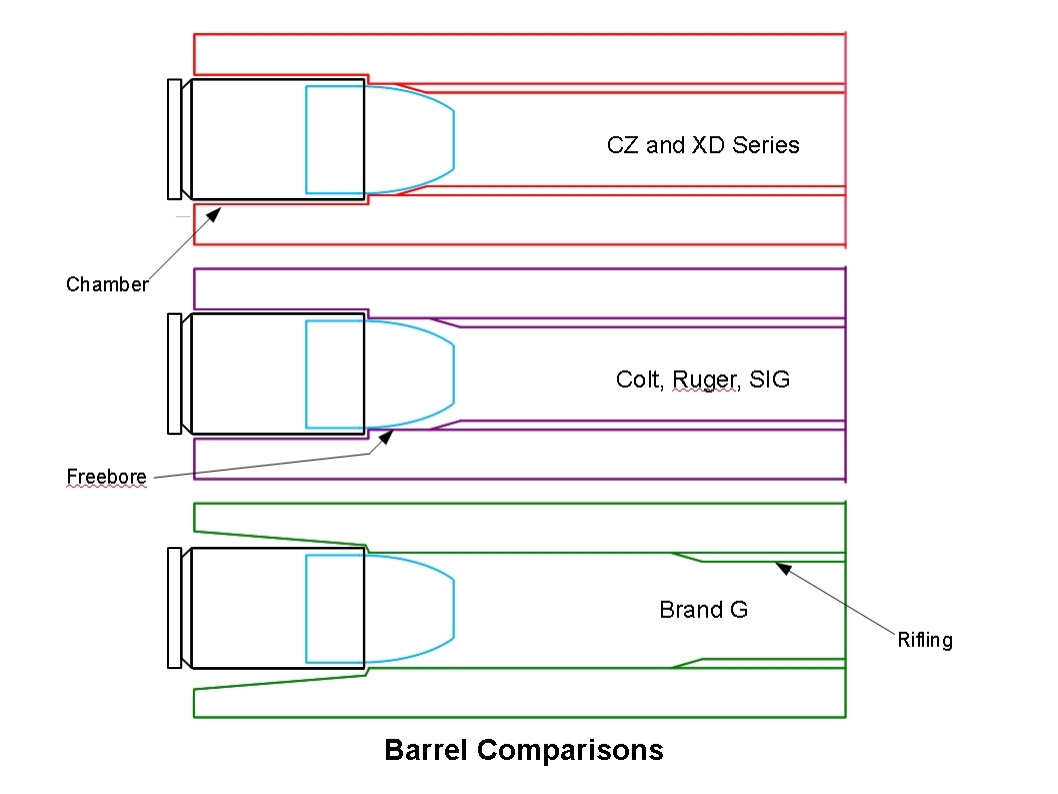
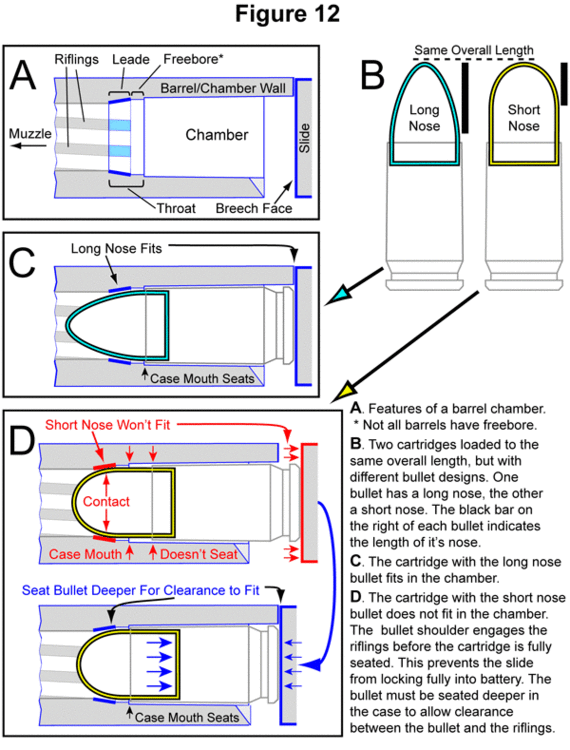
• All barrels sold in the USA supposedly meet SAAMI specs, and yet none are the same. Realize that each auto-pistol maker produces their barrel, chamber and freebore to slightly different dimensions from all other manufacturers. Those variations affect ammo feeding, types of ammo that the gun can accept, and to a great deal the accuracy obtained from shooting said ammo. The following cartoon will try to graphically explain...
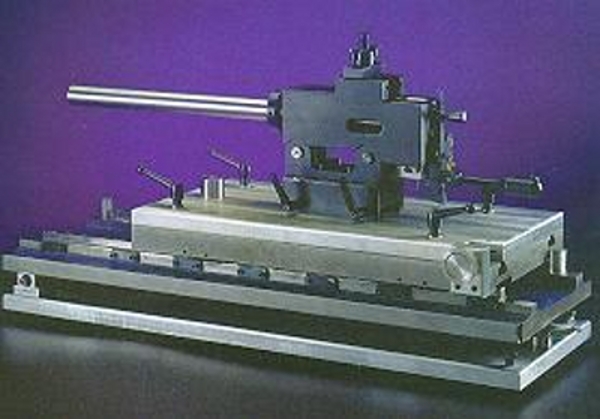
• When data shown in the reloading manuals tells us the OAL was XYZ length what they are saying is, "This is what we used and the results we got." They are NOT saying this is the "perfect OAL", that their OAL will work in every gun, or that they think this is some kind of never-fail, always-feed-correctly dimension. Since every maker's barrel is different, how could one OAL fit all guns ? Far from it. By reading the manual you'll discover that ammo testing takes place in "test barrels". A test barrel is a huge block of steel bolted to a table top, with all sorts of meters and gauges attached. It is a "gun", but it is NOT a pistol, and it is most definitely not auto loading. It's a single-shot hunk of steel, such as pictured below...
So anyone who thinks that the Hornady, Speer, or Hodgdon manual is suggesting that they use a certain OAL because it will perform well in their pistol is way, way off base. They never said that. They only said, "It worked for us and no one died. Now go make it work for you."
Now certainly, those manual writers chose an OAL that will fit "popular pistols" and work nicely for a lot of people. The problem is, they usually don't tell us which popular pistol they chose. The second problem is, the most popular pistol out there has such generous dimensions on their chambers that you can almost shoot the next larger caliber in their 9mm model.
• At the opposite end of the spectrum are all CZ's models and Springfield's striker-fired models. These are all made in eastern Europe where they still respect quality pistols and fine craftsmanship. One of the ways CZ achieves such incredible accuracy is by shortening the "freebore"; that part of the bore in front of the chamber that has no rifling. This section is also known as the "leade". The short freebore is not usually an issue with RN bullets (the only bullet style available in Eastern Europe), and generally everyone is happy.
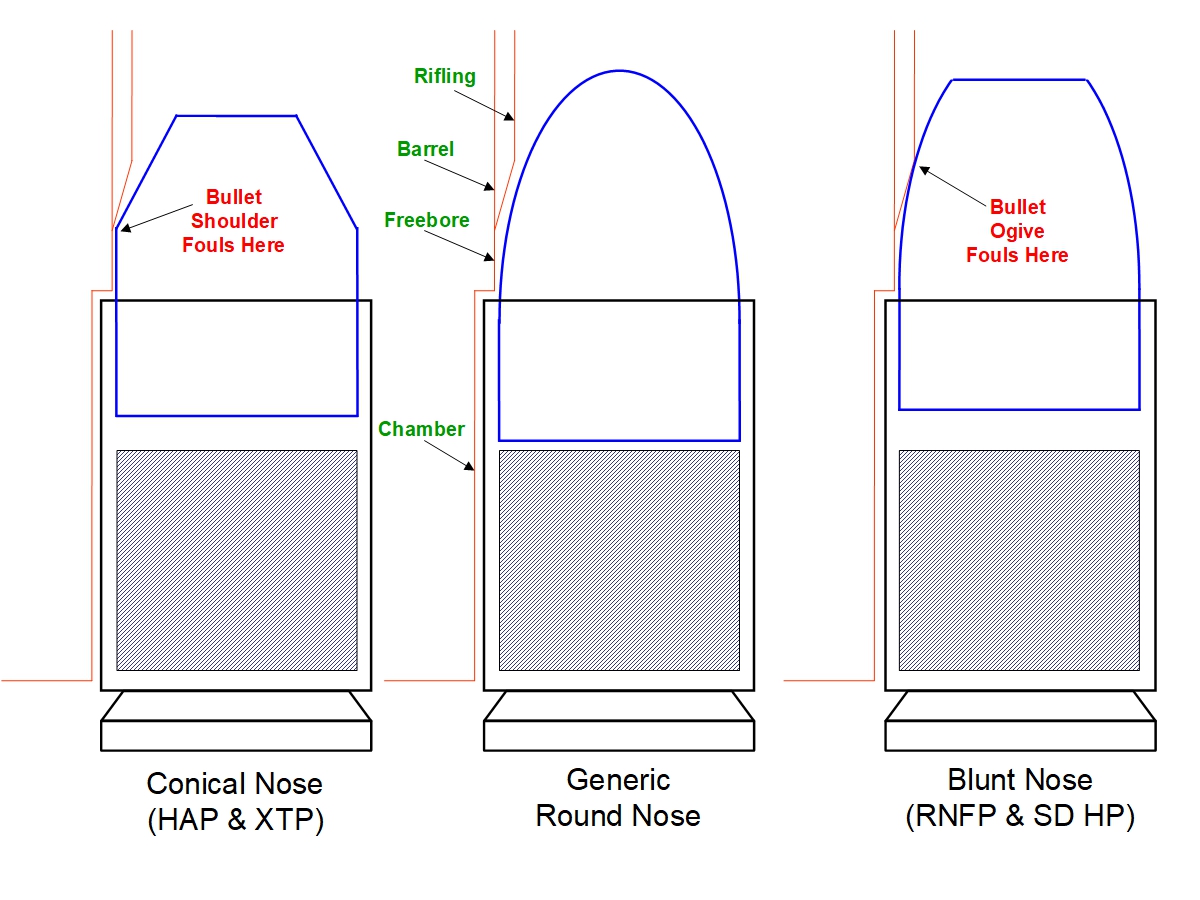
However when working with bullet types which are not sold in Europe, like the Hornady XTP, notice that the major diameter, and resulting shoulder, is brought out well in front of the cartridge case mouth. Depending upon OAL, this shoulder can protrude enough to strike the rifling. Additionally, RNFP and specialty SD ammo using large mouth HP bullets have a foreshortened ogive. The blunt-nose ogives common to this type bullet can also strike the rifling. (See the graphic below) Therefore, the short CZ freebore may force a shorter OAL than most reloading manuals quote. This is generally because most reloading manuals are NOT written with the CZ and the Springfield XD series in mind. Luckily for us, as per above, there is nothing "sacred" about OAL on an auto cartridge and the reloader can easily remedy this.
• So when you start this adventure of 'what OAL should I use', understand that it's a bit like driving. That is, if you stay between the painted boundary lines, then you'll be fairly safe. So where are the boundaries for cartridge OALs? Well, as it turns out, there are 2 sets of boundaries (or limits) for cartridge lengths. One is set by the ammunition Industry and another defined by the gun and load data, which we will call the Safety limits.
• Industry OAL Limits
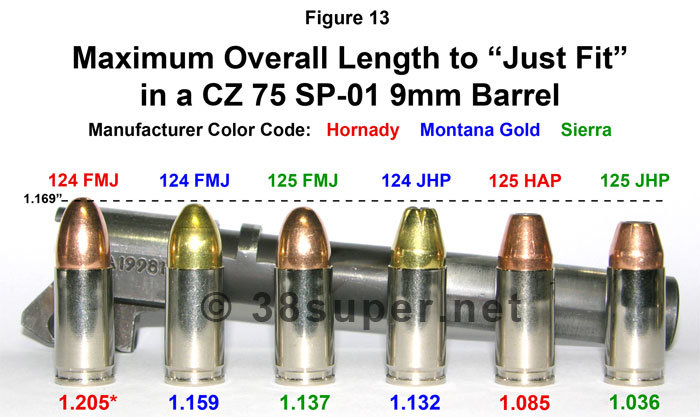
Industry OAL Limits are defined for the reloader by SAAMI in their cartridge specifications, which they set for all guns and ammunition sold in the USA. You can access those HERE. You can see from their specifications for the 9x19 Luger cartridge that the industry limits are a minimum OAL of 1.000" (a minimum length cartridges will generally feed) and a maximum OAL of 1.169" which is required to fit inside standard 9mm magazines. So from the start, SAAMI requires all 9mm cartridges to have an OAL within this 0.169" zone. Beyond those Industry OAL Boundaries are mandatory stay out zones.
• Safety OAL Limits
Typically inside the Industry OAL Limits are another set of limits we will call the Safety OAL Limits. Unlike the pre-defined Industry Limits, the Safety Limits are set by the reloader on a case by case basis. The minimum safe OAL limit is set by your published load recipe. Chamber pressure rises so fast inside most metallic cartridges that it is simply unsafe to construct a cartridge with an OAL shorter than what the load recipe shows. Chamber pressure is so dangerous that we always want to err on the side of safety. The best way to do this is to use the published OAL data as the Minimum Safe OAL.
At the upper limit we have the Maximum Safe OAL which is the maximum OAL the barrel will physically accept. If a cartridge is constructed longer than the barrel can physically accept, then the gun may fire in an Out Of Battery (OOB) condition, which is extremely dangerous. A process for you to determine this physical cartridge limit will follow in the next section. However, it is important to understand that the maximum physical length is a function of how your specific bullet interfaces with your specific barrel. Therefore this length varies for EVERY bullet in EVERY different barrel. Or stated another way... just because one brand bullet tested good at one OAL, does not mean that another similar looking brand bullet will use the same OAL. Each bullet will typically have it's own individual Maximum Safe OAL. The chart below shows these limiting boundaries in a graphic form...

• So what happens if the Maximum Safe OAL is shorter than the OAL used in the load data? There are advanced techniques to take care of this eventuality, but those are beyond the scope of this document. Generally speaking, novice reloaders shouldn't use an OAL shorter than given in published load information. If you run into this situation, then by all means ask on the forum.
One way to help avoid this scenario is to build a library of published load data. There are also dozens of reputable (typically bullet and powder manufacturers) on-line resources for you to reference for free. There is absolutely no need to refer to an individual's personal load data. To maximize your safety, it is absolutely essential that you work only from published data from reputable, professional sources.
Another way to avoid this issue is to ask forum members what brands, types, and weights of bullets work well in CZ pistols before purchasing any bullets. Novice reloaders need to be aware that there are bullets on the market that, for a variety of reasons, cannot be successfully used to reload ammo for the CZ pistol.
FINDING MAX SAFE OAL
• There are several ways to determine the Maximum Safe OAL, and all of them will work. However, the method described here returns an exact number without having to buy additional tools. For these reasons members of the CZ Forum have found the following method to be superior to all others and we have standardized on this method.
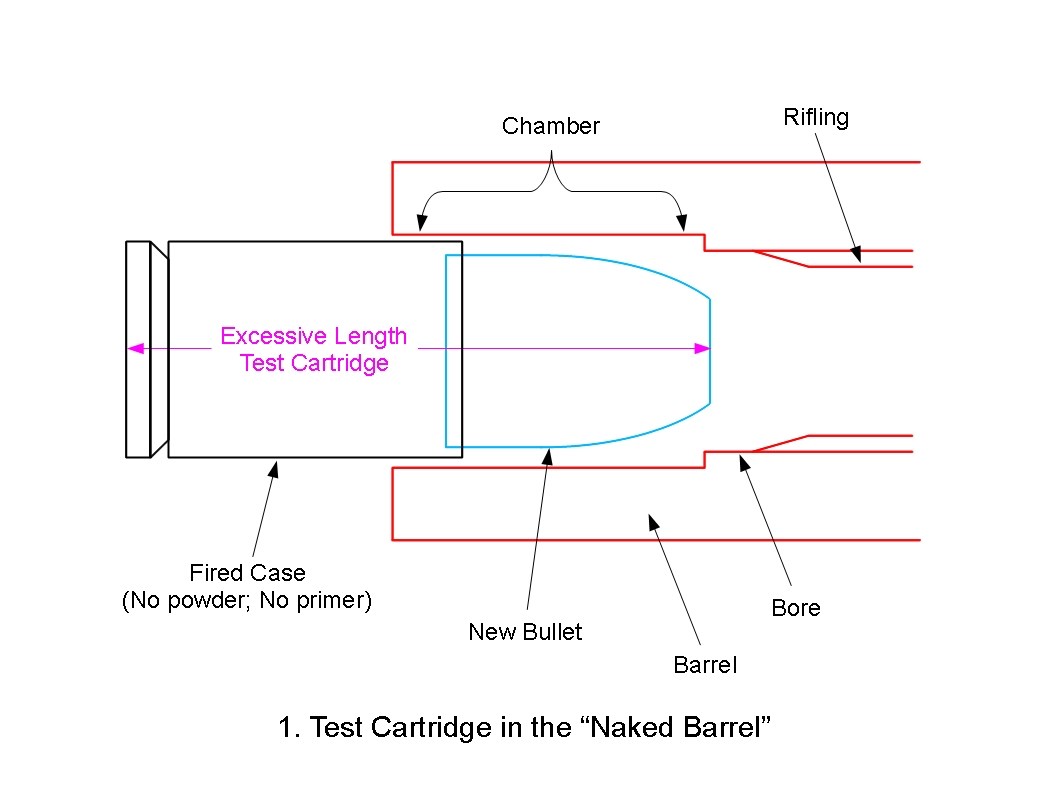
Fit a new jacketed or plated bullet into a fired case. (No powder; dead primer) If you try 4 or 5 bullet/case combinations you'll end up with 2 or 3 where the bullet is a snug "push fit". Fit the bullet inside the case, but leave the OAL out at an exaggerated length; any OAL longer than what you need. (For 9x19 Luger use an OAL longer than 1.180".) Working with your barrel REMOVED from the gun, slide this "test cartridge" into the chamber. At some point the cartridge will stop going into the chamber. In other words, whatever the bullet is striking is keeping the test cartridge from fully entering. After this, if you continue to push on the cartridge, the bullet will slide into the case until the mouth of the case comes to rest (or "head spaces") on the end of the chamber. At this point 2 things are true: a) whatever the bullet was striking has seated the bullet deeper into the case, and b) the case has fully entered the chamber. The following diagrams show this process...
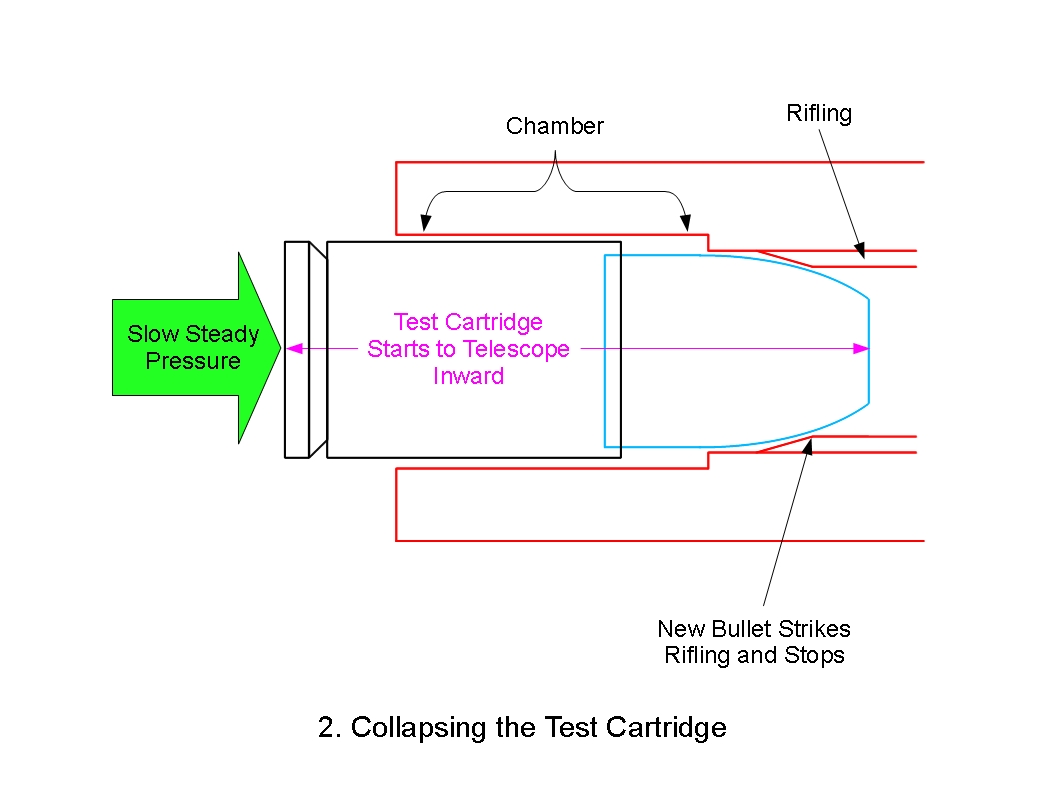
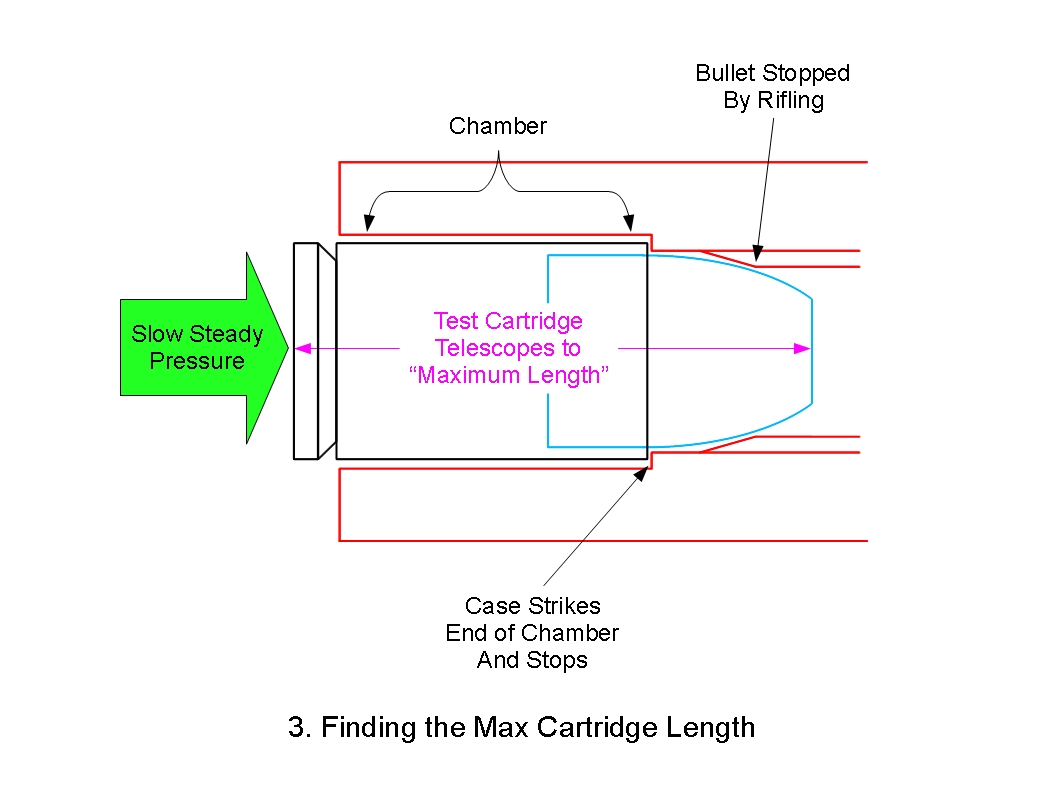
Now, slowly and carefully withdraw the test cartridge and measure its new length. Build and try additional test cartridges with other bullets from the same batch until you start to see the same number again and again. That measurement is your exact chamber length for that bullet in that barrel. For many reasons we need the ogive of the bullet set an additional distance away from the rifling, so subtract at least 0.015" from that number to obtain your Maximum Safe OAL.
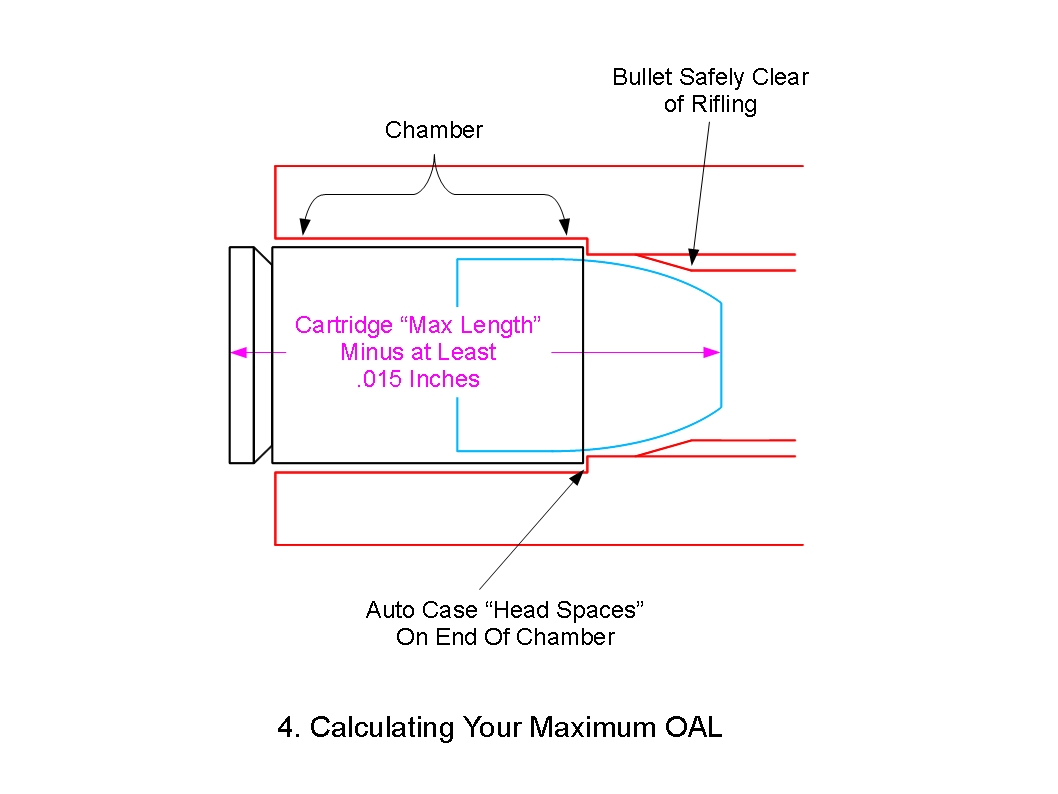
Example: Let's assume your test cartridges keep giving you a number like 1.147". We take that number, subtract our setback and get 1.147 - 0.015", or roughly 1.130". You see we've backed off an additional 0.002" because 1) it's simply easier to read on a caliper, 2) the chances of finding a load for 1.132" may be impossible, whereas 1.130" probably has a better chance, and 3) it's a difference less than a human hair, so gee whiz let's not get too carried away!
APPLICATION
• Because of our findings 1.130" becomes our Maximum Safe OAL, or more simply "Max OAL". And suppose the load data we are using lists an OAL of 1.115", which (as discussed earlier) becomes our Minimum Safe OAL, or "Min OAL". As shown in the previous diagram, the reloader is then free to choose any OAL between Max and Min to become the actual chosen OAL. In most cases, the difference between Max OAL and Min OAL allows the reloader some leeway in the final OAL decision. Whatever OAL is chosen, all 3 OALs (Max, Chosen, Min) should be recorded in the reloading notebook for future reference.
Example: Our Max OAL is 1.130" based on the limits of the barrel, and our load manual offers load data based upon an OAL of 1.115". The reloader then might choose an OAL of 1.120". Choosing an OAL longer than found in the manual increases the volume inside the case, thereby lowering the chamber pressure. Everything we do in reloading is to control the chamber pressure and thus lower our risk. Our cartridges should therefore closely follow the results found in the load manual, but at a slightly lower chamber pressure. The result will be reloads that fire with a margin of safety. Additionally, our actual cartridge OALs can vary by +/-.005" (1.115 to 1.125") and still be completely safe.
• When the first several rounds are completed, it can be a good idea to take a Sharpie Marker and color the exposed bullet. Then the finished round can be dropped into the chamber and rotated back and forth about 20 degrees. After the round is withdrawn from the chamber, if the bullet is touching anything then the marker color will be scratched off. The bullet should not be touching anything on its ogive. This 'marking and spinning' can also be an effective test for "store bought" ammunition.
• And as always... make notes in your reloading notebook so you can come back to this load, know how you developed the Chosen OAL, know where you got the load information, know the results of the incremental loads, how it shoots, etc, etc. Believe me, you won't remember any of this in 2 weeks, so write it down now!
Hope this helps !
[youtube]AyS9U90IcUc[/youtube]
So what would be the normal way to work up?? A tenth of a grain at a time?? Should that be done on all three of the caliber loads I reloaded, seems as they were all at the minimum of the load data?
0.1gr increments are too small, use 0.2gr or 0.3gr increments throughout the charge window. Published data is fairly conservative so loading a max charge is completely safe. Just always be aware of the two biggest reloading gremlins, too much powder and none at all.
0.1gr increments are too small, use 0.2gr or 0.3gr increments throughout the charge window. Published data is fairly conservative so loading a max charge is completely safe. Just always be aware of the two biggest reloading gremlins, too much powder and none at all.
None at all on the third shot in a 4 shot volley with a semi-auto with that brand new barrell! putt, WOW sore hands and fragged face. I've seen it and it ain't pretty.[/QUOTE
Forgot to mention that it's not a " new" pistol. I bought it used but because the range has been closed I haven't been able to try it out till yesterday. Hope to go again tomorrow. If I have time this evening before work I'll load a few more rounds with a couple grains increased to see how it works.
What part of the Rebublik are you from?


Well I'm a little disappointed in today's performance. I loaded 30 rounds of .45acp 115gn last night and increased from 4.2 to 4.4 grains to take to the range today. Just got back. I originally had loaded 10 rounds of 4.2 grains of HP-38 and had 1 Stove pipe on Tuesday. Today with the small increase I had about 5 stove pipes. I'm using a Ruger SR1911. The rounds today just didn't feel like they had enough punch. I shot about 40 rounds of factory Winchester 115gn and there was no issue and I could most definitely notice the difference in Zip and recoil and decibels. So am I using too little powder? The data says from 4.2 to 5.3 max.
Sounds like you need more powder.
Also recheck what bullets you are using. 115gr is a highly unlikely weight in a 45acp.
Aren't you loading CamPro for .45? If so it's probably 230gr (I think they only make 200gr, 230gr and 250gr). Again, determine your own OAL (only your barrel(s)/magazine(s) /feeding matter, nothing else, not even your gauge) and if it isn't related to length than you probably need more powder. To be completely honest I've loaded very little .45 (9mm and .38 Special/Long Colt are in my wheelhouse) but I think you need to get that number closer to 5.0gr with HP-38/W231 in .45.
I'll let more experienced .45 loaders take it from here...
P.S. A little side note on gauging. The gauge shouldn't determine OAL or if ammo is "good". Barrel(s)/magazine(s)/feeding tell you that the ammo is setup properly, the gauge checks that work. Some gauges are tighter, some looser, and some (I'm looking at you EGW) are outright garbage.