Again, I don't really load .45 but I believe the max of HP-38/W231 for a 230gr FMJ is 5.3gr(ish), correct? If so I would load 4.8gr, 5.0gr and 5.2gr. The .45 is a relatively low pressure round and with only 4.2gr of HP you're probably just lobbing the bullet out there. Hard to know for sure since I don't think you have a chronograph (very useful tool for load development). Also, being a Ruger fan myself I know that a lot of their firearms are heavily sprung, so you might need a little extra juice in the beginning.So if I check to determine and ensure the OAL is good, then how big of an increase should I be doing if I'm at 4.4gn now... 4.6 or 4.8 maybe???













































You are using an out of date browser. It may not display this or other websites correctly.
You should upgrade or use an alternative browser.
You should upgrade or use an alternative browser.
School me on powders.
- Thread starter dearslayer
- Start date

dearslayer
Regular
- Location
- On The Edge
Well the Campro Data states 4.2-5.3 for a 230gn RN FCP bullet so maybe I'll try 4.9 to see how it does and your comment about Lobbing the bullet out there is a good description..as that's what it felt like versus the factory round. Thanks for your help by the way.
No I don't have a chronograph unfortunately.
GT.
No I don't have a chronograph unfortunately.
GT.
I do like that analogy!!! Oh to be young once more.
Or even just have the wisdom back then that came with the age we are now!
dearslayer
Regular
- Location
- On The Edge
My grandfather raised me and always taught me that wise heads do not grow on young shoulders. I believe they were the truest words ever spoken and now at the age I'm at I realize what he meantOr even just have the wisdom back then that came with the age we are now!

vagrantviking
CGN Ultra frequent flyer
- Location
- Southern Alberta
You are on the right track. It's a forgiving gun/cartridge combination as mentioned. You almost certainly don't need to fear the maximum load but your systematic working up is always wise. It sucks to have to pull a bunch of they don't work out.
Most times the OAL is just about the plunk and feeding reliability but I once worked up a cast bullet load in 9mm that worked fine in one gun. It was a hair too long in another so I just seated a half turn more and made a thousand. They actually would tumble at 15m. Couldn't believe it had that much effect.
If you want to come up with a lighter shooting load you can easily get a lighter spring too.
Most times the OAL is just about the plunk and feeding reliability but I once worked up a cast bullet load in 9mm that worked fine in one gun. It was a hair too long in another so I just seated a half turn more and made a thousand. They actually would tumble at 15m. Couldn't believe it had that much effect.
If you want to come up with a lighter shooting load you can easily get a lighter spring too.
My grandfather raised me and always taught me that wise heads do not grow on young shoulders. I believe they were the truest words ever spoken and now at the age I'm at I realize what he meant
Your Grandfather was indeed a very wise man!
dearslayer
Regular
- Location
- On The Edge
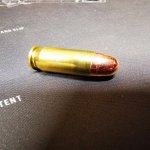
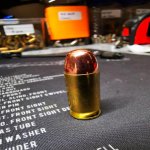
So I tried as per the method posted about finding overall maximum length for my 45 ACP. I took the barrel out of the Ruger SR1911. I'm using that as a gauge. With a fired case I put the bullet in and dropped it in the barrel and push the case down until it bottomed out. I pulled it back out and the overall measurement is ...using the data posted if I subtract 0.015 for the little bit of extra clearance I get 1.257. I believe the Campro Data suggest overall length of 1.25 which is what I sized the reloads to, but here's the kicker. At 1.25 I used magic marker on the bullet and dropped it in the barrel for plunk and spin test. It seems to plunk just fine with the head stamp sitting just slightly below the hood of the barrel.Upon removing the casing and bullet, the magic marker is rubbed off the bullet right at the mouth of the case after spinning it. Is this normal? Also attached is a photo of factory round for comparison but I also painted the factory round and after spinning, the same scratched marks appeared in the same area.
Attachments
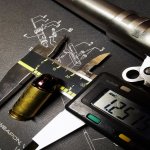
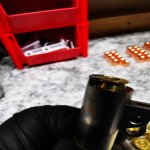
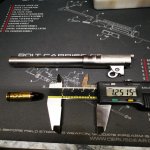
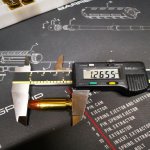
It looks good to me. The round "headspaces" off the case mouth and it looks like a little bit is getting rubbed off when you spin it. I wouldn't worry too much if it truly plunks and spins freely.
Another little reloading tidbit. Proper sizing is fairly important. You want to size as much of the case as possible. When you setup the sizing die make sure you're getting the most out of it. e.g. Dillon's sizing die must touch the shellplate, it should not be backed off (not even a little).
P.S. What's the measurement at the case mouth? Remember, little to no crimp (.471ish).

Another little reloading tidbit. Proper sizing is fairly important. You want to size as much of the case as possible. When you setup the sizing die make sure you're getting the most out of it. e.g. Dillon's sizing die must touch the shellplate, it should not be backed off (not even a little).
P.S. What's the measurement at the case mouth? Remember, little to no crimp (.471ish).
Last edited:
dearslayer
Regular
- Location
- On The Edge
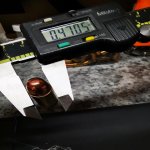
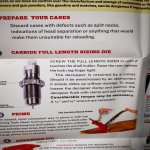
I just loaded 30 rounds at 5 grains to see how that will cycle the action. They all pass the plunk test and spin freely. I have the sizing die installed as per the Lee instructions. Screwed down until it touches the shell holder. Also have the factory crimp die installed as per the Lee instructions with a very light crimp. Case mouth is at or around .470-.473. Sorry I attached 2 photos of the sizing die instructions ... Not sure how to delete one photo. Difficult to navigate on my phone. Also the one photo showing the crimp looks a little exaggerated and is really not that much in person.
Attachments


dearslayer
Regular
- Location
- On The Edge
Thanks once again for the guidance. I'll report back here once I get to the range to test.
dearslayer
Regular
- Location
- On The Edge
Well I'm happy to report that all 30 reloaded rounds went off without a hitch. I think I'm gonna like this reloading thing. Now if there was just an easy way to catch the ejected brass before it went over the firing line. Only allowed to pick up whatever falls on the shooting side of the line. Most casings get flung down range.
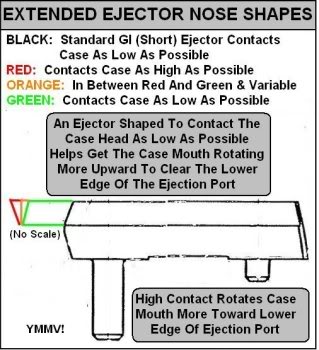
If properly adjusted the 1911 should throw the fired brass backward at an angle greater than 90 degrees but less than 180 degrees so you may have to adjust your extractor to get the ejection angle you want. That's one of the the vagaries of the 1911 pistol. Lots of YouTube videos showing how to do this are available. While it is not hard to do it is a bit of a trial and error job and you may have to fiddle with it a bit.Well I'm happy to report that all 30 reloaded rounds went off without a hitch. I think I'm gonna like this reloading thing. Now if there was just an easy way to catch the ejected brass before it went over the firing line. Only allowed to pick up whatever falls on the shooting side of the line. Most casings get flung down range.
Here's a good read to get you started:
https://www.brownells.com/userdocs/learn/bt002002.pdf

So is is a good idea to have a bunch of different brands of powder ( aside from possible supply shortages ) for different applications or do most just find a powder that works for ones pistols for instance and just stick with that one particular brand.
GT
Let me mention it to you plainly, "a reloading nut has many brands, and their models of gun powder." A reloading nut tries a different powder for their gun, if it doesn't work, shelve it for another cartridge................next. Therefore, if a hand loader does not have many different powders, then he is not a reloading nut.
Well I'm happy to report that all 30 reloaded rounds went off without a hitch. I think I'm gonna like this reloading thing. Now if there was just an easy way to catch the ejected brass before it went over the firing line. Only allowed to pick up whatever falls on the shooting side of the line. Most casings get flung down range.
Avoid chasing brass by shooting a revolver. Single actions are a lot more fun than you would think before owning one.