Just curious if anyone has determined at what point seated bullet runout started to effect accuracy ? For example , can rounds with .001 runout be measurably better ( groups ) then rounds with .003 ? Not looking for theory as lower is always better , but actual measured performance . In other words , can a shooter actually see the difference under typical field / range conditions .













































You are using an out of date browser. It may not display this or other websites correctly.
You should upgrade or use an alternative browser.
You should upgrade or use an alternative browser.
Seated Bullet Runout
- Thread starter HondaVTEC
- Start date
Speaking about rifle reloads:
When I first started reloading, my loads sucked. I was being meticulous to be consistent with my procedures, but I was not paying enough attention to the seating portion.
Once I tested my loaded rounds and saw the crazy runout that they had, I modified my seating procedures and my loads improved immediately and drastically.
There are a lot of variables, but excessive runout can definitely ruin an otherwise good load.
When I first started reloading, my loads sucked. I was being meticulous to be consistent with my procedures, but I was not paying enough attention to the seating portion.
Once I tested my loaded rounds and saw the crazy runout that they had, I modified my seating procedures and my loads improved immediately and drastically.
There are a lot of variables, but excessive runout can definitely ruin an otherwise good load.

The U.S. Military considers ammunition to be "Match Grade" if it has .003 or less runout. And a benchrest shooter would want less runout than military standards.
And full length resizing will give the bullet wiggle room for the bullet to be self aligning with the bore. "The cartridge should fit the chamber like a rat turd in a violin case".
The only part of a full length resized case that touches the chamber is the case shoulder. The rear of the case is held by the bolt face and by the bullet in the throat. Meaning the case body and case neck has little to no aligning effect on the bullet and the bore. It is the cone shaped shoulder of the case and the bullet in the throat that aligns the bullet with the bore. And the case body of a neck sized case has more effect on bullet alignment or misalignment with the bore. This is where full length resizing helps if the case warps the first time it is fired.
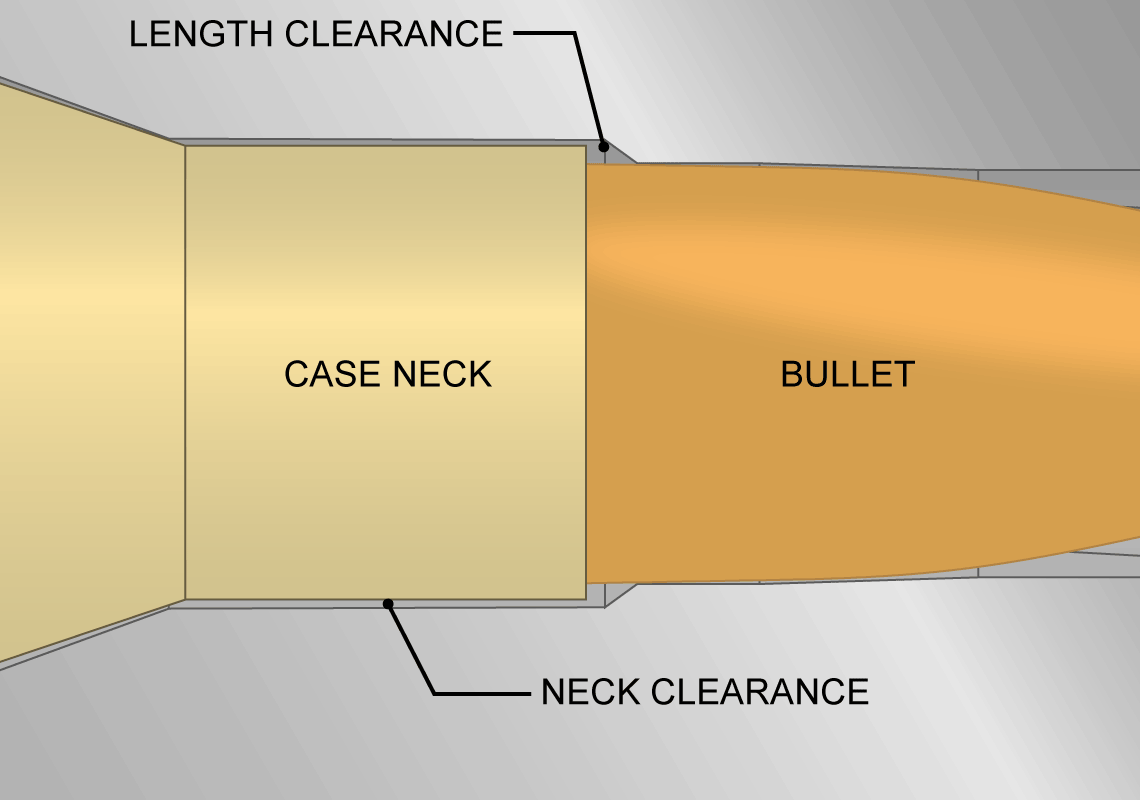
Below Mr. Salazar explains the benefits of full length resizing vs partial full length resizing or neck sizing. (The rat turd in the violin case)
Reloading: Partial Neck Sizing
by German A. Salazar
http://riflemansjournal.########.com/2010/06/reloading-partial-neck-sizing.html
"Now the last scenario, a full-length sized case in which the neck is also fully sized. There is clearance at the neck and in the body of the case, the closest fit anywhere is the bullet in the throat. If the neck to bullet concentricity is good (although it needn't be perfect), then the bullet will find good alignment in the throat and the case body and neck will have minimal influence. Let's not forget that the base of the case is supported by the bolt face or the extractor to a certain degree as well; this is yet another influence on alignment. As you can see, there are several points from base to bullet that can have an effect. My procedure is to minimize the influence of those that I can control, namely the case body and neck, and let the alignment be dictated by the fit of the bullet in the throat and to some extent by the bolt's support of the base. Barring a seriously out of square case head, I don't think the bolt can have a negative effect on alignment, only a slightly positive effect from minimizing "case droop" in the chamber. Given that a resized case will usually have a maximum of 0.001" diametrical clearance at the web, this isn't much of a factor anyway."
And full length resizing will give the bullet wiggle room for the bullet to be self aligning with the bore. "The cartridge should fit the chamber like a rat turd in a violin case".
The only part of a full length resized case that touches the chamber is the case shoulder. The rear of the case is held by the bolt face and by the bullet in the throat. Meaning the case body and case neck has little to no aligning effect on the bullet and the bore. It is the cone shaped shoulder of the case and the bullet in the throat that aligns the bullet with the bore. And the case body of a neck sized case has more effect on bullet alignment or misalignment with the bore. This is where full length resizing helps if the case warps the first time it is fired.
Below Mr. Salazar explains the benefits of full length resizing vs partial full length resizing or neck sizing. (The rat turd in the violin case)
Reloading: Partial Neck Sizing
by German A. Salazar
http://riflemansjournal.########.com/2010/06/reloading-partial-neck-sizing.html
"Now the last scenario, a full-length sized case in which the neck is also fully sized. There is clearance at the neck and in the body of the case, the closest fit anywhere is the bullet in the throat. If the neck to bullet concentricity is good (although it needn't be perfect), then the bullet will find good alignment in the throat and the case body and neck will have minimal influence. Let's not forget that the base of the case is supported by the bolt face or the extractor to a certain degree as well; this is yet another influence on alignment. As you can see, there are several points from base to bullet that can have an effect. My procedure is to minimize the influence of those that I can control, namely the case body and neck, and let the alignment be dictated by the fit of the bullet in the throat and to some extent by the bolt's support of the base. Barring a seriously out of square case head, I don't think the bolt can have a negative effect on alignment, only a slightly positive effect from minimizing "case droop" in the chamber. Given that a resized case will usually have a maximum of 0.001" diametrical clearance at the web, this isn't much of a factor anyway."
Last edited:

I am asking about seated bullet runout , not the debate between neck sizing vs full length vs bumped shoulders . For the record , I bump the shoulder .002 after every firing . My loaded rounds are the same every single time .
I am asking about seated bullet runout , not the debate between neck sizing vs full length vs bumped shoulders . For the record , I bump the shoulder .002 after every firing . My loaded rounds are the same every single time .
sorry H. my mistake.
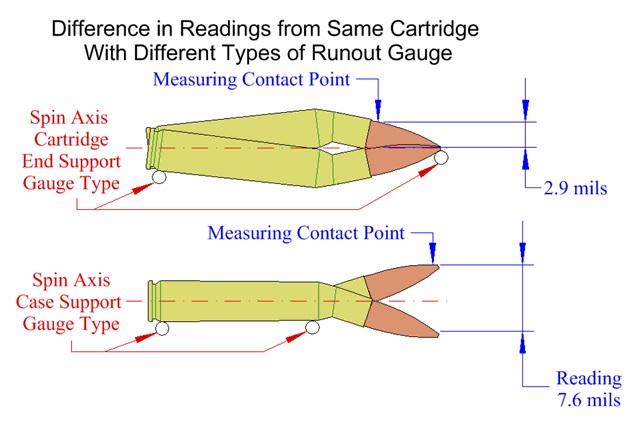
I have both runout gauges pictured below and they measure runout two different ways. The red Hornady gauge will read half as much than gauges that spin the case on its body.
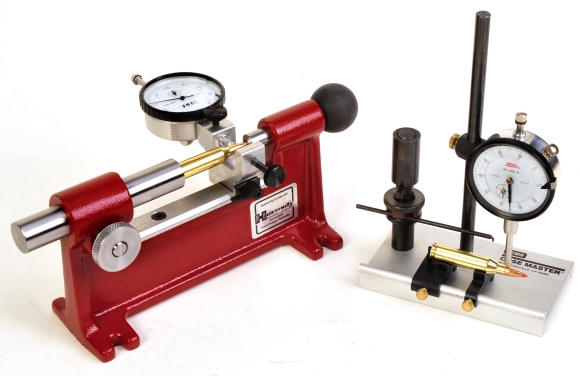
After full length resizing I check the neck thickness variations and then check case neck runout. And I want the neck runout to be .001 or less than the neck thickness variations. This is making sure the case is concentric as possible after sizing and the expander is not pulling the case neck off center.
After loading the case and seating the bullet I will check bullet runout to make sure the seating die is not inducing any runout.
If the case wall thickness is thinner on one side the case will warp when fired and its circumference will be egg shaped. Meaning spinning on the case body will show "more" runout than spinning the case on its axis.
Meaning the warped case can be causing the runout, or your sizing die or the seating die causing the runout.
NOTE, a warped banana shaped case is not a myth as shown below. A case fired in a milsurp rifle with a large diameter chamber can make thinner commercial cases warp badly. And in a tight custom chamber the case will warp much less. This is where having a gauge that can measure case wall thickness will tell you a great deal about the quality of the case
Neco Concentricity, Wall Thickness and Runout Gauge
The NECO, patented, Case Gauge is the most versatile instrument available for measuring the various accuracy determining factors of cartridge cases, bullets and loaded ammunition. No other gauge can measure all of the following: 1.Banana curvature of case. 2.Wall and neck thickness variations. 3.Case head squareness. 4.Banana curvature and out-of-round shape of individual bullets. 5.Runout of seated bullet. 6.Total runout of loaded cartridge.

Bottom line, this is why I prefer Forster benchrest sizing and seating dies, they are designed to reduce any runout. The high mounted floating expander can not pull the neck off center and induce neck runout.
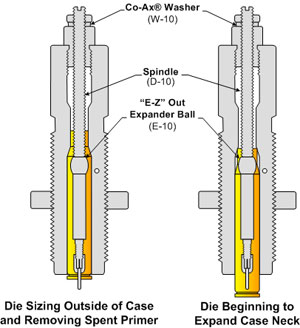
The seating die holds the bullet and case in perfect alignment and can even slightly correct the amount of bullet runout. (and they are cheaper than Reddings seater die)

After full length resizing I check the neck thickness variations and then check case neck runout. And I want the neck runout to be .001 or less than the neck thickness variations. This is making sure the case is concentric as possible after sizing and the expander is not pulling the case neck off center.
After loading the case and seating the bullet I will check bullet runout to make sure the seating die is not inducing any runout.
If the case wall thickness is thinner on one side the case will warp when fired and its circumference will be egg shaped. Meaning spinning on the case body will show "more" runout than spinning the case on its axis.
Meaning the warped case can be causing the runout, or your sizing die or the seating die causing the runout.
NOTE, a warped banana shaped case is not a myth as shown below. A case fired in a milsurp rifle with a large diameter chamber can make thinner commercial cases warp badly. And in a tight custom chamber the case will warp much less. This is where having a gauge that can measure case wall thickness will tell you a great deal about the quality of the case
Neco Concentricity, Wall Thickness and Runout Gauge
The NECO, patented, Case Gauge is the most versatile instrument available for measuring the various accuracy determining factors of cartridge cases, bullets and loaded ammunition. No other gauge can measure all of the following: 1.Banana curvature of case. 2.Wall and neck thickness variations. 3.Case head squareness. 4.Banana curvature and out-of-round shape of individual bullets. 5.Runout of seated bullet. 6.Total runout of loaded cartridge.
Bottom line, this is why I prefer Forster benchrest sizing and seating dies, they are designed to reduce any runout. The high mounted floating expander can not pull the neck off center and induce neck runout.
The seating die holds the bullet and case in perfect alignment and can even slightly correct the amount of bullet runout. (and they are cheaper than Reddings seater die)

I like to see 4 thou or less on my match loads.
If you have a spin gauge, you can mark each case with a Sharpie, showing the hi point. Then chamber the rounds with the mark up. This reduced the effect of whatever runout you have.
If you have a spin gauge, you can mark each case with a Sharpie, showing the hi point. Then chamber the rounds with the mark up. This reduced the effect of whatever runout you have.























