Seating depth then powder charge?

Talltimber1

CGN Regular
Rating - 100%
17   0   0
Location
BC Bring Cash
Looking for order of variables you play with first.
Also Im new to shooting and reloading and will have a new rifle and scope to break in and sight in. (Eventually...still waiting for PAL to come back.
Do I just reload some low powder charge standard COL cartridges to break in the barrel and sight in the scope and then start developing a load for the rifle?
At some point do you fine tune the scope again?
 
I hope this will be helpful, if some terms look like chinese just ask and i can clarify.

I have adjusted seating depth first, so that the bullet ogive is 20 thous off lands, i am shooting 308 btw.
Then did a powder load development, once i have found my load i have never retweaked seating depth,
As i can shoot 25 rounds at 200M (5x targets of 5 shots in a row) and maintain sub 1/2 moa accuracy, and can shoot 10 round groups at 300M sub 1/2 moa.
If you're objectives are tighter than this i may not be the best help.

As for scope, i regularly check 100M zero while at the range and being there.
Nothing wrong with readjusting a little click or not once in a while if everything else is confirmed,
As when the barrel wears at some point, velocity will slightly change and so will point of impact.
 
I would adjust powder charge first then use seating depth to fine tune if required

I'm of the same mind. My experience has been the same as Marty's. I seat 0.015" from the lands as a general rule. Both my rifles shoot well there, I haven't needed to play with seating depth to get the accuracy I want. There might be more there but it's not worth it to me.
 
Don't forget to do the seating depth tests guys. It can make a huge difference. If your load is golden, I still would try it as if you set your depth in a "seating node", It will be better than being at the start or end. Often if you get a powder charge to make a nice small triangle shape for three shots, changing BTOG will put them together.
Seating depth adjustments done at 0.003" jumps.
 
Don't forget to do the seating depth tests guys. It can make a huge difference. If your load is golden, I still would try it as if you set your depth in a "seating node", It will be better than being at the start or end. Often if you get a powder charge to make a nice small triangle shape for three shots, changing BTOG will put them together.
Seating depth adjustments done at 0.003" jumps.

I am curious about this though.
Myself at 1/2 moa decided to stop tuning and just shoot as much as i can,
But can see this as an experiment soon or later.

In a Brad Sauvé article i had read a while back,
He seats his 175SMK (propelled by Varget, same exact as i use) at about 20 thou jump using the low node (for him 43.0gr varget)
So i started with 20 thou jump, my low node is at 42.7gn Varget, but i have not felt the need to retune since my recipe is working well so far.

I do wonder though, if playing with seating depth would be the key to 1/3 moa
 
I am curious about this though.
Myself at 1/2 moa decided to stop tuning and just shoot as much as i can,
But can see this as an experiment soon or later.

In a Brad Sauvé article i had read a while back,
He seats his 175SMK (propelled by Varget, same exact as i use) at about 20 thou jump using the low node (for him 43.0gr varget)
So i started with 20 thou jump, my low node is at 42.7gn Varget, but i have not felt the need to retune since my recipe is working well so far.

I do wonder though, if playing with seating depth would be the key to 1/3 moa

It may of may not be the key to it, but if we put our powder in the middle of a node, why not our bullet? I don't know if the jump does something in itself, but I would think the seating depth tweak would be similar to cutting kernels of powder to get to the desired pressure. Your micro Forster seating die is far more adjustable in that sense, and once set to a node, gives yet another buffer for error or environmental changes.....maybe.

Todbartel, take that group in your avatar, and do a seating depth test on it with 0.003" steps. ( if thats yours ) Thats a perfect example of when to do a seating depth test.
 
Sheesh - Since you are new to shooting and reloading, I would suggest you save the fine tuning like seating depth, and detailed powder charge investigations until you get a handle on the basics, including learning how to shoot reasonably well. Learn to be concise and repeatable, keep written records, etc. Avoid newby mistakes like using different brass within the same load batches....
FWIW - Most sporting rifles will preferentially tune to a given bullet weight, so that should be the first investigation. Once you get a bullet your gun likes, try another powder if you have one. Otherwise, you can ramp up the powder charge, say 4 rounds per 1/2 grain increments. Give yourself some margin away from max published load until you can recognize overpressure. Keep the same coal during these trials - use the cannelure as a guide if possible. When you've got a load that you like, and some more experience, then you can start playing with seating depth. Bear in mind that it takes considerable metrology skills to get close to the lands (say less than 1/32 in), and good reloading technique to hold that tight clearance from round to round, bullet lot to bullet lot, etc. Inadvertently jamming the lands can be bad news, particularly in a hunting situation - ask me how I know...
As far as the scope is concerned, once you get on paper at say 100 yards, try to avoid making adjustments to zero the rifle between groups or trials. Changing bullet weights may take you off the paper, but otherwise the groups shouldn't move substantially. Cheap scopes, and even some half decent ones, can track poorly and jump between shots after an adjustment. Do your zeroing at the end when you've got your "go to" load.
 
Last edited:
how well can you read the wind?

Well, that’s my exact focus right now and why i have stopped try to better loads and spend more time on the field.
What i have said about sub 1/2 moa 10 shot groups at 300M is very true, what i did not mention is that i often end up with groups left or right of bullseye, so yeah wind reading practice will help more than squeezing an extra 1/8th of moa with better powder/bullet seat depth load dev.
 
I agree, there are bigger fish to fry! We all like a ###y sub half moa group, but I feel more effort should be placed on shooting skills than OCD load development
 
I agree, there are bigger fish to fry! We all like a ###y sub half moa group, but I feel more effort should be placed on shooting skills than OCD load development

I agree fully, but really, what’s another 15-18 test rounds gonna hurt? Especially when it’s just seating depth.
 
I would explore anything that crosses your mind that might affect group size. I would pick an appropriate COAL, find the right load of powder, and shoot it. If you want to change COAL, then do it. Load and shoot. The more of these avenues that you explore, the more you will put your mind at ease. And the more range time you will get.
 
Thanks for all the answers guys. I do understand most of it. I have done a bunch of reading. I have the OAL gauge and the headspace and bullet comparator on the way.
I have 4 different bullets and 2 different powders to try. Hornady and Lyman manuals.
Sako rifle Swarovski scope
And the range is 5 mins away. I plan to shoot alot. I also plan to work up a sweet load eventually. Just want to absorb as much info as I can for now.
Pretty excited to get started.
 
I agree fully, but really, what’s another 15-18 test rounds gonna hurt? Especially when it’s just seating depth.

If only it was only another 15 rounds.
Seating depth in 3 thou increments would likely mean closer to 40 rounds for me.
As only 5 shot groups count for me, anything less is not a true test, in my opinion mind you.

Edit : this is the article that inspired me back then.
Since i shoot 308, with 175 smk, varget and lapua cases,
I have replicated this to some extent, and have had a good load quick.
His sweet spot is at 43gn varget, mine is at 43.7gn,
But the rest is the same idea

http://www.6mmbr.com/gunweek031.html


OP, just for fun, what caliber are you refering to?
 
Last edited:
I'm not saying you have to try the OSD test. Just if a person does test and jumps 0.010" at a time or 0.020", you probably missed some good loads.
 
I'd say if your load is so sensitive, that 3 thou change in seating depth makes a large difference on the target, it's probably not a good load that will shoot consistently well day in and day out
 
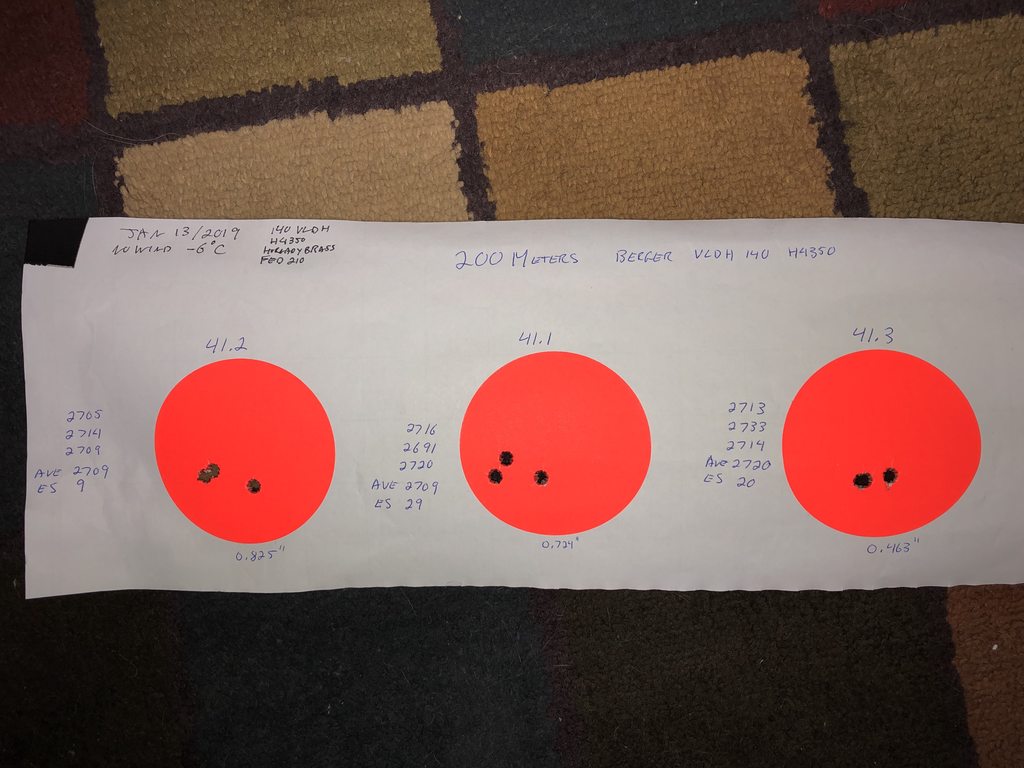
Seating depth is super important to get consistent. I remember working on my 270 load years ago, groups were from 1.5" to 5/8" at 100 yards difference. I do not have that target anymore unfortunately to show. However, this test should be done at a longer distance. I have a test target when i first started messing with the seating depth on my 6.5 Creed. My load that I use is 41.2 grains. This first target ( it looks wonky as it had been rolled up ) I shot the powder charge out of order, sorry about that. Anyway only 3 shot groups but they are all under 1/2 MOA even if you overlapped them. This test was done to see if my new lots of powder will match my old lot. It did ok. ( ya i need to get better at my shooting, I feel I am a beginner long range shooter )
4mXqUfzh.jpg


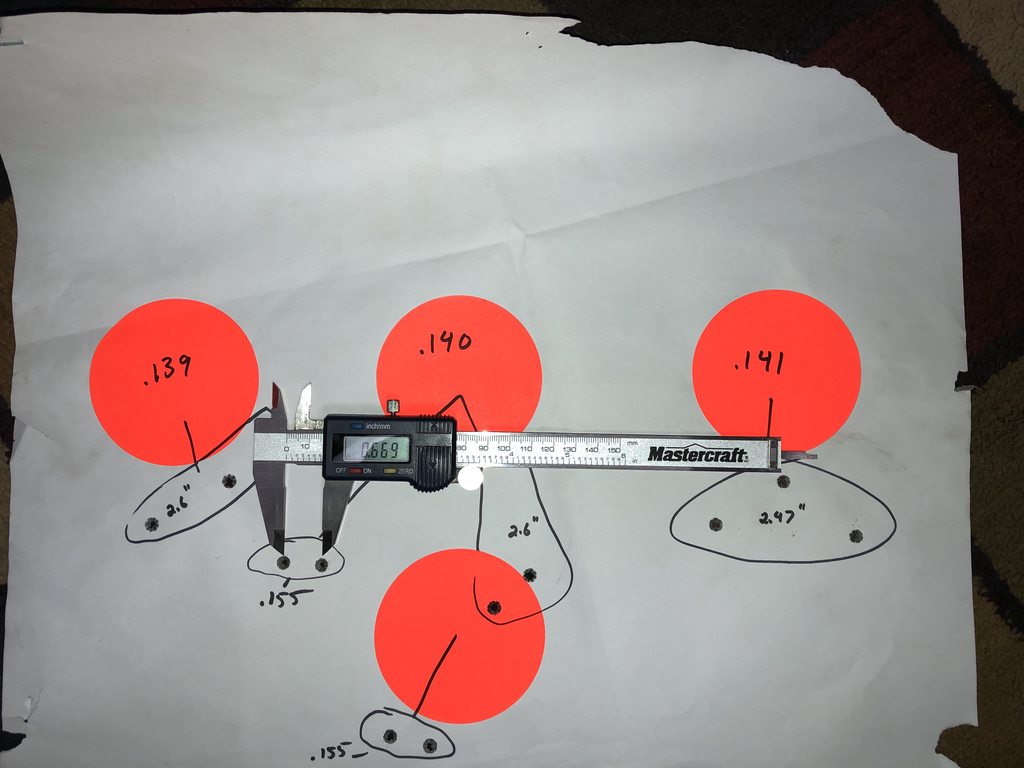
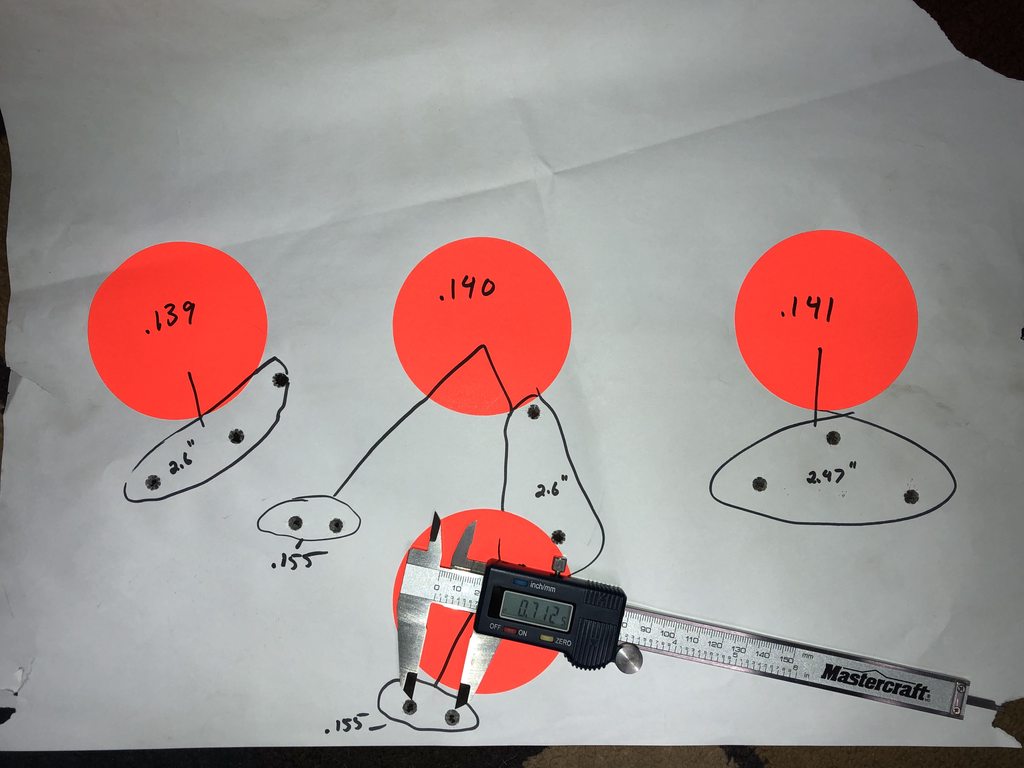
The second target is an OSD test. ( same target ) Rounds were identical except for seating depth. I was lucky in making my original load, as my BTOG was set for my mag length, and was the best so far. I had done this small test from a sample of 100 yard tests that was mostly inconclusive ( 100 is too close ) and just picked a window to try a few. I need to revisit this test closer to my .155 ( max mag length ) So load again .155, .152, .149 to see how close to the edge of the accuracy window I am. Maybe even .158 and just top load the rounds for the test. So 5 rounds at each is 20 rounds. It could be that once a person gets near 1/2 MOA that your seating depth is close already? Not sure, however Im going to test it further as the difference is huge. * note, For the last and bottom target, I had adjusted my scope to keep the rounds on the paper, you can see how the group moved up and right a bit.

GXGBaVsh.jpg


CmrxsLah.jpg
 
Sheesh - Since you are new to shooting and reloading, I would suggest you save the fine tuning like seating depth, and detailed powder charge investigations until you get a handle on the basics, including learning how to shoot reasonably well. Learn to be concise and repeatable, keep written records, etc. Avoid newby mistakes like using different brass within the same load batches....
FWIW - Most sporting rifles will preferentially tune to a given bullet weight, so that should be the first investigation. Once you get a bullet your gun likes, try another powder if you have one. Otherwise, you can ramp up the powder charge, say 4 rounds per 1/2 grain increments. Give yourself some margin away from max published load until you can recognize overpressure. Keep the same coal during these trials - use the cannelure as a guide if possible. When you've got a load that you like, and some more experience, then you can start playing with seating depth. Bear in mind that it takes considerable metrology skills to get close to the lands (say less than 1/32 in), and good reloading technique to hold that tight clearance from round to round, bullet lot to bullet lot, etc. Inadvertently jamming the lands can be bad news, particularly in a hunting situation - ask me how I know...
As far as the scope is concerned, once you get on paper at say 100 yards, try to avoid making adjustments to zero the rifle between groups or trials. Changing bullet weights may take you off the paper, but otherwise the groups shouldn't move substantially. Cheap scopes, and even some half decent ones, can track poorly and jump between shots after an adjustment. Do your zeroing at the end when you've got your "go to" load.

This ^^^

-Learn the basics.
-Don't get caught up trying to prep brass for long range competition when you're just starting out and only shooting at 100 yards.
-Read the front section of your manuals that talks about reloading
-Document everything including the ambient temperature when you're testing your loads.
-Stick to one bullet and one powder until you're convinced that it will not give the results you're looking for. If you keep switching powders and projectiles you'll never find a load.
-Try to pick the most temperature stable powders to use.
-Try to pick one projectile that will cover all of your intended needs of the rifle. No point developing an accurate load with a bullet that isn't designed to expand and hold together if you also want to hunt with your rifle
-Find someone experience in reloading in your area to come and give you a hand getting started and to walk you through your first batch of loads.
-There are no shortcuts in reloading, it takes time and it takes attention to detail, if you're sloppy and have a close enough is good enough attitude you'll likely have problems in the future with your loads.
-Once you've got your basic load safely shooting and the scope is sighted in at 100 yards move your testing to 200 yards if possible. The longer the range you test at the more it will tell you about your load. Don't go too far though or you'll start fighting ambient conditions which will throw off your results.
-Be reasonable in your expectations, if you are new to shooting the chances of you printing 1/2 moa groups is pretty slim, it's not always the ammo that's messing up your groups, some days it will be you. Learn to recognize those days and put aside the load testing and pull out your pistols or your fun gun to play with on days like that.
-Be safe, there's a lot riding on the quality of your loads, your life and the lives of those around you.
-If you're not doing your load testing shooting off of sandbags or a lead sled or some other means of removing the human factor out of your results you're wasting your time, barrel life, and money.

 
Back
Top Bottom