I often have flat base bullets catch the neck of the case when seating the bullet and crush a portion of the neck. It seems to be worse with 22-250 than with 223. I inside neck chamfer my cases. What can I do to help stop this from happening? Better quality seating dies? My 22-250 is a Lee die my 223 is a Redding die. It never happens with boattail bullets for obvious reasons.













































You are using an out of date browser. It may not display this or other websites correctly.
You should upgrade or use an alternative browser.
You should upgrade or use an alternative browser.
seating flat base 224 bullets
- Thread starter Markus
- Start date

try a Hornady seater die wit the sleeve that drops down to keep the bullet aligned on the way up
I use Redding seater on my 223 but haven't had any issues with 55gr Hornady SP, 55gr Vmax, 55gr Varmageddon. I use an RCBS VLD chamfer tool
I use Redding seater on my 223 but haven't had any issues with 55gr Hornady SP, 55gr Vmax, 55gr Varmageddon. I use an RCBS VLD chamfer tool


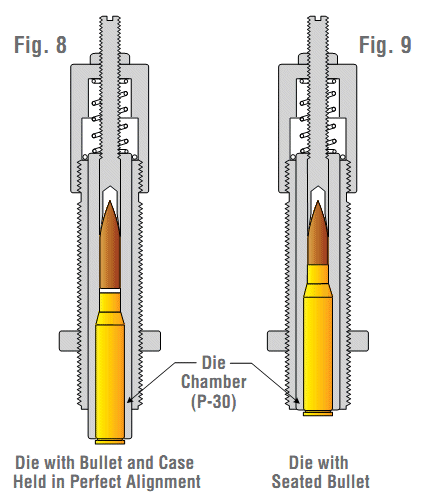
I use Forster benchrest seating dies, they keep the bullet from tilting and insure straight inline seating. As you can see below the die chamber holds the case and bullet in alignment and prevents the bullet from tilting.
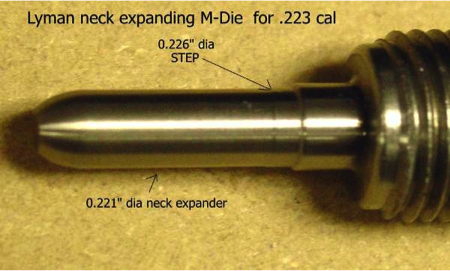
And many AR15 reloaders use a Lyman type "M" expander, they just slightly bump the case mouth onto the second step to slightly expand the case mouth. This allows the bullet to start straight into the case neck. After expanding and with brass spring back the case mouth is approximately .001 larger than bullet diameter. And if needed the case mouth can be bumped in a crimping die to streamline the case mouth.
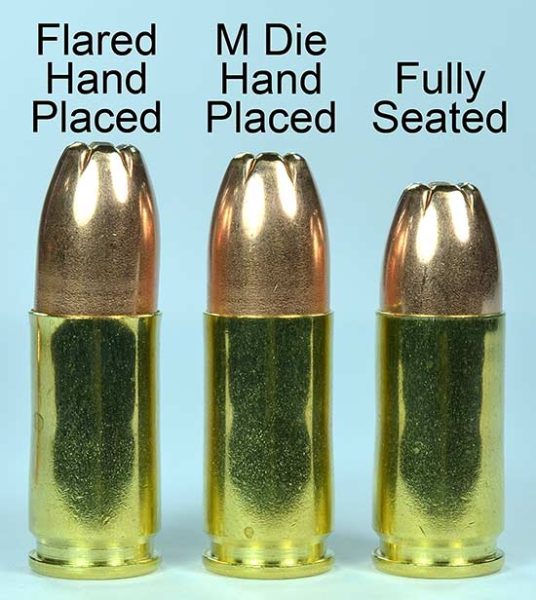
Below an example with the Lyman type "M" expander with pistol cases, and no tilting.
Most seating problems are caused because the seater plug does not fit the bullet profile and allows the bullet to tilt. And the Forster and Redding seating dies hold the bullet straight and in line with the case neck.
And many AR15 reloaders use a Lyman type "M" expander, they just slightly bump the case mouth onto the second step to slightly expand the case mouth. This allows the bullet to start straight into the case neck. After expanding and with brass spring back the case mouth is approximately .001 larger than bullet diameter. And if needed the case mouth can be bumped in a crimping die to streamline the case mouth.
Below an example with the Lyman type "M" expander with pistol cases, and no tilting.
Most seating problems are caused because the seater plug does not fit the bullet profile and allows the bullet to tilt. And the Forster and Redding seating dies hold the bullet straight and in line with the case neck.
Last edited:

Maybe try chamfering more. For the longest time I had the idea that less was more with a chamfer; but that might have been a notion from something I read about handgun loading 1000 years ago. Fast forward a few decades and Nosler pre-chamfered brass has so much chamfer to it that you could probably cut yourself on it if you tried hard enough. So I chamfer hard; and quit worrying about it. Bullets go in now.
The other thing is I use a VLD chamfer tool for everything now. I don't know why they even make the 45s anymore.
The other thing is I use a VLD chamfer tool for everything now. I don't know why they even make the 45s anymore.

Try to seat the bullet little bits at a time turn it a third each time, I should wiggle into the neck and straighten out.
I'd rather shoot factory ammo


I used to have the same problem occasionally including with 22-250. Now when chamfering and deburring I clean up the outside of the case mouth first and then the inside. This way I don't accidentally make the inside diameter of the case mouth smaller. Since I started to chamfer and deburr in this order I can't recall having any problems seating flat base projectiles which is what I mainly use..
Thanks guys. I think a big part of the issue is the Lee die. It's quite a wide unlike the Forester, Hornady and Redding competition seating dies. I chamfer with a Redding chamfer tool but I've been meaning to pick up a vld chamfer tool. It happens much less common in my Redding 223 seating die but it is still just a standard seating die. Hopefully a better seating die takes care of the issue. I'd rather not flare and crimp as that seems pretty counter productive to consistent neck tension.


I use NOE's version of the Lyman die for all of my calibres.





















