Seeking help to fix heat 'over'treated brass!!

Kayser Sose

CGN Ultra frequent flyer
Rating - 100%
1   0   0
Hello all,

So, my method is to resize/deprime, then drop the lubed brass into a bucket of warm soapy water plus Super Clean (really cleans the brass nicely!), followed by a rinse and bake at 150 for ten to twenty to dry them up. Cookie sheets of brass! its a riot. Convection oven; works a charm.

So where I ####ed up is I left them in at 450 for twenty minutes....! Now they're all purplish-blue, and very, very dark. I think I heat treated them!

Almost a hundred .308 cases... what the frack did I do? and how can I reverse the damage?

Are they now too hard or too soft? I let them air cool, no quenching.
 
There's this old trick I remember hearing about:

Stand the cases in a pan of water, full to about an inch or just less from the top. With a propane torch, heat till cherry, then tip into the water, to get longer lasting case mouths.... Thoughts?
 
There's this old trick I remember hearing about:

Stand the cases in a pan of water, full to about an inch or just less from the top. With a propane torch, heat till cherry, then tip into the water, to get longer lasting case mouths.... Thoughts?

Cherry red is not needed.

Brass is hardened in manufacture by workhardening, with annealing as needed.

I don't know if the brass is ruined or not.

Personally, given what would happen is an annealed casehead were to fail, I'd pitch it in the recycling bin. 100 .308s are just not worth it.
 
As noted by tiriaq above, the only way to "harden" brass is through working it. Any kind of "heat treating" does nothing but anneal it.

Annealing can be done by a few seconds at high temp, or a long time at a lower time. Both accomplish exactly the same thing. Anyone who says otherwise should get a copy of a properties of materials text and sit down for a week or two and read through it.


If your brass has changed colour, it is more than likely toast. Try squeezing/crushing the body of a couple pieces with pliers, and then compare the force you need with the force needed to squeeze/crush a non-annealed piece of brass. If your annealed brass is much easier to squeeze/crush, then consider it a lesson.
 
I agree, its toast. A cartridge with a soft neck and shoulder is good, but one with a soft head is bad news and potentially dangerous. If there is a chance you've softened the case head, dispose of the brass.
 
I too suspect it's gone. You can try to scratch the head area with a sharp tool and repeat it with the same pressure on a non-treated one, then compare the marks, the depth of the marks should give you a good indication of the state of the "treated" brass. But if I was in your situation, I'd just trhow them in the recycling bin.

Totally agree with others; brass cant be hardened except by working it (hammering, compressing etc).
 
Last edited:
A good article on annealing brass http://www.6mmbr.com/annealing.html Personally I would toss those cases even though you didn't get the area from the shoulder down up to 650 degrees it's most likely you still soften the brass to a point that it's unsafe.

On another point if you heat the neck and shoulder till the case is cherry red you have already ruined the case. The case should be slightly off colored when annealed properly as pictured here on my X39 brass.

Untitled.jpg
 
What are the chemical components of this "super clean"? You said you rinsed it off, but perhaps your concoction was a little strong and you didn't rinse it off completely?

Try this...take a regular brass case, and dunk it in your super clean for awhile, then DON'T rinse it and leave it to air dry (or dry the same way in your oven). See what happens.

I personally have not used the oven ever for drying my brass, but I have tarnished brass the way you describe, by not rinsing them well after a soak with some soap...
 
####. ####! I hate throwing out otherwise perfectly good brass.

...what if I tried to get one more shot out of them? Is this kind of thing dangerous even for one more firing?

Obviously what I do is my own decision, and I would be watching for signs of early failure most definitely!, but I can't bear to chuck this brass. Tho' I must..... dammit! :(

Thanks all for your support
 
It's better to err on the side of caution with potentially damaged brass. Who knows, it might work, or it might let go and give you hot bits of brass and a 60,000 PSI blast of gas towards your eyes and face. Crush them with pliers and consider it a $25 lesson. Your eyes and face are worth more than that.
 
s**t. s**t! I hate throwing out otherwise perfectly good brass.

...what if I tried to get one more shot out of them? Is this kind of thing dangerous even for one more firing?

Fire them? Hell NO. Do you value your fingers, arms, eyesight, and face?


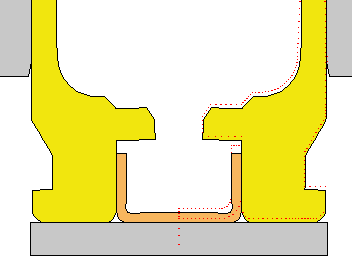
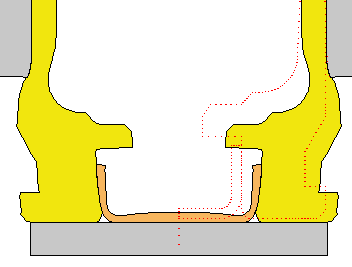
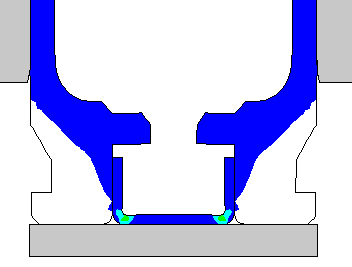
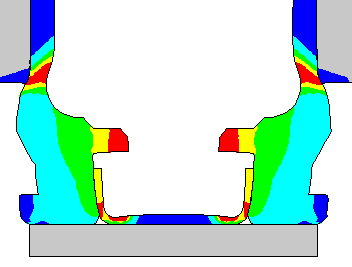
Work hardened head, no separation, Annealed case head, head separation

fhh1.gif
ann1.gif


Blue is acceptable stress in the brass. Red means the brass is stressed beyond it's yield point, meaning it has RUPTURED.

fhh2.gif
ann2.gif


From this Web Page http://www.varmintal.com/a243zold.htm
 
Purple power/super clean will discolor brass and aluminum. If brass doesn't soften under 400something degrees celsius, than 400f is no where near hot enough to soften them in any way at all. Just like fresh water ice doesn't melt below 0 or freeze above it. Your oven simply can't even get hot enough to harm them.
 
This was the best and shortest advice.


It's better to err on the side of caution with potentially damaged brass. Who knows, it might work, or it might let go and give you hot bits of brass and a 60,000 PSI blast of gas towards your eyes and face. Crush them with pliers and consider it a $25 lesson. Your eyes and face are worth more than that.
 
Purple power/super clean will discolor brass and aluminum. If brass doesn't soften under 400something degrees celsius, than 400f is no where near hot enough to soften them in any way at all. Just like fresh water ice doesn't melt below 0 or freeze above it. Your oven simply can't even get hot enough to harm them.

Bad analogy.

The real answer is IT DEPENDS. It depends on the alloy, the actual temperature, and the time.

Here are the curves for annealing to dead soft. 450°F = 232°C So what alloy was used in the brass? Remember that for annealing brass, even just the case mouth, if you go dead soft, the case is garbage. So you are not looking at the bottom of the curves, just the top part where they begin to soften.


CopperandCopperAlloys-JosephRDavis-GoogleBooks_1341406467192.png
 
tiriaq and the others had great advice. I would toss them myself.

Anealing to soften necks doens't need water quenching, its just a quick way to cool them off, and when the case is stood in the water it makes it harder to overheat the base/head of the case. Some people hold the case in a drill or hand and turn over a flame till they can't hold it any more.
 
Back
Top Bottom