












































You are using an out of date browser. It may not display this or other websites correctly.
You should upgrade or use an alternative browser.
You should upgrade or use an alternative browser.
Shooting an Enfield without the magazine in place?
- Thread starter lord-humungous
- Start date


Can it be done? Is it dangerous? I'm considering one that doesn't have a magazine and wondering if I can shoot it loading singles.
It's not dangerous but magazines aren't that hard to come by...the round is supposed to feed up from below, not just close the bolt on it in the chamber.

I tried to chamber a round directly into my Enfield Envoy when I first bought it, but it was virtually impossible! The extractor claw is too large and powerful to snap over the case rim. It was always meant to feed from underneath as previously suggested. The action is strong enough to shoot without a mag, but the extra pressure a correctly inserted mag exerts can affect the point of impact.

Infanteer90
CGN Regular
- Location
- Where you all want to be... Alberta
Early No1 MkIII rifles came with a magazine cut-off. This blocked any rounds from the magazine from being loaded when the bolt came forward so that single rounds could be loaded and fired. Originally, the 10 rounds in the magazine were intended to be used as a ready reserve for times when rapid fire was required. This tactic changed and the mag cut-off was eliminated on the MkIII* rifles. Point is, that I agree that the Enfield should be capable of being loaded with single rounds as that is in fact how they were originally intended to be used.
Like the Mauser rifles, the Lee-Enfield has a "controlled feed" of the cartridges from the magazine, and is not designed to be loaded by by having a cartridge pushed in, and then having the extractor claw go over the rim of the catridge. That causes a lot of stress for the extractor claw, and might cause a serious malfunction by a broken extractor, when you need it most.
If you carefully study the loading cycle of a Lee-Enfield, you can easily observe how the spring from the clip gently pushing the rim of the cartridge up to the front of the bolt and just behind the extractor claw, for a firm and locked "controlled feed" of the 303 british catridge, as well as observing how the spend cartridge is ejected by the extractor claw only, when the rim of the cartridge reaches the cutout along the raceway, just below the charger bridge.
The only function for the extractor screw is therefore only, when you extract a live round from the chamber. Very simple and clever system
If you carefully study the loading cycle of a Lee-Enfield, you can easily observe how the spring from the clip gently pushing the rim of the cartridge up to the front of the bolt and just behind the extractor claw, for a firm and locked "controlled feed" of the 303 british catridge, as well as observing how the spend cartridge is ejected by the extractor claw only, when the rim of the cartridge reaches the cutout along the raceway, just below the charger bridge.
The only function for the extractor screw is therefore only, when you extract a live round from the chamber. Very simple and clever system

Like the Mauser rifles, the Lee-Enfield has a "controlled feed" of the cartridges from the magazine, and is not designed to be loaded by by having a cartridge pushed in, and then having the extractor claw go over the rim of the catridge. That causes a lot of stress for the extractor claw, and might cause a serious malfunction by a broken extractor, when you need it most.
If you carefully study the loading cycle of a Lee-Enfield, you can easily observe how the spring from the clip gently pushing the rim of the cartridge up to the front of the bolt and just behind the extractor claw, for a firm and locked "controlled feed" of the 303 british catridge, as well as observing how the spend cartridge is ejected by the extractor claw only, when the rim of the cartridge reaches the cutout along the raceway, just below the charger bridge.
The only function for the extractor screw is therefore only, when you extract a live round from the chamber. Very simple and clever system
My friend, if your gun is doing what you describe, you are useing it wrong! Enfields, except P-14's and M-17's are push feed systems. With the exception of some of the .308 versions, they should all be able to be chamber loaded and the extractor should smartly snap over the rim of the cartridge case. Remove the ejector screw and let me know of your rifle ejects either loaded or empty cartridge cases.
Enfield bolts are designed to be operated smartly, not gingerly. The bolt should be thrust closed without haste and rotated down in one motion. There is no way you could or should be able to tell if the extractor is helping the case to feed into the chamber if the rifle is operated properly!
And as far as firing it without the mag in place, no problem but it will tend to change your trigger pull weight.
Scott

I take my Enfield’s to the range and shoot from the bench, sitting next to me is a plastic case containing 50 rounds. I take one round out of the case and lay it on the follower, start the bullet in the chamber and close the bolt. I single feed 50 to 100 rounds without ever loading the magazine. If the extractor claw won’t snap over your round you have old petrified Cosmoline restricting the movement of the extractor.
I just don’t understand why some of you Canadian Hosers don’t know how an Enfield works.

I just don’t understand why some of you Canadian Hosers don’t know how an Enfield works.

It will be fine, I shot one of my Enfields with no mag with no problems. the DCRA 7.62 conversions were mostly loaded single shot and they have the exact same extractor design (just adjusted to fit 7.62 NATO rims).

Like the Mauser rifles, the Lee-Enfield has a "controlled feed" of the cartridges from the magazine, and is not designed to be loaded by by having a cartridge pushed in, and then having the extractor claw go over the rim of the catridge. That causes a lot of stress for the extractor claw, and might cause a serious malfunction by a broken extractor, when you need it most.
If you carefully study the loading cycle of a Lee-Enfield, you can easily observe how the spring from the clip gently pushing the rim of the cartridge up to the front of the bolt and just behind the extractor claw, for a firm and locked "controlled feed" of the 303 british catridge, as well as observing how the spend cartridge is ejected by the extractor claw only, when the rim of the cartridge reaches the cutout along the raceway, just below the charger bridge.
The only function for the extractor screw is therefore only, when you extract a live round from the chamber. Very simple and clever system
i dont think you know what your talking about. the enfield was built to be single fed, and the 10 rounds held in reserve to begin with.
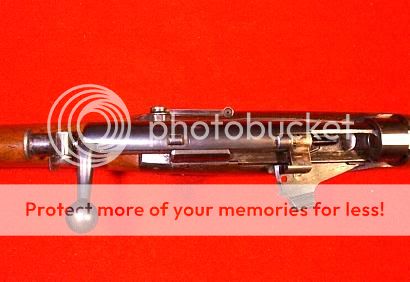

Out to lunch
You are so far off the mark, it's not funny. The Lee action in British-Commonwealth service has ALWAYS been a CRF action. It is true that the extractor WILL snap over the rim of a chambered round, but you shouldn't make a habit of it. The Mk.III used a cut-off, but if you've ever actually looked at one, they have a little ramp at the back. You drop the round on the cut-off plate, and the extractor hooks the rim BEFORE the round gets to the chamber. You don't push the round into the chamber with your fingers, you use the bolt. I've seen many broken extractor springs from closing the bolt over chambered rounds. Incidentally, I've tested many L-E's without the ejector screw in place. About half of them will eject empty or loaded cases exactly like if the screw was there. The others were almost the same, but the tension of the extractor spring is far more important than the ejector screw. A weak spring will often fail to eject even with the screw in place. And the Lee will extract the fired case even if the spring breaks, but it won't eject.
My friend, if your gun is doing what you describe, you are useing it wrong! Enfields, except P-14's and M-17's are push feed systems. With the exception of some of the .308 versions, they should all be able to be chamber loaded and the extractor should smartly snap over the rim of the cartridge case. Remove the ejector screw and let me know of your rifle ejects either loaded or empty cartridge cases.
Enfield bolts are designed to be operated smartly, not gingerly. The bolt should be thrust closed without haste and rotated down in one motion. There is no way you could or should be able to tell if the extractor is helping the case to feed into the chamber if the rifle is operated properly!
And as far as firing it without the mag in place, no problem but it will tend to change your trigger pull weight.
Scott
You are so far off the mark, it's not funny. The Lee action in British-Commonwealth service has ALWAYS been a CRF action. It is true that the extractor WILL snap over the rim of a chambered round, but you shouldn't make a habit of it. The Mk.III used a cut-off, but if you've ever actually looked at one, they have a little ramp at the back. You drop the round on the cut-off plate, and the extractor hooks the rim BEFORE the round gets to the chamber. You don't push the round into the chamber with your fingers, you use the bolt. I've seen many broken extractor springs from closing the bolt over chambered rounds. Incidentally, I've tested many L-E's without the ejector screw in place. About half of them will eject empty or loaded cases exactly like if the screw was there. The others were almost the same, but the tension of the extractor spring is far more important than the ejector screw. A weak spring will often fail to eject even with the screw in place. And the Lee will extract the fired case even if the spring breaks, but it won't eject.
maybe im wrong. im going to have to chamber a round off the plate, and see what it does. got no arguments about the ejector screw, the extractor spring is far more important to ejection that the screw. i personally have never broken, or seen a broken extractor on a #4. and, i would hate to guess how many rounds i have put through many different rifles in the past. maybe im just lucky
All what you have to do, is take your time to observe the loading cycle, in "slow montion", of the Lee-Enfield rifle, and you cannot avoid noticing the "controlled feed" system of this fine rifle, which predates the Mauser "controlled feed" system of cartridge loading.
Push feeding the Lee-Enfield is an option, but you are putting a lot of stress on the extractor hook.
Push feeding the Lee-Enfield is an option, but you are putting a lot of stress on the extractor hook.
The spring will fail before the hook. I've actually never seen a hook break.
The AIA No 4 Mk IV series of rifles are push feed. The round actually pops out of the magazine and the bolt head pushes it home. The extractor then pops over the rimless 7.62 case.
As for .303, definitely controlled feed. When I check headspace on one, I have to push the headspace gauge up under the extractor claw before it can chamber.
And no, I'm not removing the extractor, no need.

Seeing as early variants of the Lee Enfield were fitted with a magazine cutoff specifically for the purpose of feeding a single round into the chamber, I don't see any problem.
The inability of the extractor to snap over a round fed directly into the chamber is not a defining characteristic of a controlled feed action. While most Mauser type actions, particularly military ones, won't allow the extractor to snap over a round in the chamber, there are some that will. Extractors are sometime modified by gunsmiths to allow a round to be fed directly into the chamber.
Any rifle action in which the case rim slides under the extractor as soon as it clears the magazine feed lips or rails can be legitimately be considered controlled feed. My Savage No.4 Mk.I* functions like this and a double feed cannot be induced by short stroking the bolt.
The inability of the extractor to snap over a round fed directly into the chamber is not a defining characteristic of a controlled feed action. While most Mauser type actions, particularly military ones, won't allow the extractor to snap over a round in the chamber, there are some that will. Extractors are sometime modified by gunsmiths to allow a round to be fed directly into the chamber.
Any rifle action in which the case rim slides under the extractor as soon as it clears the magazine feed lips or rails can be legitimately be considered controlled feed. My Savage No.4 Mk.I* functions like this and a double feed cannot be induced by short stroking the bolt.





















