













































The Winchester Model 1873 has history spoken in its very appearance. For many, it speaks of the Old West, having made its debut in 1873. For others, it is a reminder of old farms, cedar rail fences, corn fields surrounded by hardwood covered hills, and wood smoke curling up from the farm house chimney on a fall evening. The Model 1873 is what many Old Timers used to put venison on the table every fall. When a fellow picks up one of these old rifles from a bygone era when cars had not yet been invented and horse and buggy were the mode of travel, there is a feeling of history in ones hands, silently spoken in its appearance.
A few months ago, I had the good fortune of acquiring an original Winchester Model 1873, and in my favourite ’73 caliber, the 38 W.C.F., also known as the 38-40. This rifle was received in the Winchester warehouse November 18th, 1891 and shipped on the twelfth of the following month, order number 16325, just in time for somebody’s Christmas. I call it my Christmas gun. The fellow I had purchased it from had had it for 40 years, though he never fired it. Prior to that, it had hung on the wall of a sporting supplies shop for as long as anyone could remember, in a small village in the English-speaking Eastern Townships of Quebec, just across the border from Vermont. It is beautiful country, with hills covered with Sugar Maples and farms in the fertile valleys. When the shop closed up around 1960, the old rifle came down off the wall and into the possession of the fellow from whom I eventually bought it 40 years later. It is an honest old ’73. No one has ever messed with it, and from its appearance, it has done its share of putting venison in the fall larder. Below is a photo of the old timer.
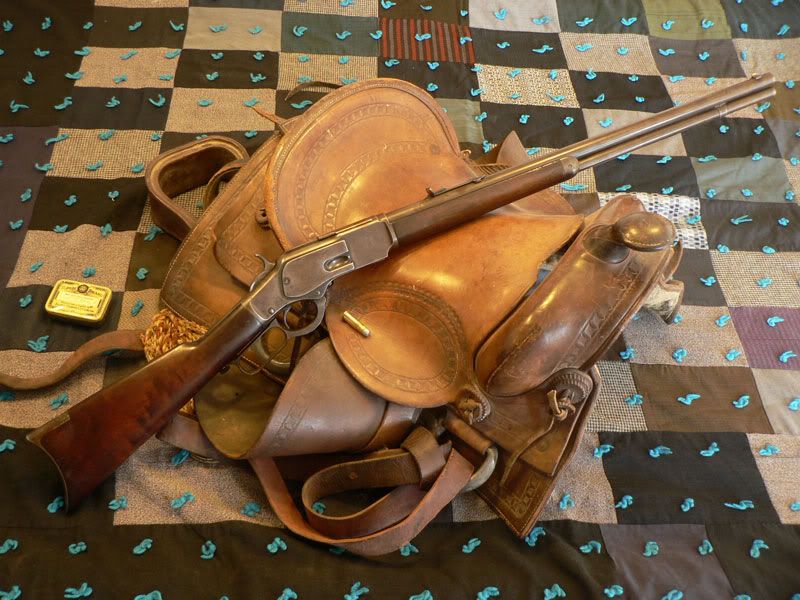
Any old Winchester I have the privilege of owning must earn its keep which means, in the case of this old timer, that it will need to put some venison on the table at least one more time. The bore has good rifling, but there is the occasional spot of light pitting here and there. Whoever once owned it at the turn of the previous century, must have been careful not to waste a single shot, as was so often the case back then. As a result, the action is tight, with no droop at all in the lever.
Figuring out a load
My copy of an 1896 Winchester catalogue lists the 38 W.C.F. as firing a 180 grain cast lead bullet at 1,268 fps. This was a black powder load. When Winchester changed the cartridge over to a smokeless powder, the velocity increased to 1,325 fps. For my purposes, I did not want to exceed the bolt thrust of the 44 WCF, which was also chambered in the Model 1873; nor did I wish to exceed the chamber pressure of the 44 WCF. The 44 WCF in Winchester’s early smokeless loads for the ’73 and the Model 1892 generated a bolt thrust of 37 foot-pounds. That would permit a velocity for the lighter 180 grain 38-40 bullet of 1,444 fps. The chamber pressure of the 44 WCF would have been higher for the 200 grain bullet than the 180 grain bullet used in the 38-40. For the same chamber pressure, the 180 grain bullet could be sent out the barrel at 1,400 fps. The bottom line is that I would be limited by chamber pressure before I had to worry about bolt thrust, if I wanted to keep pressures at or below those generated by the 44 WCF. When all is said and done, I want something around 1,325 fps, which is Winchester’s original velocity for smokeless cartridges for the Winchester Model 1873. Of course, I would have to use a smokeless powder that gave a peak pressure equivalent to, or slightly less than, black powder. There are several smokeless powders that would qualify, but the two I had in hand were Alliant 2400 and IMR SR4759, both with burn rates virtually identical to black. My 180 grain bullet is cast from a RCBS mould, using old wheel weights I collected from a tire shop. For those who may be unfamiliar with the 38 W.C.F. (38-40) cartridge, the photo below shows it beside the more well-known 30-30 cartridge. Also shown is one of my cast bullets for the 38-40.

First Trial
I loaded up five cartridges with 17 grains of IMR SR4759. This gave me 1,211 fps with an E.S. of 116 fps and a S.D. of 42 fps. Ken Waters lists a velocity of 1,235 fps for only 15 grains of the same powder. I suspect the burn rate of this powder has decreased with modern production. I had no idea where the gun would shoot, so I set up a target at 50 yards. Four of the bullets went into a 1 & 3/8” but a fifth flyer widened the group to 2 & 15/16”. I was very pleased. For the very first time out, this old rifle showed promise. A photo of the target is shown below.

Second Trial
This time I came with two loads. I needed to beef up the previous load a bit, as it fell a good bit lower than my goal of 1,325 fps, so I tried 17.5 grains of IMR SR4759. This gave me 1,313 fps with an E.S. of 77 fps. I also tried 14 grains of Alliant 2400. Waters lists 16 grains of 2400 as safe for the ’73 and with a velocity of 1,402 fps, so I figured 14 grains would be a safe place to start. It turned out that 14 grains gave me an average velocity of 1,431 fps! Good thing I didn’t start with Waters’ load. It appears to me that modern 2400 burns faster than the older version of 2400 that Waters would have used. This time I set the targets up at 100 yards. For a 119-year old rifle, I was pleased again. Keep in mind that for Whitetail deer, the maximum recommended range is 100 yards. I would be using it at 30 to 60 yards in the mature forest where I hunt. Photos of the two targets are shown below.


This same second trip to the range, I had loaded up seven culled bullets. These were either ‘lumpy’ from too cold a mould before it had warmed up enough, or they were quite a bit off on their weight. I had no idea how awful the accuracy would be, but I wanted to find out, so I set a target at 50 yards. I was quite surprised. The accuracy didn’t appear to be affected in the least by the bullets I would normally cull. The target is shown below.

Third trip to the range
This time I tried two loads adjusted to give me what I thought would be somewhere around 1,325 fps, but I tried once-fired brass, partially neck sized for only the top 1/8” of the neck. 13.3 grains of 2400 gave me 1,278 fps with an E.S. of 121 fps and 17.7 grains of SR4759 gave 1,321 fps with an E.S. of 20 fps. When I went to take a look at the targets the ‘groups’ were awful! The small change in powder weight and velocity was unlikely to be the cause. Instead, I suspected that it was due to only a partial resize of the neck. With such a stubby, fat little bullet it might allow a bit of wobble in the case neck at the moment of firing. The two targets are shown below.


Fourth trip to the range
To test my theory that the poor accuracy of the last trip was due to only partially resizing the neck, I loaded up the exact same loads as before, but did a full resizing of the neck. This time they gave higher velocities, probably due to the slightly resized case volume. 17.7 grains of SR4759 gave 1,376 fps with an E.S. of 116 fps and a S.D. of 45 fps. This was up from the previous 1,321 fps. My load of 13.3 grains of 2400 gave 1,383 fps and an E.S. of 115 fps and an S.D. of 36 fps, up from 1,278 fps in the partially neck sized cases. Accuracy was much better, with the SR4759 load giving me a 5-shot group at 100 yards of 3 & 3/8”. Photos of the two targets are shown below.


Conclusions
Full neck sizing from now on; no doubt about it. Also, I want to play around a bit more to see if I can lower the velocity to around 1,350 fps. I find, however, that ambient temperature does affect velocity, so we’ll have to see how this plays out in colder weather.
A few months ago, I had the good fortune of acquiring an original Winchester Model 1873, and in my favourite ’73 caliber, the 38 W.C.F., also known as the 38-40. This rifle was received in the Winchester warehouse November 18th, 1891 and shipped on the twelfth of the following month, order number 16325, just in time for somebody’s Christmas. I call it my Christmas gun. The fellow I had purchased it from had had it for 40 years, though he never fired it. Prior to that, it had hung on the wall of a sporting supplies shop for as long as anyone could remember, in a small village in the English-speaking Eastern Townships of Quebec, just across the border from Vermont. It is beautiful country, with hills covered with Sugar Maples and farms in the fertile valleys. When the shop closed up around 1960, the old rifle came down off the wall and into the possession of the fellow from whom I eventually bought it 40 years later. It is an honest old ’73. No one has ever messed with it, and from its appearance, it has done its share of putting venison in the fall larder. Below is a photo of the old timer.
Any old Winchester I have the privilege of owning must earn its keep which means, in the case of this old timer, that it will need to put some venison on the table at least one more time. The bore has good rifling, but there is the occasional spot of light pitting here and there. Whoever once owned it at the turn of the previous century, must have been careful not to waste a single shot, as was so often the case back then. As a result, the action is tight, with no droop at all in the lever.
Figuring out a load
My copy of an 1896 Winchester catalogue lists the 38 W.C.F. as firing a 180 grain cast lead bullet at 1,268 fps. This was a black powder load. When Winchester changed the cartridge over to a smokeless powder, the velocity increased to 1,325 fps. For my purposes, I did not want to exceed the bolt thrust of the 44 WCF, which was also chambered in the Model 1873; nor did I wish to exceed the chamber pressure of the 44 WCF. The 44 WCF in Winchester’s early smokeless loads for the ’73 and the Model 1892 generated a bolt thrust of 37 foot-pounds. That would permit a velocity for the lighter 180 grain 38-40 bullet of 1,444 fps. The chamber pressure of the 44 WCF would have been higher for the 200 grain bullet than the 180 grain bullet used in the 38-40. For the same chamber pressure, the 180 grain bullet could be sent out the barrel at 1,400 fps. The bottom line is that I would be limited by chamber pressure before I had to worry about bolt thrust, if I wanted to keep pressures at or below those generated by the 44 WCF. When all is said and done, I want something around 1,325 fps, which is Winchester’s original velocity for smokeless cartridges for the Winchester Model 1873. Of course, I would have to use a smokeless powder that gave a peak pressure equivalent to, or slightly less than, black powder. There are several smokeless powders that would qualify, but the two I had in hand were Alliant 2400 and IMR SR4759, both with burn rates virtually identical to black. My 180 grain bullet is cast from a RCBS mould, using old wheel weights I collected from a tire shop. For those who may be unfamiliar with the 38 W.C.F. (38-40) cartridge, the photo below shows it beside the more well-known 30-30 cartridge. Also shown is one of my cast bullets for the 38-40.
First Trial
I loaded up five cartridges with 17 grains of IMR SR4759. This gave me 1,211 fps with an E.S. of 116 fps and a S.D. of 42 fps. Ken Waters lists a velocity of 1,235 fps for only 15 grains of the same powder. I suspect the burn rate of this powder has decreased with modern production. I had no idea where the gun would shoot, so I set up a target at 50 yards. Four of the bullets went into a 1 & 3/8” but a fifth flyer widened the group to 2 & 15/16”. I was very pleased. For the very first time out, this old rifle showed promise. A photo of the target is shown below.
Second Trial
This time I came with two loads. I needed to beef up the previous load a bit, as it fell a good bit lower than my goal of 1,325 fps, so I tried 17.5 grains of IMR SR4759. This gave me 1,313 fps with an E.S. of 77 fps. I also tried 14 grains of Alliant 2400. Waters lists 16 grains of 2400 as safe for the ’73 and with a velocity of 1,402 fps, so I figured 14 grains would be a safe place to start. It turned out that 14 grains gave me an average velocity of 1,431 fps! Good thing I didn’t start with Waters’ load. It appears to me that modern 2400 burns faster than the older version of 2400 that Waters would have used. This time I set the targets up at 100 yards. For a 119-year old rifle, I was pleased again. Keep in mind that for Whitetail deer, the maximum recommended range is 100 yards. I would be using it at 30 to 60 yards in the mature forest where I hunt. Photos of the two targets are shown below.
This same second trip to the range, I had loaded up seven culled bullets. These were either ‘lumpy’ from too cold a mould before it had warmed up enough, or they were quite a bit off on their weight. I had no idea how awful the accuracy would be, but I wanted to find out, so I set a target at 50 yards. I was quite surprised. The accuracy didn’t appear to be affected in the least by the bullets I would normally cull. The target is shown below.
Third trip to the range
This time I tried two loads adjusted to give me what I thought would be somewhere around 1,325 fps, but I tried once-fired brass, partially neck sized for only the top 1/8” of the neck. 13.3 grains of 2400 gave me 1,278 fps with an E.S. of 121 fps and 17.7 grains of SR4759 gave 1,321 fps with an E.S. of 20 fps. When I went to take a look at the targets the ‘groups’ were awful! The small change in powder weight and velocity was unlikely to be the cause. Instead, I suspected that it was due to only a partial resize of the neck. With such a stubby, fat little bullet it might allow a bit of wobble in the case neck at the moment of firing. The two targets are shown below.
Fourth trip to the range
To test my theory that the poor accuracy of the last trip was due to only partially resizing the neck, I loaded up the exact same loads as before, but did a full resizing of the neck. This time they gave higher velocities, probably due to the slightly resized case volume. 17.7 grains of SR4759 gave 1,376 fps with an E.S. of 116 fps and a S.D. of 45 fps. This was up from the previous 1,321 fps. My load of 13.3 grains of 2400 gave 1,383 fps and an E.S. of 115 fps and an S.D. of 36 fps, up from 1,278 fps in the partially neck sized cases. Accuracy was much better, with the SR4759 load giving me a 5-shot group at 100 yards of 3 & 3/8”. Photos of the two targets are shown below.
Conclusions
Full neck sizing from now on; no doubt about it. Also, I want to play around a bit more to see if I can lower the velocity to around 1,350 fps. I find, however, that ambient temperature does affect velocity, so we’ll have to see how this plays out in colder weather.
























