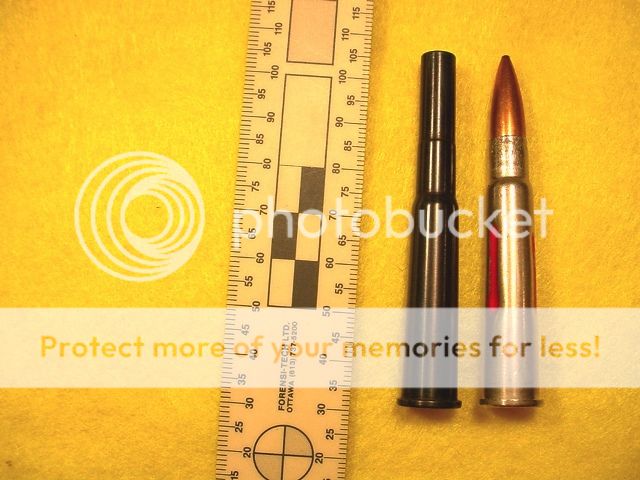
Short 303 round ?

Well it's a martini 303 lee enfield with the little lever on the bottom. Not sure why they would have used this as a trainer in newfoundland

Might have helped to pass that info on two days ago.

BTW, there is no such thing as a "Martini .303 Lee Enfield". You can have Lee Enfields, or Martini Enfields.
 
Doea it loook like this?
Enfield1883a.jpg

If so, it is indeed a Martini-Enfield originally chambered in 303. It coiuld be chambered in any calibre now.
 
There is no such thing as a "martini 303 lee enfield"; it would be like a "ford 383 chevrolet".

"ENFIELD" refers to the FACTORY in which the thing was made. It is NOT a type of rifle.

The Royal Small Arms Factory at Enfield Lock was in the firearms manufacturing business for more than 160 years. In that period of time they built muskets, pistols, rifles, machine-guns, assault rifles, battle rifles, target rifles. In rifles alone, they manufactured at least EIGHT totally-different designs and experimented with many others.

I keep asking people and asking people to get their nomenclature right...... and I keep getting flamed for being a pedant. NOW we find out why knowing the right NAME of the thing is important (apart from the fact that absolutely NO parts interchange between most of the models).

The term MARTINI refers to a type of lever-action single-shot rifle.

The term LEE refers to a system of bolt-action rifle with a box magazine under the action.

Both terms come from the names of the INVENTORS of the original designs.

A rifle can't be both at the same time.

.
 
"ENFIELD" refers to the FACTORY in which the thing was made.

I was under the impression that "ENFIELD" reffered to the type of rifling used, hence, Lee Metford's used Metford pattern rifling and Lee Enfield's used Enfield pattern rifling. Which is why we don't hear of Lee-BSA's or Lee-Lithgow's.
 
I actually had no clue what it was up till a few hours ago. The fellow that owns it said it was a lee enfield. Then had his wife send pics of it up and that's when another coworker informed is that it was a martini
 
Prior to the Great War, Newfoundland had NO military whatsoever, everything being looked after by the small British garrison (coast artillery and a handful of troopies). In 1904/05 the old Auxiliary Screw Corvette HMS CALYPSO was refitted, renamed HMS BRITON and sent to Newfoundland, obsolete as she was, to be a training centre and recruiting post for the Royal Navy. She continued in this role until about 1920. Her most famous contribution to Newfoundland defence was her couple of hundred Lee-Metford rifles which were used for basic marksmanship training for the entire Newfoundland Regiment during the Great War. By the end of the war, most of them were pretty well shot, so they were sold off surplus at the same time as the ship. CALYPSO/BRITON's wreck today lies in Job's Cv, Embree, NDB, a sad old heap of rust and rotting timber. I have been aboard of she and it's enough to make one weep.

But there also were local patriotic associations, mainly sponsored by the various Churches. The ones best remembered were the CLB (Church Lads' Brigade), sponsored by the Church of England; there was also a rival Catholic group. They paraded regularly, gave their members some military training...... and many of them carried Martinis, which were available cheaply and in quantity, especially after the introduction of the Short Lee-Enfield rifle in 1902, at which time the .303 Martinis (which had started as .577/.450 Martinis back in the 1870s) were 3 generations obsolete and being surplused.

Martins, obsolete as they might have been, continued in service for MANY years. In WW2, many were used to arm the Home Guard in England. Indeed, the first German bomber shot down over England was brought down by a platoon of Home Guards with volley-fire from their Martinis.

And Martinis continued in Colonial service long afterward. A good friend will NEVER forgive the Americans for BURNING the local Cadet Corps' Martinis following the 1982 invasion of Grenada. The rifles were a gift from the Lancashire Fusiliers and are now irreplaceable. Likely they were the last Martinis in military Service, most of them 100 years old at the time of their destruction.... and still looking good and still serviceable.

Hope this helps.
.
 
not originally chambered in .303 but converted to handle it. If you are able, check the knoxform for rifling type, E enfield or M metford, and the left side of the receiver should have the conversion cypher stamped. and yes, now it could be any calibre.
 
ENFIELD can ALSO refer to the type of rifling, as has been pointed out. On Martinis, Enfield-rifled barrels were ALL marked "E" on the Knox-form. Early Metford barrels were not marked, owing to it being the only type of rifling used in .303s at that time. Metford barrels have 7 grooves, left-hand, segmental rifling; they look washed-out when they are new, so gauges are helpful.

It can ALSO refer to a system of screw threads, just to really "screw" things up!

Enfield RIFLING is characterised by an odd number of lands and grooves, lands and grooves of equal width. For rifle-calibre barrels, this generally is 5 grooves and generally is Left-hand twist. It is very distinctive and, if not overheated and looked after a bit, it will last an amazing number of rounds. Recently it has been "invented" by an American company and is marketed as "5R" rifling, touted as the best thing since sliced bread and praised for its long-lasting accuracy. Ho-hum! We knew about that in 1896, so what's all the fuss about? (Answer: money. The Americans couldn't say a thing good about the LE until it came time to steal the rifling!) I suppose we could call it "5L" rifling and we would be modern..... if we wanted to be.

But the term "Enfield" can mean a lot of things, including a town and a rather-nice hand-finished motorcycle which goes fast enough to kill you very dead..... but what a way to go!

Hope this might clear up a TINY bit of the confusion!
.
 
Yes, but the original post said it was a training rifle, so presumably not .303 inch.

Warren, yes please if you can post the pictures.

Regards
TonyE

Here is a picture of the sub cal round along with a drill round for comparison. You can see the shorter body length.
Photobucket was not cooperating for a day or so hence the delay in posting this picture
subcal.jpg
 
Well it's a martini 303 lee enfield with the little lever on the bottom. Not sure why they would have used this as a trainer in newfoundland

.
The correct name for this, (if it is an original rifle,) is the Martini-Enfield. It can be a Martini-Enfield Mark I, which was rebarreled from the existing Martini-Henry Mark III (.577-450) rifles with a new extractor added, or it could be a Martini-Enfield Mark II rifle, which was newly manufactured for the most part, but there were a few converted Mark II rifles also. It does depend upon the DATE on the rifle ----perhaps in another 20 posts or so, we can find out what date it is if the OP would be kind enough to share that information.

Starting in 1899, METFORD type rifling was used, so the Martini-Henry conversions were known as Martini-Metford rifles, and were used for the then current Black Powder .303 cartridges. The Metford rifling wore out quickly when used with the more "modern" .303 Cordite or Nitrocellulose cartridges introduced in 1895, so in 1895, the Enfield rifling was introduced for this smokeless powder cartridge. Thus, after 1895, the rifle became known as the Martini-Enfield.

The Martini-Enfield rifle was in service from 1895 to 1918, but some places like India and New Zealand, it remained as a Reserve rifle until well into WWII. Since Newfoundland was a British Colony during this time, it is possible that some were there too.

Once again --PICTURES are most important when trying to identify an object here, and more so when it is a rifle. There are other markings that are important, not just a Name on the rifle, and these markings can give a much more detailed idea of what the rifle is.

For example, the Royal Small Arms Factory, (RSAF) at Enfield Lock in England made or converted most of these rifles. However, London Small Arms, (LSA), Birmingham Small Arms and Metals, (BSA&M), Henry Rifle Barrel Company, (HRB Co) and National Arms and Ammunition, (NA&A) also made or converted these rifles for the Military.

PICTURES ARE ALSO IMPORTANT, BECAUSE WE NOW COME TO THE FUN PART. There are many copies of this rifle system that were made in the Kyber Pass region of India and Pakistan. Most of these were made in small home shops and can be from questionable materials. (Somewhere, the Indian State Railway is missing a rail.) Some are crudely made, and some are quite well made, with lettering and stamps that SEEM to be authentic but are not. Examples of these show up here in Canada frequently, and a lot more often than most people think.

If this is a Kyber Pass copy, then all bets are off as to calibre, safety, and quality of the rifle.
.

 
Back
Top Bottom