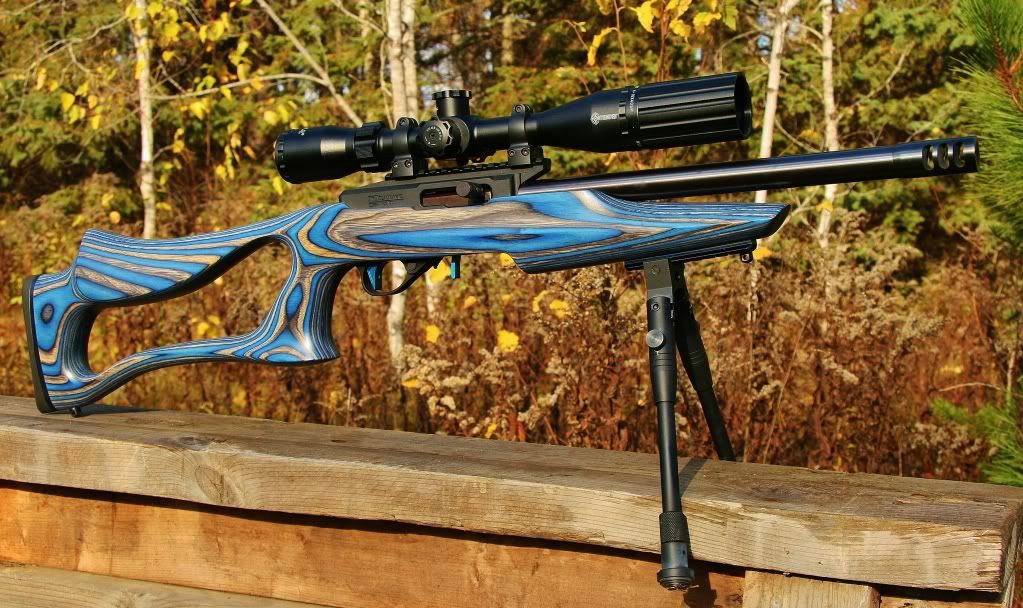
short barrel shoots flatter

savagelh

CGN Ultra frequent flyer
Super GunNutz
Rating - 100%
187   0   0
I was shooting my 10/22's lots this weekend and discovered something kind of strange. I sighted all of them in dead-on at 50 yards with the same ammo. I then moved the target to 75 yards and shot a few groups with my 20" 10/22T followed by a few groups with my 11.5" dlask. I was quite surprised to see that the 10/22T shot about 2 1/2" low at 75 and the little dlask was only 1/2" or so low. I found this quite surprising and strange. I will have to do more testing at different ranges to figure this out. I wish I would have had the chronograph with me. Just thought I would share my findings.
 
Target ammo?
I believe after about 16 inches of barrel in a .22lr the extra length starts to slow the bullet.
 
not really target ammo. Its called winchester target but its just re-branded dynapoint. I think its about 1100 fps. And I thought it was after about 18" the bullet would begin to slightly slow down.
 
the optimum is actually about 14 inches thats why iam doing a build on a 12 inch barrel it should not lose much in the velocity department
 
Even if they are both in the same size rings the machining tolerences in the different actions, bases and rings can add up, so the center axis of the bore and scope will be slightly different.
 
Considering that many centerfire barrels, even high quality match barrels, will vary 100fps with the same load, having some variance is no surprise on your .22's. I have seen different velocity tests and they show max velocity occurring at 12"-16" barrel length depending on the details.

Have a read through this thread for more info: http://www.canadiangunnutz.com/forum/showthread.php?t=573014


Mark
 
There will be variances between the two weapons, that is natural... probably contributing is also variance in the two POI's... as in the Ruger is center-low and the Dlask is center-high... but the difference is extreme... I would expect the differences to add up to under an inch of deviation... your Dlask build appears to be defying physics and gravity... the .22 load you are using, when zeroed at 50 yards with a scope height 1.5" over the bore should drop 2.3" at 75 yards (about what the Ruger is doing)... and should drop 6.9" at 100 yards... I would recheck your zero at 50 yards with both guns and then retest at 75 yards... I would expect the deviation to be significantly less than you first experienced.
 
I did recheck my zero at 50. Thats why I was so surprised. I know that tighter bore, scope hight, ROT, could all affect poi but not to this extreme. 2" at 75 yards is a pretty big velocity variance. I'm starting to think it could be just muzzle jump from the lighter barrel. I was shooting off of sand bags with both guns. The 11.5" dlask does have quite noticable muzzle jump while the 20" hb doesn't even wiggle.
 
I did recheck my zero at 50. Thats why I was so surprised. I know that tighter bore, scope hight, ROT, could all affect poi but not to this extreme. 2" at 75 yards is a pretty big velocity variance. I'm starting to think it could be just muzzle jump from the lighter barrel. I was shooting off of sand bags with both guns. The 11.5" dlask does have quite noticable muzzle jump while the 20" hb doesn't even wiggle.

Any muzzle lift occurs after the bullet has left the barrel... there might be a deviation of 1/2" to 1" or so, between the two rigs just due to specific nuances at work... but not two inches... when comparing the deviation from the original POI at an alternate range (25 yards)... that does not change the fact that the Dlask gun should still be in the neighborhood of 2.3" lower at 75 yards when zeroed at 50 yards... so something is not computing... what was your sample size? How many rounds did you fire at each range with each gun?

P.S - I have a number of SBR builds including Dlask and they all pretty much comply with physics...


030RFC-1.jpg
 
depends on your rifling too how many inchs on a full turn?

Curious about this - can you shed some light or reference on this. Many and probably most factory barrelled RF are 16 twist. Some aftermarket barrel makers offer different twists for claimed stability reasons but how does twist rate have such a dramatic affect on POI ?
 
Curious about this - can you shed some light or reference on this. Many and probably most factory barrelled RF are 16 twist. Some aftermarket barrel makers offer different twists for claimed stability reasons but how does twist rate have such a dramatic affect on POI ?

Spin can create lift... but there is more to it than just twist rate alone... bullet length, weight, BC etc... come into play. In this case, it doesn't matter, because both of his barrels are 1:16"
 
Back
Top Bottom