Shotguns with a history

Brutus

CGN Ultra frequent flyer
Rating - 100%
116   0   1
Usually a rifle or to much lesser extent in Canada, a handgun could hold some provenance. Therefore holding our interest for just a few more seconds.

Example one: I bought from a gentleman out of Utah a Parkhurst 10 gauge, hammer coachgun full and full. It needed though some TLC and Nick Makinson (God bless him) rebrowned the barrels, extended the 10 gauge chambers at my request, and put it up on face for safe three point lock up.
Funny enuf there's some phony Wells Fargo emblems on it. It has a rack # 87 engraved into its wooden butt stock. I live in The MD of Bonnyville/Cold Lake #87. Weird.
I wish I knew it's past history because with both chokes at full, it's not a cut down?

Example two: about 5 years ago I bought from Ellwood Epps from thier used selection an M37 Ithaca in 28 gauge. Made in early 2010.
Ithaca informed me by research of serial number, it was sold to RLC Shooting Supplies (now closed) in Florence Kentucky.
Somehow it got to Ontario.

Wish these guns could speak.
 
Last edited:
Usually a rifle or to much lesser extent in Canada, a handgun could hold some provenance. Therefore holding our interest for just a few more seconds.

Example one: I bought from a gentleman out of Utah a Parkhurst 10 gauge, hammer coachgun full and full. It needed though some TLC and Nick Makinson (God bless him) rebrowned the barrels, extended the 10 gauge chambers at my request, and put it up on face for safe three point lock up.
Funny enuf there's some phony Wells Fargo emblems on it. It has a rack # 87 engraved into its wooden butt stock. I live in The MD of Bonnyville/Cold Lake #87. Weird.
I wish I knew it's past history because with both chokes at full, it's not a cut down?

Example two: about 5 years ago I bought from Ellwood Epps from thier used selection an M37 Ithaca in 28 gauge. Made in early 2010.
Ithaca informed me by research of serial number, it was sold to RLC Shooting Supplies (now closed) in Florence Kentucky.
Somehow it got to Ontario.

Wish these guns could speak.

Researching provenance and past history is very rewarding when you can do so. Sometimes the makers or holders of company records can provide some details, and sometimes it might be cryptic markings on a gun case or initials on a gun that get you started. It is sometimes possible to tease out quite a lot of information, with the help of a lot of tangential information sources, like business records and directories, births-deaths-marriages-census data, and national/local newspapers. In the past, persons who could afford fine guns often ended up in the news, as socialites or sources of scandal (!), or were in professions that kept detailed records, like the military. Also on hand-made guns, it was not unusual for individual craftsmen to leave distinguishing marks, on barrels, actions or locks for example, as part of their pride in their work. As with any field, those 'in the business' hold a lot of information, and thankfully there have been social historians who have documented related professions, and written detailed histories of makers and companies.

Ultimately I hope to match a gun with the name of the original owner. Sadly it offers no additional monetary value, but it certainly makes it more interesting for me.
 
Two years ago I bought 3 vintage shotguns from a woman in Sun Valley Idaho. She and her husband had reached the age where they had decided to stop hunting. 79 and 85. They had lived in Sun Valley for almost 50 years. Sun Valley is a very small place. I’m from Winnipeg. My grandmother’s sister moved from Winnipeg to Sun Valley in the 1930s, and raised her only son there. The woman who was selling the guns knew both my relatives.

I now live along the shore of Lake Ontario about 1 hr east of Toronto. Across Lake Ontario from Rochester. The woman had grown up just outside Rochester and had inherited the guns from her family. The guns were originally sold by VL&D a prominent NYC sporting goods store and catalogue business. All three were European in origin and relatively high end guns when they were new. Yet bought by members of a family living near the heart of the American SxS gun industry.

Lost in time now but I would love to know the thinking of the original purchasers of these guns. Why not a high end LCSmith or Ithaca or Lefever? Or Remington for that matter. To my mind, it’s like a wealthy Londoner buying a high end German gun.
 
Now that's really neat canvasback. On a somewhat similar tone I own a side hammer drilling (blackpowder) built in a then Prussian state, by Suhl & Son. Probably about 1890ish era in 45-70x10 gauge. Funny thing it's got no sling swivels? Just about every German-Austrian drilling I have seen from this time frame has sling swivels. Was imported by Charles Daly.
Makes me wonder if this was ordered by a wealthy farmer/rancher, and was carried about mostly in wagon seat-box or via horse saddle scabbard perhaps? It's no featherweight at ten and three quarters lb. There's no rub marks at all to indicate long term carry outside of leather at all. Is it overly dramatic to state that shotguns more than any other firearm, reflected the settlement of North America? Maybe that's too dramatic?? Was it merely the only one to travel overseas to a frontier when space was limited?
 
Last edited:
Brutus, those kinds of questions is part of what makes vintage gun collecting interesting to me. And I know the same is true for Pinfire. I tried to glean a little more info from the woman in Sun Valley. Spoke quite a bit to her and her husband......several hours worth by phone as we were completing the deal. But she was sure that anyone in her family back home who could shed any light on things was long since deceased. I have a single barrel English game gun in near perfect condition. Not child sized. And not a trap gun. It's in near perfect condition. But I know it was not, like many American guns, bought and kept for future collectibility (LNIB). I always wonder who bought it originally and why. Clearly when the owner(s) went to pick a gun to hunt with from the gun room, this one got passed over again and again. So why buy it? A gift to a wife who found she didn't enjoy shooting?

Correction to my earlier post. Two the guns were originally sold by VL&D. The thirds was sold by SD&G. That "D" stands for Daly, as in Charles Daly, one of the partners. So your gun and several of my guns, including one from Idaho, were originally from the same retailer....Schoverling, Daly & Gales. And not far apart in time.

Speaking of that, I had two guns from Pieper, both 16 gauge and circa the 1920s and very similar in dimensions, weight etc. They both have Pieper's unique "sliding top rib" action. One just has a little more engraving than the other. They are three serial numbers apart! They were made at the same time. They could easily have been on the same worker's bench together 100 years ago, in Europe. Somehow, they both ended up together 100 years later in my safe in Ontario. I sold them both to a good hunting buddy so he can give one each to his two grandsons. I felt that was a worthy cause to give them up.
 
Thanks guys! Nice to know I am not the only one on this forum with similar questions. Vintage firearms always held my interest for more than a moment. I remember a school science textbook in elementary. Amongst many other images a S&W #1 somewhere on its hardcover. But seemingly smoothbores have captured my vision and in the last fifteen years especially.
 
Last edited:
Thanks guys! Nice to know I am not the only one on this forum with similar questions.

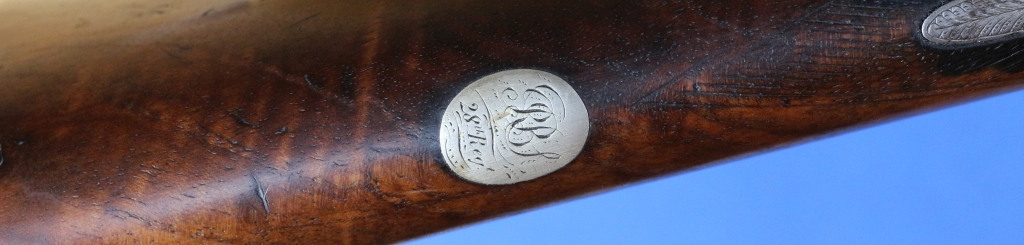
Wheedling out the history is a big part of the fun of collecting. A case in point -- this gun, a Theophilus Murcott pin-fire, was in poor condition, but it had an intriguing inscription on the silver escutcheon:
WcYHbcL.jpg


From this, I could determine the gun was owned, and perhaps first ordered, by Captain Robert Burn Singer of the 28th (The North Gloucestershire) Regiment of Foot. He became an Ensign in September 1858, purchased his first commission as Lieutenant in February 1864, and his second as Captain in October 1868, serving 19 years in the regiment, notably in India and Gibraltar. A Murcott of London pin-fire with Stanton locks would have represented a significant financial investment on a Captain's pay, about a tenth of his gross annual income.

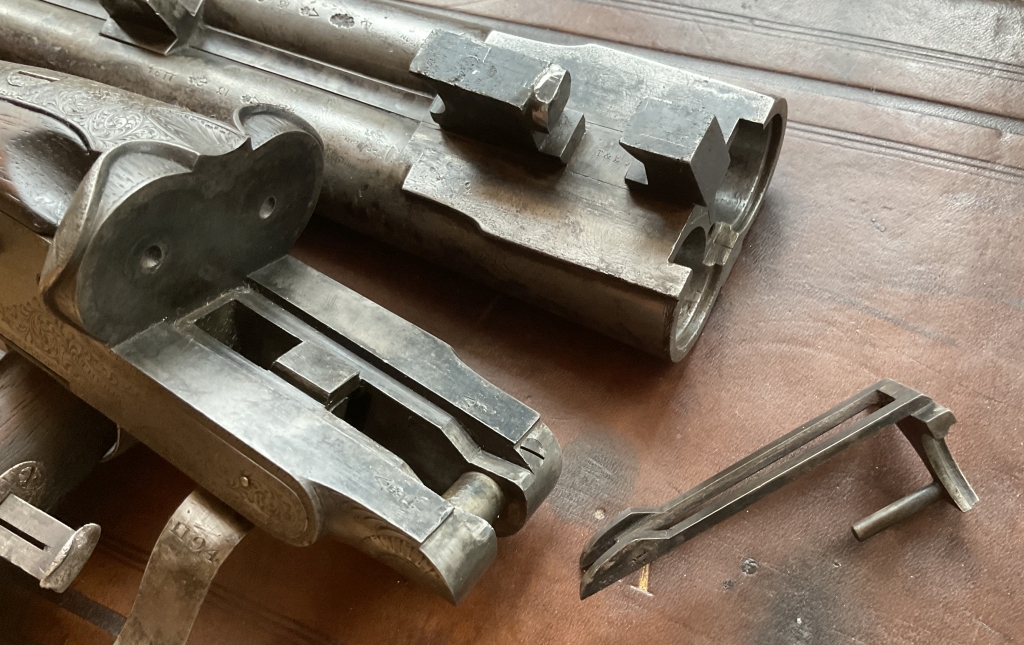
The gun also had other secrets and clues. It was a conversion to centre-fire, and an extractor was fitted. It took some digging, but I finally identified it as the design of the Birmingham gunmaker William Spinks Riley. He obtained patent No. 491 of 16 February 1866 for his extractor, a variation of the Schneider extractor that appeared on George Daw’s breech-loader.
ETZl0Yc.jpg


Finally, the initials between the barrel lugs, "T&L," suggest the conversion was done by the London firm of Tipping and Lawden (Murcott was an agent for Tipping & Lawden from around 1846 before he started his business in 1851).

A lot can be determined by a few marks, and some persistent digging.
 
This is an earlier post, made in the "Let's see some pic's of your SxS's & O/U's" thread:

When you see an old gun with a silver or gold stock escutcheon, it is worth taking a closer look to see if initials or family crests appear. It is surprising what can be learned from them. I recently came across an incorrectly ‘restored’ pinfire gun with an interesting inscription, leading me to discover Henry Walker's Horsley.

What are you to do if you are a Gentleman who is a distant sixth in line to the family title? A life in the military is a good prospect, and Papa can afford to buy a good commission. This appears to have been the case for Henry Stephen Walker, son of Sir James Walker of Sand Hutton, Ryedale District, North Yorkshire. Sir James held various posts as High Sheriff of Yorkshire, Deputy Lieutenant, and Justice of the Peace, and would later become 1st Baronet of Sand Hutton (the Baronetcy would be passed on to his first son, James). Henry would have to make his way in the world, albeit with a helping start. Choosing a regiment would have been difficult, but Henry and Sir James chose the 13th Hussars, purchasing in November 1863 the rank of Cornet. Cornet was the lowest grade of commissioned officer in a British cavalry troop, the modern equivalent being a second lieutenant.

The 13th Hussars had a glorious history. As the 13th Light Dragoons, the regiment performed well in the Peninsular War and later at the Battle of Waterloo. In the Crimean War, the regiment was part of the light brigade under the command of Major General the Earl of Cardigan, first at the Battle of Alma. Then the regiment was the first line of cavalry on the right flank during the Charge of the Light Brigade at the Battle of Balaclava. Not entirely done with that, the regiment also took part in the Battle of Inkerman and the Siege of Sevastopol. In 1861 the regiment was renamed the 13th Hussars. After the Crimean War, the regiment moved around Ireland, Scotland and England. In 1866 the regiment happened to be in York, about 5 kilometres from the Sand Hutton estate.

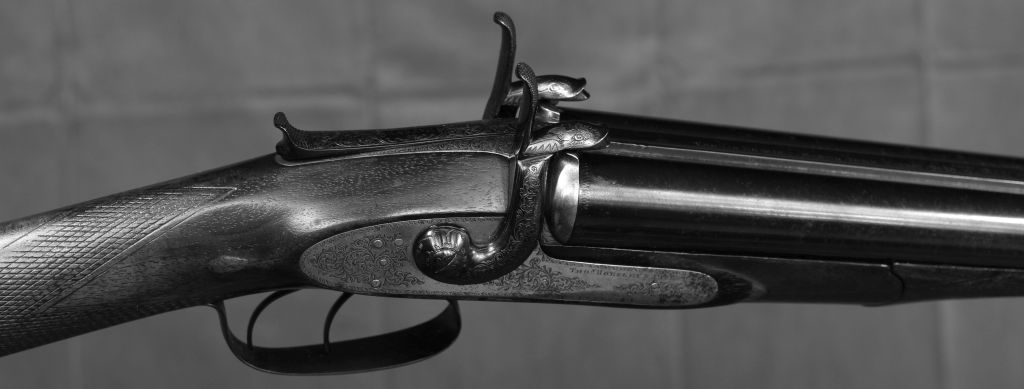
This year is important, as it was in 1866 that Henry purchased a best-quality 12-bore bar-in-wood pinfire game gun number 1507 from Thomas Horsley, 10 Coney Street, York. The gun is signed "Thomas Horsley Maker York, Patent 2410" on the top rib, the 30 1/16" damascus barrels have London proofs, and the action bar has an unnumbered "Horsley's Patent No." cartouche. The non-rebounding bar locks are marked "Thos Horsley Patent," and the pull-top-lever snap-action is Thomas Horsley's patent No. 2410 of October 1863. There is fine foliate scroll engraving throughout, a well-figured walnut stock, and the silver stock escutcheon is tellingly marked "HSW XIII Husr" in Old English script.

Whether Henry had a chance to use his new gun on Yorkshire pheasants is unknown, as the regiment was ordered to embark for Canada to defend the country from a Fenian uprising, sailing from Liverpool on three steamships on the 11th and 12th of September 1866. Two troops were posted to Montreal, and the rest went to Toronto. The 13th Hussars' time in Canada was mainly spent establishing a cavalry school to instruct Canadian Mounted Volunteers. Moving up in rank, Henry purchased his Lieutenantcy on the 12th of October, 1867.

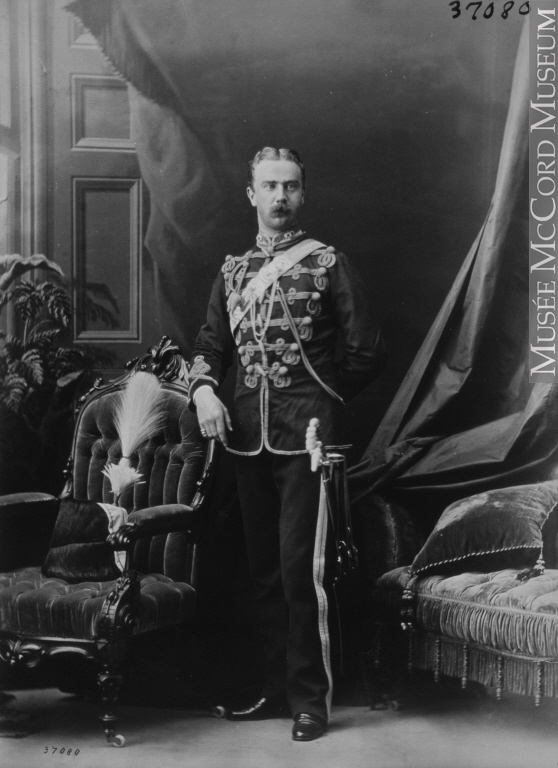
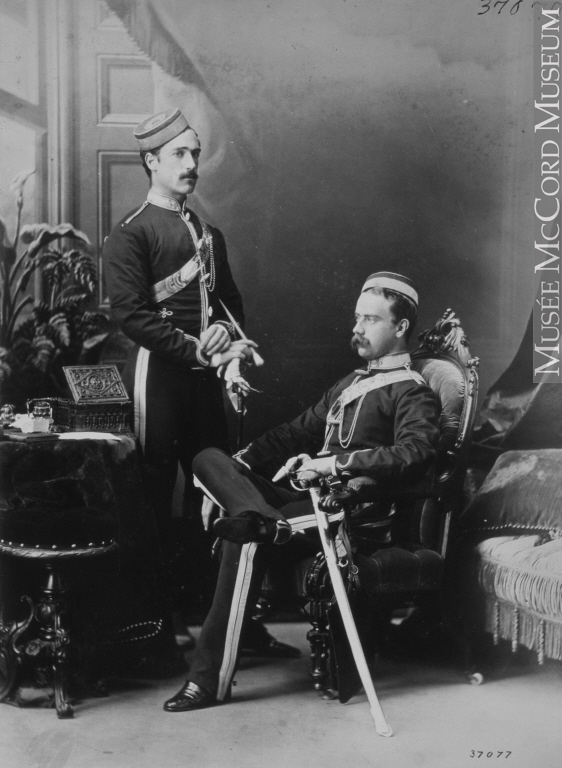
The regiment departed for England in June 1869, arriving in Liverpool on the 13th of July. However, before returning, Henry visited the studio of the famed Montreal photographer William Notman to have some portraits made, shown below. Back in England, Henry retired from the army and sold his Lieutenantcy in June 1870. He returned to Canada, settling down in the town of Cobourg along the shores of Lake Ontario, about halfway between Toronto and Kingston. He married Emma Mason in 1870 and raised two sons and a daughter. Whether Henry's prized Horsley returned to the UK and then back to Canada, or remained in Canada the whole time, is unknown.

A note on Notman. His first important commission was the documentation of the construction of Montreal's Victoria Bridge across the St. Lawrence River. The Prince of Wales attended the bridge opening in 1860. The gift to the Prince of a maple box containing his photographs of the construction of the bridge and scenes of Canada so pleased Queen Victoria that she named Notman "Photographer to the Queen."

rbtbDQ5.jpg

E9RtCjG.jpg

1vGcbJU.jpg

© McCord Museum

A8dJ2Xn.jpg

© McCord Museum

 
Back
Top Bottom