This is an earlier post, made in the "Let's see some pic's of your SxS's & O/U's" thread:
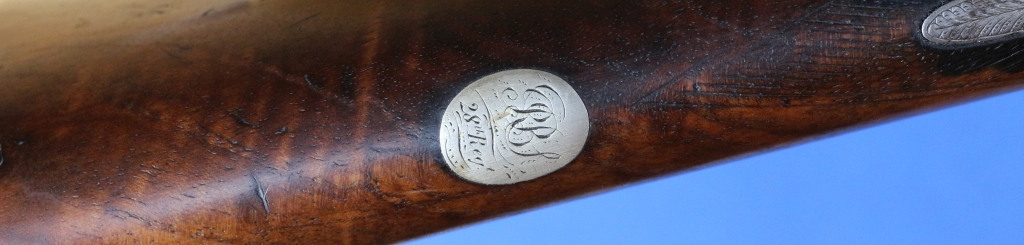
When you see an old gun with a silver or gold stock escutcheon, it is worth taking a closer look to see if initials or family crests appear. It is surprising what can be learned from them. I recently came across an incorrectly ‘restored’ pinfire gun with an interesting inscription, leading me to discover Henry Walker's Horsley.
What are you to do if you are a Gentleman who is a distant sixth in line to the family title? A life in the military is a good prospect, and Papa can afford to buy a good commission. This appears to have been the case for Henry Stephen Walker, son of Sir James Walker of Sand Hutton, Ryedale District, North Yorkshire. Sir James held various posts as High Sheriff of Yorkshire, Deputy Lieutenant, and Justice of the Peace, and would later become 1st Baronet of Sand Hutton (the Baronetcy would be passed on to his first son, James). Henry would have to make his way in the world, albeit with a helping start. Choosing a regiment would have been difficult, but Henry and Sir James chose the 13th Hussars, purchasing in November 1863 the rank of Cornet. Cornet was the lowest grade of commissioned officer in a British cavalry troop, the modern equivalent being a second lieutenant.
The 13th Hussars had a glorious history. As the 13th Light Dragoons, the regiment performed well in the Peninsular War and later at the Battle of Waterloo. In the Crimean War, the regiment was part of the light brigade under the command of Major General the Earl of Cardigan, first at the Battle of Alma. Then the regiment was the first line of cavalry on the right flank during the Charge of the Light Brigade at the Battle of Balaclava. Not entirely done with that, the regiment also took part in the Battle of Inkerman and the Siege of Sevastopol. In 1861 the regiment was renamed the 13th Hussars. After the Crimean War, the regiment moved around Ireland, Scotland and England. In 1866 the regiment happened to be in York, about 5 kilometres from the Sand Hutton estate.
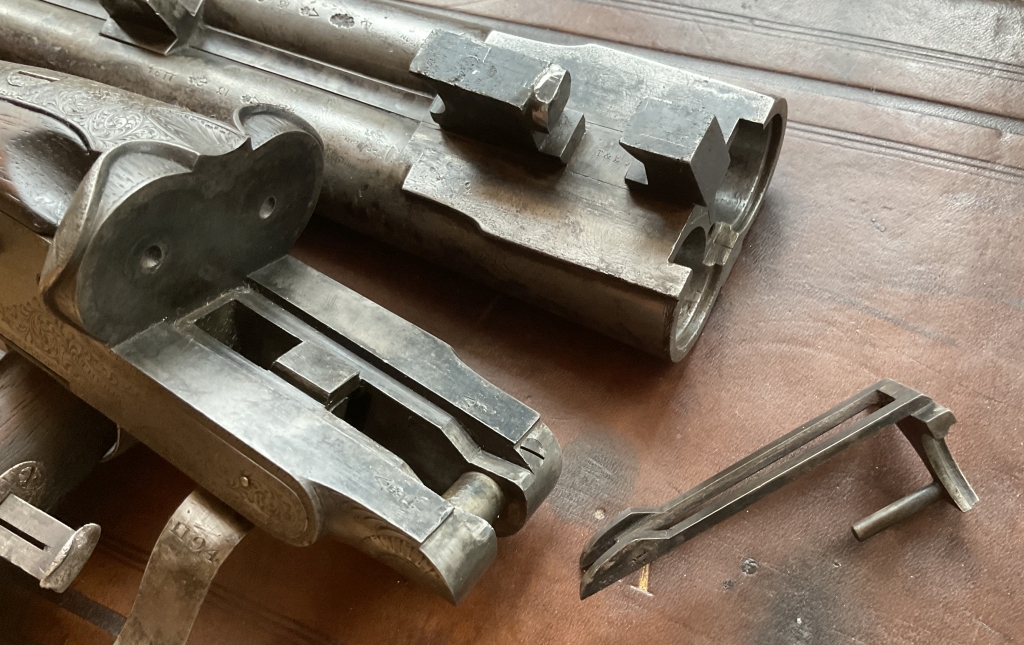
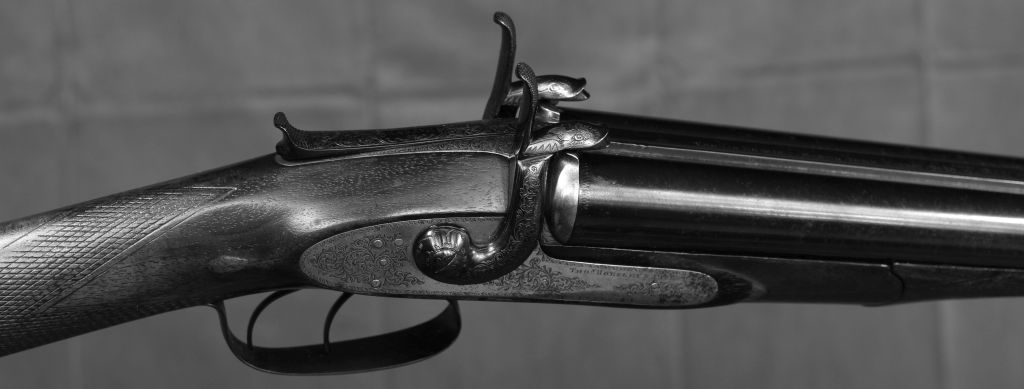
This year is important, as it was in 1866 that Henry purchased a best-quality 12-bore bar-in-wood pinfire game gun number 1507 from Thomas Horsley, 10 Coney Street, York. The gun is signed "Thomas Horsley Maker York, Patent 2410" on the top rib, the 30 1/16" damascus barrels have London proofs, and the action bar has an unnumbered "Horsley's Patent No." cartouche. The non-rebounding bar locks are marked "Thos Horsley Patent," and the pull-top-lever snap-action is Thomas Horsley's patent No. 2410 of October 1863. There is fine foliate scroll engraving throughout, a well-figured walnut stock, and the silver stock escutcheon is tellingly marked "HSW XIII Husr" in Old English script.
Whether Henry had a chance to use his new gun on Yorkshire pheasants is unknown, as the regiment was ordered to embark for Canada to defend the country from a Fenian uprising, sailing from Liverpool on three steamships on the 11th and 12th of September 1866. Two troops were posted to Montreal, and the rest went to Toronto. The 13th Hussars' time in Canada was mainly spent establishing a cavalry school to instruct Canadian Mounted Volunteers. Moving up in rank, Henry purchased his Lieutenantcy on the 12th of October, 1867.
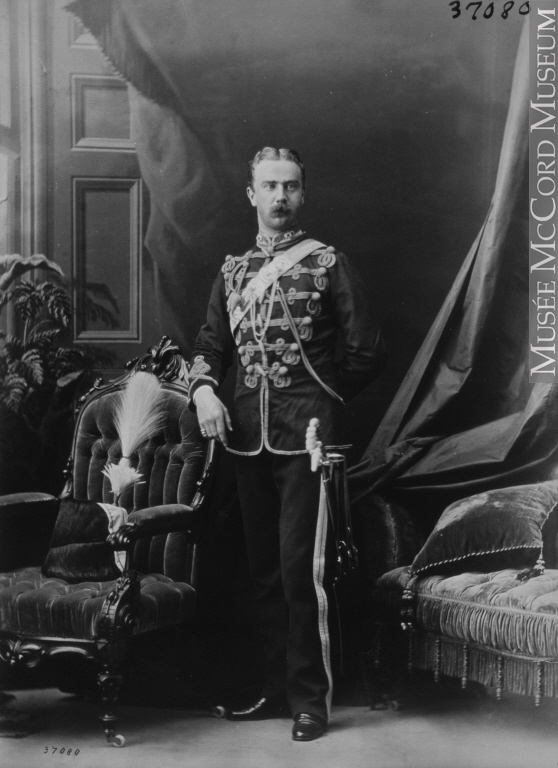
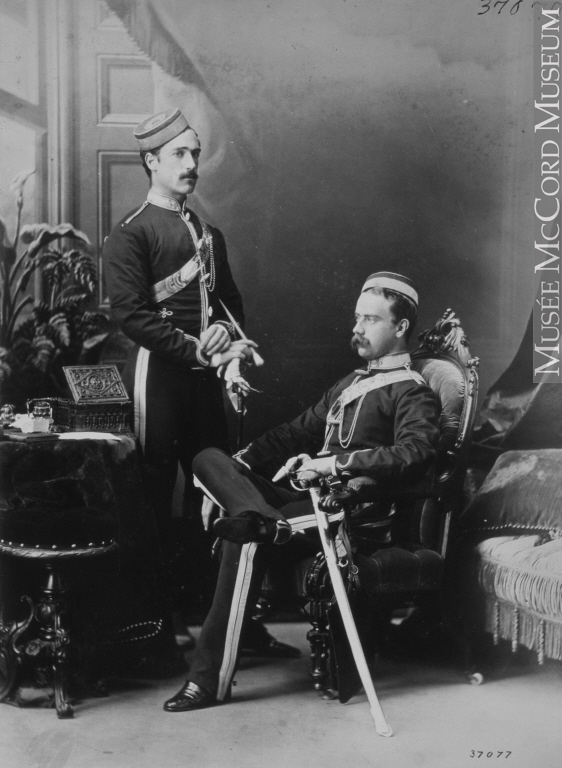
The regiment departed for England in June 1869, arriving in Liverpool on the 13th of July. However, before returning, Henry visited the studio of the famed Montreal photographer William Notman to have some portraits made, shown below. Back in England, Henry retired from the army and sold his Lieutenantcy in June 1870. He returned to Canada, settling down in the town of Cobourg along the shores of Lake Ontario, about halfway between Toronto and Kingston. He married Emma Mason in 1870 and raised two sons and a daughter. Whether Henry's prized Horsley returned to the UK and then back to Canada, or remained in Canada the whole time, is unknown.
A note on Notman. His first important commission was the documentation of the construction of Montreal's Victoria Bridge across the St. Lawrence River. The Prince of Wales attended the bridge opening in 1860. The gift to the Prince of a maple box containing his photographs of the construction of the bridge and scenes of Canada so pleased Queen Victoria that she named Notman "Photographer to the Queen."
© McCord Museum
© McCord Museum