
I wonder if we could pool some advice here for us newbies who are just learning how to sight in rifles. I currently have a Ross Mk.III, which is very confusing, but I'm learning about. I'm also about to get my hands on a Cooey 82, minus the receiver sight. How do you experts sight in your favourite rifles? Is there a standard approach to gauging where the rifle is shooting? Then is there standard methodology for fixing things if they don't hit where you're aiming? Apologies if this sounds silly, but I really find myself in the dark a bit when I go to the range. I'm also not talking about stock bedding or chamber sizing or anything else that requires machine tools. I'm talking the simple process of adjusting rear sights. One can never know if his barrel is off by a few mms if he hasn't got an idea of his sights.













































You are using an out of date browser. It may not display this or other websites correctly.
You should upgrade or use an alternative browser.
You should upgrade or use an alternative browser.
Sighting in milspec rifles
- Thread starter Kirk1701
- Start date
You can start with the rear sight set at a mechanical zero with the part moveable for windage centered on the fixed base. Set the rear sight elevation at the lowest setting or at a 100 yd setting if there is one on the elevation scale. Make sure that the front sight, if movable, is centered on the fixed barrel stud/retainer. Make sure that both sights are tight. Make sure that both guard screws are tight before shooting. Set up a target @25 yds. Use a 2ftx2ft target backer to make sure that you have enough paper to "catch" the bullet impact. Use a 2 inx2in black square in the center of your target as an aiming point. Use a 6'oclock hold on the bottom of the target square. Watch the bullet impact as you fire and adjust the rear sight so that you are hitting the 2inx2in aiming "bull". Once you have a 25 yd zero, this should generally be repeatable @100 yds.
To confirm your zero @ 100 yds again use a 2ftx2ft white or buff (cardboard) colored target backer with a 8inx8in black square stapled in the center of this. Use a 6 o'clock hold on the "aiming bull". Shoot, observe bullet impact, adjust sights so that you are 2-3 inches above the point of aim @100 yds and then fire a couple of 3 shot groups to confirm your zero. Use a solid bench rest and the same ammo for all shooting and blacken both front and rear sights (wooden kitchen match) before shooting. I find that the reverse side of a roll of wallpaper makes a cheap and effective target backer. You can use a piece of black Bristol board to make your "bulls".
To confirm your zero @ 100 yds again use a 2ftx2ft white or buff (cardboard) colored target backer with a 8inx8in black square stapled in the center of this. Use a 6 o'clock hold on the "aiming bull". Shoot, observe bullet impact, adjust sights so that you are 2-3 inches above the point of aim @100 yds and then fire a couple of 3 shot groups to confirm your zero. Use a solid bench rest and the same ammo for all shooting and blacken both front and rear sights (wooden kitchen match) before shooting. I find that the reverse side of a roll of wallpaper makes a cheap and effective target backer. You can use a piece of black Bristol board to make your "bulls".

If you can remove the bolt AND see through the barrel, look though the barrel to see if sights line up roughly with bore at 100yds or more.
You need to be able to rest the rifle securely for this.
Irons sights:
Move rear sight in direction you want impact to go.
-Or
Move front sight opposite to direction you want the inpact to go.
Use black circle targets.
Scopes:
Never trust what the click adjustments are supposed to be. See for yourself what you get.
Scopes usually adjust in direction your want impact to go. Not all have click adjustments.
Always fire three shots before making changes, and call your shots and disregard any you jerked off.
Test your scope, for both elevation and windage. They may not take the same amount.
One inch grid background targets best here.
With a new acquisition, I usually bring a roll of brown paper as the first target. cut to 2x2ft or even 3x3ft as first target.
If it misses the target then I shot at the corners until I see a bullet hole through the spotting scope and watch for dirt impact.
.
You need to be able to rest the rifle securely for this.
Irons sights:
Move rear sight in direction you want impact to go.
-Or
Move front sight opposite to direction you want the inpact to go.
Use black circle targets.
Scopes:
Never trust what the click adjustments are supposed to be. See for yourself what you get.
Scopes usually adjust in direction your want impact to go. Not all have click adjustments.
Always fire three shots before making changes, and call your shots and disregard any you jerked off.
Test your scope, for both elevation and windage. They may not take the same amount.
One inch grid background targets best here.
With a new acquisition, I usually bring a roll of brown paper as the first target. cut to 2x2ft or even 3x3ft as first target.
If it misses the target then I shot at the corners until I see a bullet hole through the spotting scope and watch for dirt impact.
.
Last edited:
Great advice guys. Looks like I have some craft projects, lol. Fortunately I work in print publishing, so I have access to free paper.
My club has steel targets from 25 to 50 yards. With my Ross, I've got the Mk.III sight adjusted to the base and centered there as well. I aim at about 6 o'clock on the 5" steel plate. I have a Caldwell Matrix shooting rest. I was ringing the plate 8 out of 10 times at 50 yards. I'd say that's pretty sighted in, right?
My club has steel targets from 25 to 50 yards. With my Ross, I've got the Mk.III sight adjusted to the base and centered there as well. I aim at about 6 o'clock on the 5" steel plate. I have a Caldwell Matrix shooting rest. I was ringing the plate 8 out of 10 times at 50 yards. I'd say that's pretty sighted in, right?
Last edited:
Not really. Least 10 of 10 at 50yds, then futher out.
Paper at 100yd is better for giving you good feedback as to what's happening.
Alright. Will adjust.
Here's the other thing; a lot of the MILSURPs do shoot extremely well, so it is fun to try to wring the best out of them on paper under range conditions @ 100 yds. Handloads will inevitably shoot better. I've been rewarded with amazingly small groups from various Lee-Enfields, Garands, M1903 Springfields, Mosins, Model 1917/P14 Enfields, Rosses, M14s and Swede Mausers.
Plagerized from Gunboards posting made by MK VII.
http://forums.gunboards.com/showthread.php?283627-Question-about-Ross-Mk-III-rear-sight
~~~~~~~~~~~~~~~~~~~~~~~~~~~~~~~~~~~~~~~~~~~~~~~~~~~~~~~~~
The following article appeared originally in a wartime number of The Rifleman(US):-
OUR military authorities occasionally issue weapons, especially to the unfortunate Home Guard, with totally inadequate, and some cases complete absence of, information as to how to use them. The Ross rifle is a case in point. Most people manage eventually to worry out the mysteries of the bolt, but generally the backsight defeats them. The Editor has asked me to ensure that readers at least of The Rifleman shall be properly informed.
There have been several variations of this sight issued in past years, but all those I have seen in this country are of the model described here.
It has two “Battle Sights”, which are cut-away apertures both fixed to the slide which also has an ordinary or closed Aperture.
The normal position of this slide is, of course, at the bottom of the Leaf, and the Leaf down.
The Battle Sight which then shows is set for 600 yards. NOT 400 yards. There is no 400 yard Battle Sight on this Ross.
If you now flip up the Leaf, the other Battle Sight shows.
This is (with the slide at the bottom as stated) set for 1,000 yards.
The idea is that, against an advancing enemy, the soldier starts shooting, with this Battle Sight up, when they are 1,000 yards away, and until they reach 600 yards away. He then flips the Leaf down and continues with the 600 yard Battle Sight aiming down (if he knows the trajectory) when they get closer. A very good idea, too—if anyone were ever told about it.
Both these Battle Sights have, as I said, cut-away Apertures. They are variously referred to by the ignorant as “Open sights,” “Modified U’s,” “Buckhorns,” and all kinds of things ; and instructors instruct recruits to “get the blade in the centre of the U and level with the shoulders.” It is pathetic! Imagine any rifle designer fitting an open sight at two inches from the eye! Not outside Bedlam.
No—use them exactly like any other aperture. Just imagine, if you like, that the bit of the ring cut away at the top is still there, and go ahead. It is cut out to let more light through in bad light, and to enable you to pick up your object quicker. But as no British soldiers or Home Guards ever practise shooting in dusk at natural targets, they would not know this. Nor would they know anything about the virtues of white sight-paint and shooting with both eyes open—things which the stalker learns in his cradle and which soldiers should be taught but never are. However, we are supposed to be talking about the Ross Sight.
As stated, there is an ordinary Aperture, at the bottom of the slide, which has the 1,000 yard Battle Sight at the top.
This Aperture is for all accurate deliberate fire. It is raised up the Leaf by a quick thread screw, and on the face of the Leaf are Range Markings in yards. This series of figures starts at zero, and then 2, 3, 4, 5, 6, 7, 8, 9, 10, 11 and 12 hundred yards. There is no 100 yards. One hundred is never used as a range marking in war, and if you want to set your sight accurately for 100 for practice (grouping) you have to find the elevation, somewhere above zero, for yourself.
On the right edge of the Leaf is a Scale. This is not another series of hundreds of yards markings. Its zero is level with the other zero. There is no other connection. It is meant to be used, for targeting the rifle, exactly like the scales on civilian .22 rifle sights, which have no ranges marked on.
This scale is marked from One to Nine. These are tenths of an inch. Each division is again divided up into four.
One-tenth of an inch, at this sight radius, gives you, near enough, ten minutes of angle. A quarter division therefore gives you a quarter of this, or 21 minutes of angle; and this is the finest adjustment shown. There are no “clicks” but you can of course set the sight to finer adjustment by judgment. The scale is probably intended chiefly to enable a man to take exact readings of the sight on this scale for the various ranges, if the rifle does not agree exactly with the range markings, as it seldom does, owing to the impossibility of standardising precisely such things as stocking and barrel flip and jump.
Behind and at the bottom of the Leaf is a triple knurled head which works the Windgauge. There is on the front of the Leaf a Windgauge Scale marked in twentieths of an inch. Each of these, of course, gives five minutes of lateral angle. They are not divided any more finely, and intermediate settings are obtained by the knurled head.
The windgauge is, of course, a very convenient means of adjustment for straight shooting. It should then be left alone. Wind allowance is not done now by windgauge in military shooting.
By the way, there is a very simple way of checking the range to which these, or any other Battle Sights are supposed to be set, as follows.
Fix the rifle firmly in a vice or the like, with the 600 yard Battle Sight and foresight lined up correctly at a mark - any mark, at any distance. It doesn’t matter.
Now raise the Leaf (without moving the rifle) and screw up the slide until the Aperture in the bottom of it comes correctly to the same aim. If you have done it right, you will find that it has come up to the 600 yards mark. That is your check.
Similarly, with the Leaf up and slide at the bottom, line up the Leaf Battle Sight with the mark. Then screw up the slide until the Aperture comes to the aim. It will be at the 1,000 yards mark.
You can check a P.14 or M.17 similarly, when with the P.14 you will find that the Battle Sight aim agrees with that of the Slide Aperture at 400 yards, as a rule. I have found a few which were set for 300 yards. The Battle Sight on the M.17 agrees with the leaf at 450 yards. This is because the Battle Sight is identical and the same height on both rifles, and thus gives a longer range, by 50 yards, to the higher velocity .300 cartridge. The leaf sights are not the same, each being correctly marked at the range elevations for its cartridge. (September, 1942.)
~~~~~~~~~~~~~~~~~~~~~~~~~~~~~~~~~~~~~~~~~~~~~~~~~~~~~~~~~~~~
Helped me quite a bit figuring how to use my M10 Ross properly.
http://forums.gunboards.com/showthread.php?283627-Question-about-Ross-Mk-III-rear-sight
~~~~~~~~~~~~~~~~~~~~~~~~~~~~~~~~~~~~~~~~~~~~~~~~~~~~~~~~~
The following article appeared originally in a wartime number of The Rifleman(US):-
OUR military authorities occasionally issue weapons, especially to the unfortunate Home Guard, with totally inadequate, and some cases complete absence of, information as to how to use them. The Ross rifle is a case in point. Most people manage eventually to worry out the mysteries of the bolt, but generally the backsight defeats them. The Editor has asked me to ensure that readers at least of The Rifleman shall be properly informed.
There have been several variations of this sight issued in past years, but all those I have seen in this country are of the model described here.
It has two “Battle Sights”, which are cut-away apertures both fixed to the slide which also has an ordinary or closed Aperture.
The normal position of this slide is, of course, at the bottom of the Leaf, and the Leaf down.
The Battle Sight which then shows is set for 600 yards. NOT 400 yards. There is no 400 yard Battle Sight on this Ross.
If you now flip up the Leaf, the other Battle Sight shows.
This is (with the slide at the bottom as stated) set for 1,000 yards.
The idea is that, against an advancing enemy, the soldier starts shooting, with this Battle Sight up, when they are 1,000 yards away, and until they reach 600 yards away. He then flips the Leaf down and continues with the 600 yard Battle Sight aiming down (if he knows the trajectory) when they get closer. A very good idea, too—if anyone were ever told about it.
Both these Battle Sights have, as I said, cut-away Apertures. They are variously referred to by the ignorant as “Open sights,” “Modified U’s,” “Buckhorns,” and all kinds of things ; and instructors instruct recruits to “get the blade in the centre of the U and level with the shoulders.” It is pathetic! Imagine any rifle designer fitting an open sight at two inches from the eye! Not outside Bedlam.
No—use them exactly like any other aperture. Just imagine, if you like, that the bit of the ring cut away at the top is still there, and go ahead. It is cut out to let more light through in bad light, and to enable you to pick up your object quicker. But as no British soldiers or Home Guards ever practise shooting in dusk at natural targets, they would not know this. Nor would they know anything about the virtues of white sight-paint and shooting with both eyes open—things which the stalker learns in his cradle and which soldiers should be taught but never are. However, we are supposed to be talking about the Ross Sight.
As stated, there is an ordinary Aperture, at the bottom of the slide, which has the 1,000 yard Battle Sight at the top.
This Aperture is for all accurate deliberate fire. It is raised up the Leaf by a quick thread screw, and on the face of the Leaf are Range Markings in yards. This series of figures starts at zero, and then 2, 3, 4, 5, 6, 7, 8, 9, 10, 11 and 12 hundred yards. There is no 100 yards. One hundred is never used as a range marking in war, and if you want to set your sight accurately for 100 for practice (grouping) you have to find the elevation, somewhere above zero, for yourself.
On the right edge of the Leaf is a Scale. This is not another series of hundreds of yards markings. Its zero is level with the other zero. There is no other connection. It is meant to be used, for targeting the rifle, exactly like the scales on civilian .22 rifle sights, which have no ranges marked on.
This scale is marked from One to Nine. These are tenths of an inch. Each division is again divided up into four.
One-tenth of an inch, at this sight radius, gives you, near enough, ten minutes of angle. A quarter division therefore gives you a quarter of this, or 21 minutes of angle; and this is the finest adjustment shown. There are no “clicks” but you can of course set the sight to finer adjustment by judgment. The scale is probably intended chiefly to enable a man to take exact readings of the sight on this scale for the various ranges, if the rifle does not agree exactly with the range markings, as it seldom does, owing to the impossibility of standardising precisely such things as stocking and barrel flip and jump.
Behind and at the bottom of the Leaf is a triple knurled head which works the Windgauge. There is on the front of the Leaf a Windgauge Scale marked in twentieths of an inch. Each of these, of course, gives five minutes of lateral angle. They are not divided any more finely, and intermediate settings are obtained by the knurled head.
The windgauge is, of course, a very convenient means of adjustment for straight shooting. It should then be left alone. Wind allowance is not done now by windgauge in military shooting.
By the way, there is a very simple way of checking the range to which these, or any other Battle Sights are supposed to be set, as follows.
Fix the rifle firmly in a vice or the like, with the 600 yard Battle Sight and foresight lined up correctly at a mark - any mark, at any distance. It doesn’t matter.
Now raise the Leaf (without moving the rifle) and screw up the slide until the Aperture in the bottom of it comes correctly to the same aim. If you have done it right, you will find that it has come up to the 600 yards mark. That is your check.
Similarly, with the Leaf up and slide at the bottom, line up the Leaf Battle Sight with the mark. Then screw up the slide until the Aperture comes to the aim. It will be at the 1,000 yards mark.
You can check a P.14 or M.17 similarly, when with the P.14 you will find that the Battle Sight aim agrees with that of the Slide Aperture at 400 yards, as a rule. I have found a few which were set for 300 yards. The Battle Sight on the M.17 agrees with the leaf at 450 yards. This is because the Battle Sight is identical and the same height on both rifles, and thus gives a longer range, by 50 yards, to the higher velocity .300 cartridge. The leaf sights are not the same, each being correctly marked at the range elevations for its cartridge. (September, 1942.)
~~~~~~~~~~~~~~~~~~~~~~~~~~~~~~~~~~~~~~~~~~~~~~~~~~~~~~~~~~~~
Helped me quite a bit figuring how to use my M10 Ross properly.
Last edited:

Military rifles generally have a rear sight graduated in 100 yard or meter increments. If you are zeroing at 100 yards (much better than 50 yards) you can't really adjust the rear sight up or down. It has to stay on 100. If it has an adjustable rear for wind. set it to the "0" position.
Most of these rifles were made so you make your zero adjustments on the front sight, so that when you are done, you just set the rear sight for the appropriate distance, and shoot.
For wind, move the front sight the opposite way you want the bullets holes to go. For elevation, change out the front for a taller or shorter sight, or screw it up or down, if that is an option.
If it is the kind of front sigh that you have to swap out, you can always file it shorter, if you ant it to shoot higher.
Most of these rifles were made so you make your zero adjustments on the front sight, so that when you are done, you just set the rear sight for the appropriate distance, and shoot.
For wind, move the front sight the opposite way you want the bullets holes to go. For elevation, change out the front for a taller or shorter sight, or screw it up or down, if that is an option.
If it is the kind of front sigh that you have to swap out, you can always file it shorter, if you ant it to shoot higher.
Any specific questions you have?
I'm just looking for the basics, which have been provided here. I appreciate it. I'll no doubt have more questions once I get more range time in.
You are going to find that some military rifles are going to shoot high at 100 yds even though the rear sight is set a the lowest level. Troops were trained to shoot center mass out to 300 yards or so with the "battle" sight or adjustable sight at lowest setting. It really didn't matter if the bullet struck 3" high on the "bad guy's" torso.
I've found M96 Swedes shoot high with issue sights. My two M38's shoot to point of aim- No problems. 3 Carcano's- 2 rifles and a carbine all shoot high. One of the nice things about shooting mid range cast out of these rifles is that the cast loads usually shoot lower than jacketed putting groups closer to POA at 100 yds. If required elevation adjustments up are required to zero- No sweat just move the rear sight higher. Lowering groups which are too high can only be done by increasing front sight height or holding lower.
I've found M96 Swedes shoot high with issue sights. My two M38's shoot to point of aim- No problems. 3 Carcano's- 2 rifles and a carbine all shoot high. One of the nice things about shooting mid range cast out of these rifles is that the cast loads usually shoot lower than jacketed putting groups closer to POA at 100 yds. If required elevation adjustments up are required to zero- No sweat just move the rear sight higher. Lowering groups which are too high can only be done by increasing front sight height or holding lower.
Last edited:
A 5" steel plate won't tell you where the rifle is hitting, just that it is. Put a black dot on a large piece of paper and shoot at 100 yards of a solid bench rest for group only. Rear sights get adjusted in the direction you want the group to go. Front sights are adjusted opposite to that. Fronts usually need a tool as well.
You can get a .pdf Ross Mk III manual here. I think it's free.
http://www.milsurps.com/content.php?r=415-1913-Ross-MkIII-Rifle-Manual
You can get a .pdf Ross Mk III manual here. I think it's free.
http://www.milsurps.com/content.php?r=415-1913-Ross-MkIII-Rifle-Manual

I wonder if we could pool some advice here for us newbies who are just learning how to sight in rifles.
Here's a few things that may help...
1913 Ross MkIII Rifle Manual (click here)http://www.milsurps.com/showthread.php?t=25904
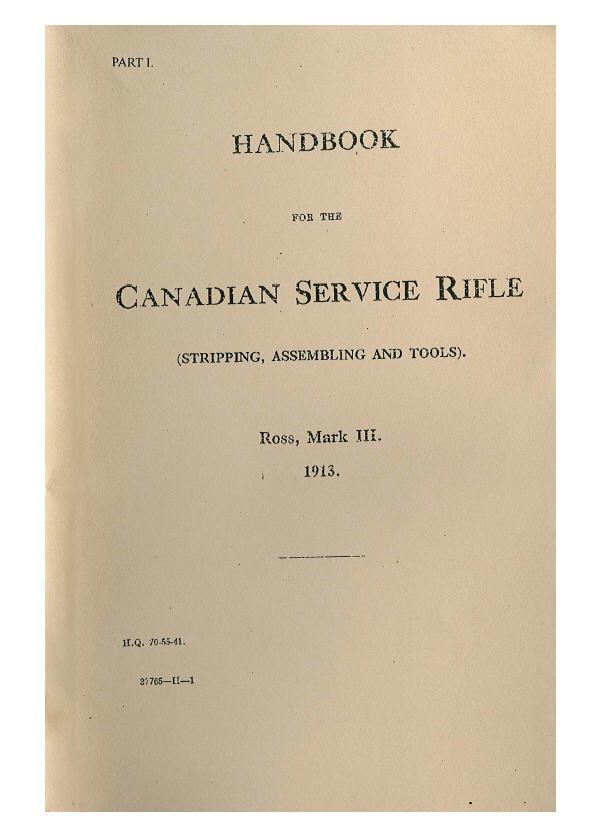
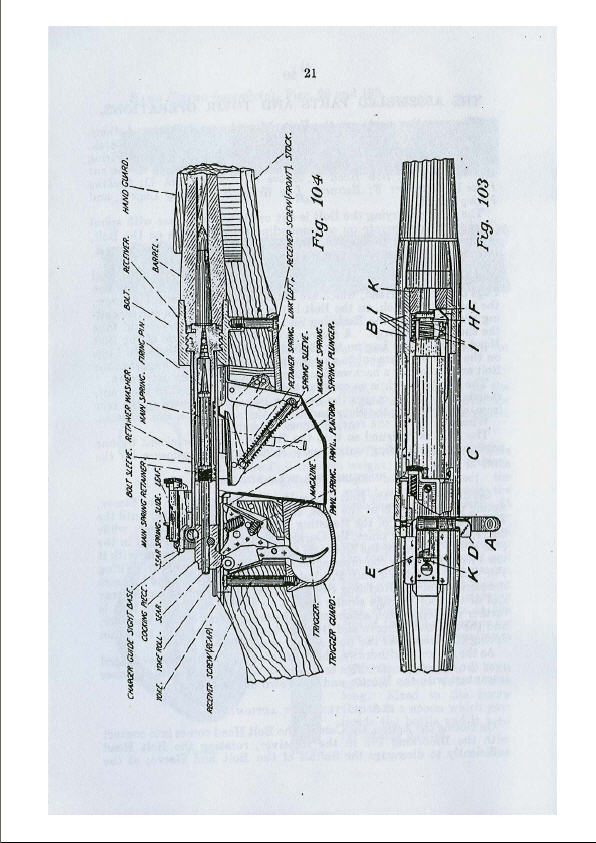
Handbook for the Canadian Service Rifle
Stripping, Assembling and Tools (Parts 1 and 2)
Format: 43 pages with diagrams
 (Click PIC to Enlarge)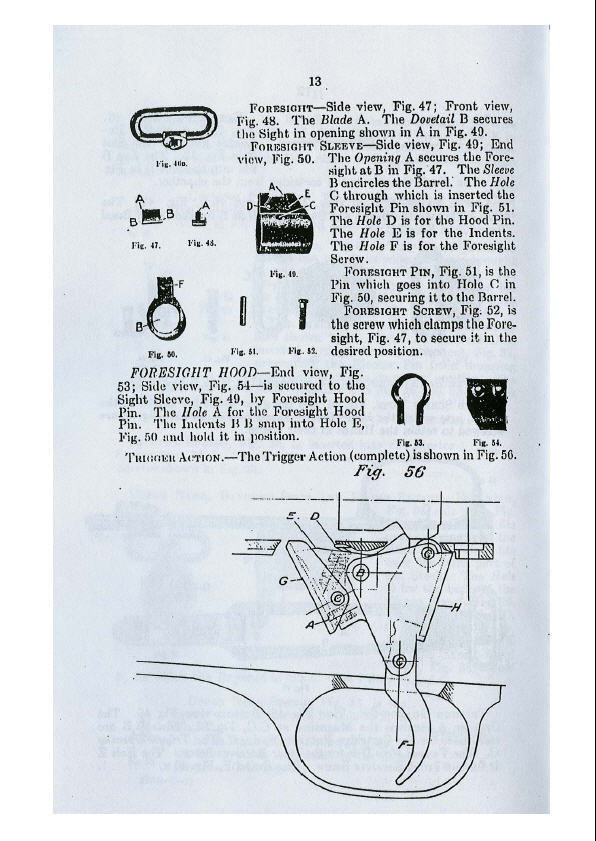
 (Click PIC to Enlarge)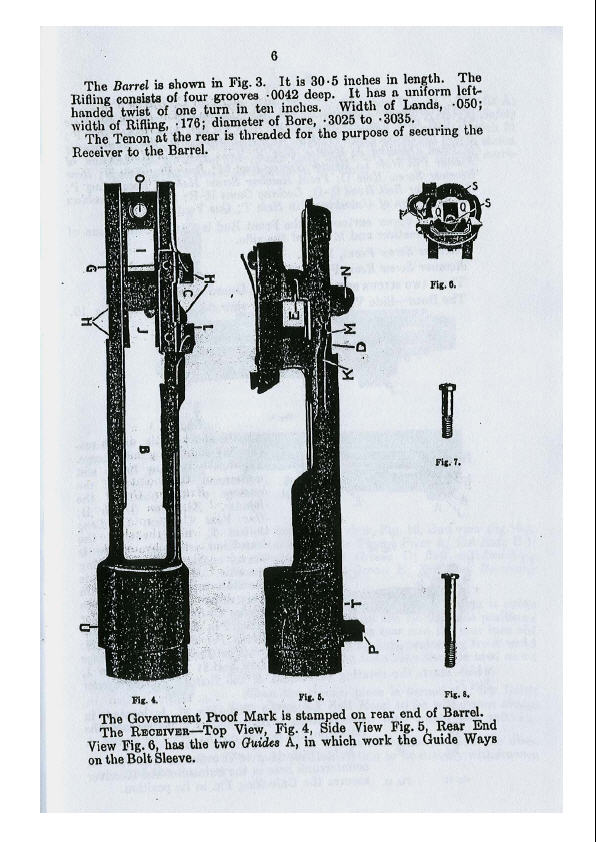
Also, some general information about sighting, zeroing and shooting…
Jay Currah's Markmanship Informationhttp://www.milsurps.com/enfield.php?pg=mi.htm
Jay Currah's Sighting Instructions For The Enfield Riflehttp://www.milsurps.com/enfield.php?pg=ti15.htm
Jay Currah's Calculating Correct Front Sight Height for Zerohttp://www.milsurps.com/enfield.php?pg=ti12.htm
Enfield Sight Basicshttp://www.milsurps.com/enfield.php?pg=ti14.htm
Finally…
Presenting the Johnson Method of Musketry Coaching As Adopted By the Canadian Army, Ottawa, Chief of the General Staff.
"Shoot-to-Live" - 1945 (click here)
This is an excellent Canadian Government issued training manual. If you are specifically a collector and shooter of Lee Enfield rifles, you'll find this to be an outstanding reference work and it contains a wealth of information on how to properly shoot the No.4 Mk1 Enfield, although much of the content is applicable to any bolt action rifle. I remember being issued this manual as part of our regimental rifle team, when I was a little younger back in the early 60's.
Hope this helps...
Regards,
Doug






















