













































You are using an out of date browser. It may not display this or other websites correctly.
You should upgrade or use an alternative browser.
You should upgrade or use an alternative browser.
Slings - please explain
- Thread starter UncleWalther
- Start date

1 Point : One big loop connected the rifle
w w w.atstacticalgear.com/istarimages/p/t/pt-TROY-009!135.jpg
2 Points : Classical type, connected two points on the rifle, usually front and rear
w w w.bulldogequipmentinc.com/store/catalog/thumbs/t_133.jpg
3 Points : Starts with the 2 points but with an added loop in the middle for you to fit in !
w w w.blackhawk.com/images/catalog/BHT_M16AR15.jpg
w w w.atstacticalgear.com/istarimages/p/t/pt-TROY-009!135.jpg
2 Points : Classical type, connected two points on the rifle, usually front and rear
w w w.bulldogequipmentinc.com/store/catalog/thumbs/t_133.jpg
3 Points : Starts with the 2 points but with an added loop in the middle for you to fit in !
w w w.blackhawk.com/images/catalog/BHT_M16AR15.jpg

It's the number of points the sling is connected to the weapon.
Say, the Canadian Forces Patrol Sling is a 2-point sling, being connected to the lower receiver and to the front sling swivel, although when you release the front snap it effectively becomes a one-point sling.
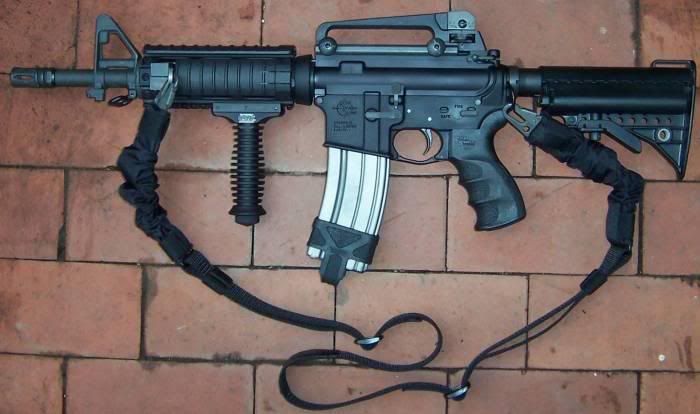
A sling like the "bungee" sling, the tac vest attachment or a creative looping of the old sling are single-point, which means that the sling is only connected at one place, generally where the receiver meets the stock
Say, the Canadian Forces Patrol Sling is a 2-point sling, being connected to the lower receiver and to the front sling swivel, although when you release the front snap it effectively becomes a one-point sling.
A sling like the "bungee" sling, the tac vest attachment or a creative looping of the old sling are single-point, which means that the sling is only connected at one place, generally where the receiver meets the stock

PaveHammer
CGN frequent flyer
- Location
- Kingston, ON
Deuce,
To clarify, the CF patrol sling is a three pointer. If you released one end of a two point sling, your rifle would just hit the ground. It's like cutting one end of a purse strap.
Blueforcegear has all three slings individually, as well as their SOC-C sling that does all three. Oneshottactical sells them, as well as Daves, I believe.
The three sling designs all have their own pros and cons, and no one sling does the other two's job very well - as a civilian shooter at a range, all that really matters is cool and comfort factor, it's not like you'll have to hump a rifle for 10k and hate your one point for banging into your knees, or kick in doors and wish your three point would stop getting hung up on your gear, or really just wish there was a better way to hold your rifle at the low ready while you did all sorts of things.
Uncle, since slings are like $50, get all three, sell the two you don't like. I know you've got the cash for it. I suggest that you start with the VCAS sling, a two-pointer, as it's generally regarded as the top of the coolguy pyramid right now. Two pointers are very versatile, in that they can be sinched up tight for freedom of movement, transitioned behind you for ladders and other obstacles, and are easy to ditch should the need arise. There's lots of reading material over at lightfighter.net if you care to look for it.
I know, I just compared AR's and slings to purses. Get over it. At least you'll never forget now.
To clarify, the CF patrol sling is a three pointer. If you released one end of a two point sling, your rifle would just hit the ground. It's like cutting one end of a purse strap.
Blueforcegear has all three slings individually, as well as their SOC-C sling that does all three. Oneshottactical sells them, as well as Daves, I believe.
The three sling designs all have their own pros and cons, and no one sling does the other two's job very well - as a civilian shooter at a range, all that really matters is cool and comfort factor, it's not like you'll have to hump a rifle for 10k and hate your one point for banging into your knees, or kick in doors and wish your three point would stop getting hung up on your gear, or really just wish there was a better way to hold your rifle at the low ready while you did all sorts of things.
Uncle, since slings are like $50, get all three, sell the two you don't like. I know you've got the cash for it. I suggest that you start with the VCAS sling, a two-pointer, as it's generally regarded as the top of the coolguy pyramid right now. Two pointers are very versatile, in that they can be sinched up tight for freedom of movement, transitioned behind you for ladders and other obstacles, and are easy to ditch should the need arise. There's lots of reading material over at lightfighter.net if you care to look for it.
I know, I just compared AR's and slings to purses. Get over it. At least you'll never forget now.

A single point sling is exactly that. One attachment point to your firearm. In most cases there is some form of sling plate, sling swivel stud or stud located on the firearm. In most cases it is toward the rear of the firearms point of balance and if you release the firearm it will drop muzzle down. Works best with short barrel firearms. Its extremely simple to use, however, the drawback is that if not secured with a limb, it will tend to flop all over the place when running/walking/engaging other targets with back-up/secondary firearms.
A two point sling is the more traditional type that most hunters are familiar with. In "tactical" terms, the sling attachment points do not necessarily have to be along the bottom of the firearm, but may also be found on the sides and/or top of the weapon. Again, its a relatively simply design, but with two attachment points, the firearm doesn't tend to flop around as much as with the single point and this type is more suitable to longer barrel firearms.
The three point "tactical" sling is a much more complex affair, involving a strap system that attaches to the firearm at two points, just as with the two point sling, however, an additional strap system is then attached along the length of this two point system via some sort of slider, D-ring or metal/plastic clasp. Through this attachment point, another strap/sling arrangement is run around the shooter's torso and either right/left shoulder, across the back in a diagonal fashion and back up and through the D-Ring/Slider.
Usually there are an arrangement of fastex buckles and sliders that allow each shooter to lengthen or shorten the sling to fit them individually. Some designs employ some form of quick attachment using fastex buckles or similar devices the permit the shooter to quickly detach the firearm from the sling system that is worn on the body in case the firearm needs to be abandoned during combat, loaned to another shooter, or you're simply making a head call and don't want to screw around trying to get out of all the straps, etc...This kind of set-up permits multiple carry angles, both in front and behind the shooter, muzzle up, down or level and comes in handy for guys on guard duty, etc...as the firearm can be kept at low-ready 100% of the time and it gives you some place to rest your hands. Of the three designs, it probably offers the most secure carry style for your firearm if you have to move on the run as many designs allow you to essentially lock your firearm into one position. This comes in handy when going over obstacles, climbing ladders, etc...
While still popular with some combat troops, a lot of the "high-speed, low-drag" kinda' guys are returning to the more "simple" styles of sling, such as the "Vickers Sling" manufactured by Blue Force Gear & designed by former Delta "operator" Larry Vickers. Vickers and his supports see the 3 point system as being too complex and too easy to become entangled during the confusion of combat. For us range "tacticool operators" it mostly comes down to a decision between what you like best or what feels most comfortable for you.
A two point sling is the more traditional type that most hunters are familiar with. In "tactical" terms, the sling attachment points do not necessarily have to be along the bottom of the firearm, but may also be found on the sides and/or top of the weapon. Again, its a relatively simply design, but with two attachment points, the firearm doesn't tend to flop around as much as with the single point and this type is more suitable to longer barrel firearms.
The three point "tactical" sling is a much more complex affair, involving a strap system that attaches to the firearm at two points, just as with the two point sling, however, an additional strap system is then attached along the length of this two point system via some sort of slider, D-ring or metal/plastic clasp. Through this attachment point, another strap/sling arrangement is run around the shooter's torso and either right/left shoulder, across the back in a diagonal fashion and back up and through the D-Ring/Slider.
Usually there are an arrangement of fastex buckles and sliders that allow each shooter to lengthen or shorten the sling to fit them individually. Some designs employ some form of quick attachment using fastex buckles or similar devices the permit the shooter to quickly detach the firearm from the sling system that is worn on the body in case the firearm needs to be abandoned during combat, loaned to another shooter, or you're simply making a head call and don't want to screw around trying to get out of all the straps, etc...This kind of set-up permits multiple carry angles, both in front and behind the shooter, muzzle up, down or level and comes in handy for guys on guard duty, etc...as the firearm can be kept at low-ready 100% of the time and it gives you some place to rest your hands.
Of the three designs, it probably offers the most secure carry style for your firearm if you have to move on the run as many designs allow you to essentially lock your firearm into one position. This comes in handy when going over obstacles, climbing ladders, etc...While still popular with some combat troops, a lot of the "high-speed, low-drag" kinda' guys are returning to the more "simple" styles of sling, such as the "Vickers Sling" manufactured by Blue Force Gear & designed by former Delta "operator" Larry Vickers. Vickers and his supports see the 3 point system as being too complex and too easy to become entangled during the confusion of combat. For us range "tacticool operators" it mostly comes down to a decision between what you like best or what feels most comfortable for you.




- Location
- Southern ON.
I just got my HK sling yesterday and had a hell of a time trying to figure out how it worked. Glad someone actually asked. Thanks for the info.
Last edited:

Eli Wallach in the good the bad and the ugly is the godfather of slings. He kept his revolver in his pocket and the butt was strung around his neck with a piece of leather string lol...
Too funny. I just watched that the other night. Tuco is the man...
"If your going to shoot....Shoot....Don't talk"
"If your going to shoot....Shoot....Don't talk"
LOL words to live by























