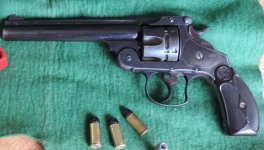
Slow smokeless loads in .44 russian

Not to cause any alarm but when you say the entire gun fits in the sink your not submerseing the whole gun in water to clean it are you ?
S&Ws have alot of small parts inside the action and ejector and even fresh water should be kept outa the action/working parts.
This is why i dont like BP the thought of running my guns under water when there made of steel just goes against the grain.
even just the barrel you end up with water in the ejector hinge area. Its not bad if you get the gun 100% dry but water gets into places you wouldnt think it would.
+ i used to use BP and in a brand new gun its not as bad if you dry it good, but in a 130 year old gun the bores have some minor pitting some you cant see and the salts get in there and keep working the pitting makeing it worse.
I washed and scrubed out a bore on a really nice wilkinson revolver after a BP shoot took it out a few months later and the pitting had gotten worse.
So light smokeless loads are really better for the antique guns and very safe if you know what you are doing way better clean up to.
 
No, I wasn't submerging it! I just meant it as opposed to claening my long guns which is a pain since they're so long - the revolver fits inside the sink and all the black water falls into the sink, not on the counter, also no need to use a funnel and pitcher of water as I can put it under the faucet.

After I cleaned it I took the side plate off and heated the whole metal up with my wife's hair dryer to help get rid of the moisture, then sprayed G96 in the hinge mechanism after it had a chance to dry.

My gun also has pitting in the bore, I hadn't thought of the salts getting stuck in pits. Thanks for that. I'll definitely work more on the smokeless loads!

B
 
Pitted barrels are the pits with any powder. I had a lightly pitted Webley that would rust after shooting reloads with Unique. Had to scrub it with a bronze brush to get it clean, and it would rust under the oil later. BP fouling is pretty inert stuff by comparison. With a lightly pitted bore, simply saturate a swab with Bore Butter or similar, and work it into the bore. It stays in, and the fouling does not accumulate in the pits. About two or three times a year I clean the bore more thoroughly to remove the Bore Butter, and replace it with fresh stuff.

So many people are afraid of using BP in their guns due mostly to bullsh!t they read on the internet. I have had people refuse to buy guns from me once they learned that I had shot them with BP because "that stuff eats barrels". I see antiques on the EE "pitted from black powder use" when the pitting was most likely from corrosive primers and early smokeless loads.

I have a Uberti 1873 revolver, .45 Colt, that has only fired about 40 smokeless loads, and literally thousands of full strength BP loads. Cleaning has never been a problem, and it does not have to be soused in water to clean it. Any of the BP cleaning solvents work great, and clean up is far easier than a modern rifle with copper fouling, or a Mosin Nagant or SKS with corrosive priming residue, which really is a SALT. Every so often I strip the revolver down, clean, and oil the internal parts. They are sometimes a bit dirty, but never rusty even in the damp West coast climate.

Same with my original '73 Winchester, Trapdoor, Rolling Blocks, Sniders, Colts, Webleys, 71/84 Mauser, Martini-Henry's, etc. All of which are fed only BP, and never have any issues. When I first started out, I had read a bunch of hooey in modern books and magazines, and was so paranoid I took the barrel out of my Snider every time I used it, and cleaned it with "hot, soapy water" like the "experts" said to. 16 years of shooting antiques later, I know much better. I was doing more harm than good with all the taking apart and putting back together, than any BP fouling ever did! Now, I clean the old Snider or whatever at the range, which takes no more than five minutes.

One must use caution with old guns and smokeless powders. Also avoid magnum primers, as they wash out the first few inches of your bore. Another tip from the "experts" which cost me the bore in a perfectly good rolling block. I no longer use magnum primers in any BP cartridges. Many older barrels were malleable iron, not steel, and they don't stand up to the heat. The early steels are not much better. Many old guns were ruined in the early 1900's by loading smokeless, and even today a few get blown up every year.
 
Hey Gyppo, how did you make out with your loads of 4.4 and 4.6 grains of universal? Just another question for the experts. I know that .44 russian is the .44 special shortend, but can you use .44 special reloading dies on .44 russian, or am i missing something
 
Pitted barrels are the pits with any powder. I had a lightly pitted Webley that would rust after shooting reloads with Unique. Had to scrub it with a bronze brush to get it clean, and it would rust under the oil later. BP fouling is pretty inert stuff by comparison. With a lightly pitted bore, simply saturate a swab with Bore Butter or similar, and work it into the bore. It stays in, and the fouling does not accumulate in the pits. About two or three times a year I clean the bore more thoroughly to remove the Bore Butter, and replace it with fresh stuff.

So many people are afraid of using BP in their guns due mostly to bullsh!t they read on the internet. I have had people refuse to buy guns from me once they learned that I had shot them with BP because "that stuff eats barrels". I see antiques on the EE "pitted from black powder use" when the pitting was most likely from corrosive primers and early smokeless loads.

I have a Uberti 1873 revolver, .45 Colt, that has only fired about 40 smokeless loads, and literally thousands of full strength BP loads. Cleaning has never been a problem, and it does not have to be soused in water to clean it. Any of the BP cleaning solvents work great, and clean up is far easier than a modern rifle with copper fouling, or a Mosin Nagant or SKS with corrosive priming residue, which really is a SALT. Every so often I strip the revolver down, clean, and oil the internal parts. They are sometimes a bit dirty, but never rusty even in the damp West coast climate.

Same with my original '73 Winchester, Trapdoor, Rolling Blocks, Sniders, Colts, Webleys, 71/84 Mauser, Martini-Henry's, etc. All of which are fed only BP, and never have any issues. When I first started out, I had read a bunch of hooey in modern books and magazines, and was so paranoid I took the barrel out of my Snider every time I used it, and cleaned it with "hot, soapy water" like the "experts" said to. 16 years of shooting antiques later, I know much better. I was doing more harm than good with all the taking apart and putting back together, than any BP fouling ever did! Now, I clean the old Snider or whatever at the range, which takes no more than five minutes.

One must use caution with old guns and smokeless powders. Also avoid magnum primers, as they wash out the first few inches of your bore. Another tip from the "experts" which cost me the bore in a perfectly good rolling block. I no longer use magnum primers in any BP cartridges. Many older barrels were malleable iron, not steel, and they don't stand up to the heat. The early steels are not much better. Many old guns were ruined in the early 1900's by loading smokeless, and even today a few get blown up every year.

Good point there bushman - not a lot of people understand how much of a difference there has been in the last century with metallurgy. It's funny to think that a primer can cause so many issues, but it's none the less a factor.
 
4.5gr of Unique is good for any bullet from 180gr to 250gr bullets and it shoots well with no stretch at the latch.
You have to be careful not to attempt to exceed 750fps or you can shoot the gun loose over time. This is why S&W abandoned the top break design in the end

If your interested in 5744, win 38-55 did an in depth review of it in 44R a few years back, he found it to be an excellent BP replacement but I found it was 4x the cost of unique due to the large volume and powder cost.
 
Hey Gyppo, how did you make out with your loads of 4.4 and 4.6 grains of universal? Just another question for the experts. I know that .44 russian is the .44 special shortend, but can you use .44 special reloading dies on .44 russian, or am i missing something

actually 44spl is a longer 44Russian.
44R-44spl-44mag virtually the same case lengthened for more powder capacity.
yes the dies will work, except for crimping, and they "may" reach for that. dies vary.
 
My pet load for my original 44 Russian was 12.5 grains of 5744 under a 256 grain Keith cast bullet which gave 770 fps and an E.S. of 36 fps. 12 grains under the same bullet gave me 733 fps and an E.S. of 34 fps. If I recall correctly, the original load was 23 grains of BP. I could only fit 22 grains in and then only if I set the bullet out a bit. That gave me 780 fps with an E.S. of 20 fps.
 
actually 44spl is a longer 44Russian.
44R-44spl-44mag virtually the same case lengthened for more powder capacity.
yes the dies will work, except for crimping, and they "may" reach for that. dies vary.

My appologies, thats what I was meaning about the case length, but I guess I didn't get it spit out right, lol
 
If you use cut down 44 mag cases you may need to thin the inside of the case neck as 44 mag cases are supper thick walled that far down.
Buy some 44 Russian cases and use a 4.5 or 5 gr unique load thats a safe load in the S&W DAs a 200 or 220 to 240 gr LEAD bullet sized .430 is best.
I tryed the 44 mag case thing years ago the exta thick case walls caused the cases to buldge out when the bullet is seated and they would not chamber in the gun.
Theres a few CGN traders that sell 44 Russian brass. or track the wolf in the USA has it and ships to Canada.

Unless things have changed since I tried ordering rifle brass from TOTW, they will not ship it. The only kind of brass ammunition casing not subject to ITAR is brass shotshell:

ITAR part 121.1 Category III paragraph f subsection 1.

These rules control and limit export from the U.S. They have NOTHING to do with Canadian import or firearms laws, there's no exception if the item is for an antique, even if the more generous U.S. definition of "antique" is used.

I would love to be proven wrong on this and that your order of brass is indeed shipped.
 
Unless things have changed since I tried ordering rifle brass from TOTW, they will not ship it. The only kind of brass ammunition casing not subject to ITAR is brass shotshell:

ITAR part 121.1 Category III paragraph f subsection 1.

These rules control and limit export from the U.S. They have NOTHING to do with Canadian import or firearms laws, there's no exception if the item is for an antique, even if the more generous U.S. definition of "antique" is used.

I would love to be proven wrong on this and that your order of brass is indeed shipped.

Also my understanding - the allusions to something different in the first couple of pages were never clarified. If it were any different then prices for many early chamberings would (I imagine) be substantially lower then we see.
 
Thanks Dingus, I've ordered some proper .44 russian brass. cutting .44 mag cases sucks anyway, I thought of doing it because I have a lot. The loaded cases do slide right into the chamber of my ranch hand so I though tit would work.

Do you know what velocities I should be looking for with 4.5 and 5 grains of Unique?

DEZ, what about your load with Blue Dot? starting velocity? Can this load safely be brought up to black powder velocities in an antique gun?

Jethunter - I've looked at the Hodgdon data but I assumed it's for reproductions. Some of the 240 grain loads are pushing 375 foot-pounds! These seem way too hot for an antique revolver. Would the starting loads be ok to use in antiques? the starting load with HP-38 pushes 240 grains at 750fps, which is right about an original load. 8900CUP.

Still no one for loads with 5744, 2400 or 4759?

Thanks for the replies.

B
Hello Gyppo, did you ever settle on a load for 44 Russian using 5744 Powder? I have searched everywhere and cannot seem to come up with a starting load. Kirk D has worked up a load and settled on 12.5 grains of 5744 ( 246 Grain lead) with a very simlar pressure and velocity to the original. Its definetly a hotter load and I was thinking to go 10/15% less to start........and go from there. Thoughts. ? thanks. mark3kb
 
In charcoal burning pistols of a medium power, 4.5 grains of unique has always satisfied my needs.
Had Bullseye 'train wreck' a Steyr-Hahn.
Not saying it wasn't human error, but once bitten.
Never used Universal, paying attention though
 
I've been shooting HP38 out of mine with both the 200 and 240 gr. lead bullets. A kind gentleman on this site has cast me a bunch of 200 gr moly coated. My Lee reload data suggests 4.2-5 gr. for the 200 gr. and 4.0-4.8 gr. for the 240 gr. I load 4.6 gr. for the 200 gr. as a plinking load but my 240 gr. are hollow point and I load those to 4.8 gr. since those are intended for serious deployment.
 

Attachments

  • Finished product.JPG
    Finished product.JPG
    109.1 KB · Views: 9
Hello Gyppo, did you ever settle on a load for 44 Russian using 5744 Powder? I have searched everywhere and cannot seem to come up with a starting load. Kirk D has worked up a load and settled on 12.5 grains of 5744 ( 246 Grain lead) with a very simlar pressure and velocity to the original. Its definetly a hotter load and I was thinking to go 10/15% less to start........and go from there. Thoughts. ? thanks. mark3kb
I never ended up using 5744. I ended up making some loads with trail boss which I didn't like so much (low velocities but seemed like high pressures) and Unique, which I liked. I never shot targets with them but they don't seem like the pressures are as high.
 
Had Bullseye 'train wreck' a Steyr-Hahn.
Can you clarify this? Steyr-Hahan is a smokeless gun, and always has been designed for smokeless

Anyways for 44 Russian I find 3.4-3.8 grains of Bullseye on a 240 gr bullet seated to 1.330" or a 3.6-3.8 grains with 200 gr bullet seated to 1.250" gives between 600 at lower charges and 675 fps at higher charges
 
I do recall, many years ago in a thread regarding this topic, that the consensus was that the smokeless powder pressure curve is steeper, with peak pressure occurring early in the pressure curve vs a gentle rise and reduction of peak pressure as with burning black powder.

It was thought that this ( relatively speaking ) steep pressure curve and not the peak pressure itself, that was responsible for causing play in the S&W action's lock-up.
For those of you using smokeless loads......have you found any increased play in the barrel hinge or latch?

I have, after firing modest smokeless loads of various powders. It is slight, but it's there, perceptible. So now, it's BP only in my gun.
 
Back
Top Bottom