Smokeless Loads for Martini-Henry .450/577 and Snider-Enfield .577 Calibers!?

The current issue of "Handloader" magazine has an article by Terry Wieland on the .577 Snider. Very timely for our discussion. I recommend it to anyone who has a Snider he intends to shoot. His three bander is a Mk II, lacking the locking thumb latch.

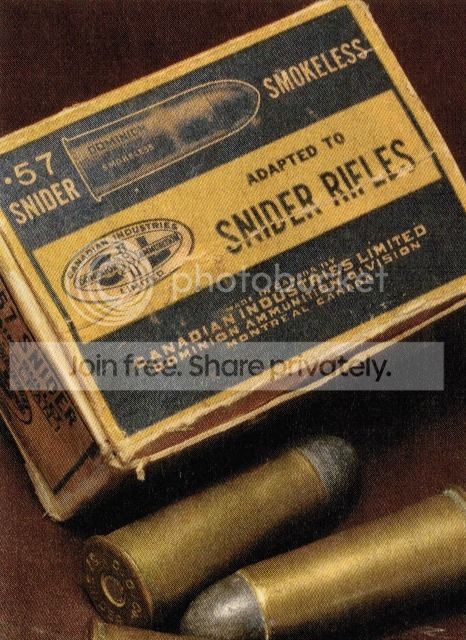
The article mentions a round offered by Dominion that chambered in both the American .58 Berdan and the .577 Snider. They labelled it ".57 Snider". I have two such cartridges in my collection, one a shotshell and the other a ball round. I now know why the odd head stamp, which before I thought was some sort of error.

The case length of the drawn brass Kynoch ball cartridge I have measures 2", 1/16th " longer than the three foil/paper wrapped rounds I have. These have no head stamp. That of the drawn brass Dominion .57 measure 1-9/16". I also have a short brass/paper cartridge that might be a blank round with no head stamp.

Almost makes me wish I still had my Mk III three band Snider .....

Wieland even lists a duplex loading using 5.0 grs of SR4759 with 70 grs of BP. I'd be a little leery of that myself in a Snider. There is a picture of a package of Dominion .57 rounds and it is marked "Smokeless".
 
CIL%20577%20Snider%20Smokeless_zpskyjckhag.jpg
 
'A clever man knows when to start - but a wise man knows when to stop.'

Ammunition made in the 1930s for use in guns seventy-five years old is a long way from using the same loads today in a gun that it now almost a hundred and fifty years old.

I'll be sticking to reasonable loads of real BP when I get around to shooting my couple of Sniders...

YMMV.

tac
 
NABS,

I've read this thread VERY closely.

Here's my thoughts for what they are worth.

I shoot smokeless in black powder rifles A LOT. I've put hundreds and hundreds of stiff 43 Mauser smokless loads down range in my good old 71/84 mauser. Just test fired a ratty Remington rolling block chambered in 43 Spanish the other day with a decent amount of fast pistol powder in the case.

That being said I would NEVER personally shoot smokeless in my snider. The reason for me is the fact that the barrel is iron, and the breach is held closed by nothing more then the hammer and a small ball detent on the back of the breach block.

Sniders were built at the very beginning of breach loading technology and therefore to me I'm not comfortable with pushing the envelope on what it will or won't shoot safely.

OK I'LL CLIMB OFF MY SOAPBOX!!

Now that being said my brother has newer snider with an steel barrel and newer style locking breach block. I may shoot smokeless from that one......... maybe.

Nabs, to answer your question if I was going to load smokeless in a snider I'd use IMR SR4759 at say 38% max of the black powder load. That would duplicate pressures of black powder bang on.
 
Just wanted to chime in on using Trail Boss in antiques. I know it can be used, but as has been mentioned, it produces a fairly high pressure spike due to being quite fast burning. So charges need to be quite low to stay within the pressure limits of the gun.
Since there are powders that more closely follow the pressure curve of BP, (2400etc) why use powders with a higher pressure curve. Its a bit like using 4f in guns designed for 2f. It can be done, but there are much better options that give a better safety margin. I love Trail Boss, and use quite a bit, but like any powder, you need to understand it's properties.
Incidentally, Vihtavoury Tin Star has much the same bulky properties of Trail Boss, but quite a bit slower burn rate, closer to that of Unique. So likely a lower pressure curve (although I haven't seen any tests to verify this). It may well give a better margin of safety in BP handguns than Trail Boss.
 
Found this:

.577-.450 Smokeless Load Data

From Handloader Magazine (Nov-Dec 1978) by Jim Jukes on this subject, and it gives the following data (I apologize for the formatting, but I lost the war with the rudimentary editor used here):


Powder Charge Bullet Weight Velocity Remarks

IMR-4759 27 400 1,172 Mild load
Blue Dot 27 400 1,422 Good load - Max
Unique 16 400 1,124 Light recoil
Green Dot 16 400 1,094 Nice-shooting
Red Dot 16 400 1,136 Nice-shooting
Herco 20 400 1,272 Efficient load
IMR-3031 45 400 1,424 Powder left in bore - wadding essential
Blue Dot 19 475 1,075 Nice load. Accurate
Blue Dot 22 475 1,220 Very uniform, with wadding
Blue Dot 25 475 1,374 Powerful, but OK pressure and very uniform velocity
IMR-4759 23 475 990 Very accurate, mild
IMR-4759 25 475 1,109 Very accurate, mild
2400 20 475 1,132 Wadding a great help
IMR-4756 20 475 1,082 Very accurate load
Herco 20 475 1,213 Good Ignition
IMR-4227 30 475 1,144 Wadding a must
IMR-3031 45 500 1,582 Plenty of recoil. Some powder kernels in bore
IMR-4064 50 500 1,529 Unreliable ignition. Wide velocity spreads
Reloder 7 37 500 1,416 Unreliable Ignition
IMR-4759 27 500 1,170 Good-shooting load
 
Last edited:
I'd use that data with caution. There is a lot more knowledge now than before. The use of wads (particularly in BN cases) is now very much discouraged by the cognoscenti.

45 grs of 3031 and 50 grs of 4064 under 500 gr bullets? Right ..... better YOUR rifle than mine!
 
I'd use that data with caution. There is a lot more knowledge now than before. The use of wads (particularly in BN cases) is now very much discouraged by the cognoscenti.

45 grs of 3031 and 50 grs of 4064 under 500 gr bullets? Right ..... better YOUR rifle than mine!

Tell us all why those two loads are unsafe, and then I'll tell you why you're wrong.
 
Shazzam! Thank you Andy. I appreciate those loads. I am looking forward to seeing about helping my friend load BP FG and FFG into his Snider, 72 grains with a 480 grain wadcutter hollow base bullet, and if I can find it with him, 25-27 grains of IMR 4759. Not easy to find up here in the far north of B.C.! Being a propellant, not an explosive, can you privately order and have mailed to you smokeless powder, providing you have a PAL ( I know it is not required but possibly evidence of responsible use knowledge?)?
 
Better yet, YOU shoot them in your iron barrel MkI of MkII Snider and get back to us!

That's about what I expected. It's clear that "Cognoscenti" means "the people who do my thinking for me".

Here's why those loads are safe.

1. There are multiple 45-70 smokeless loads published for the Springfield Trapdoor that are limited to about 25K CUP or lower;
2. The Martini Henry action is widely accepted to be stronger than the Springfield Trapdoor; and
3. The .577-450 has a capacity of about 120.0 grs of water (very close to the 45-120 Sharps) and the 45-70 has a capacity of about 75.0 grs - a huge difference. Their bore sizes are essentially the same, with a few thousands of an inch of each other.

We know that for the same bore size, the cartridge with the greater case capacity will produce lower pressures with the same powder load.

Hodgdon publishes smokeless loads for both Springfield Trapdoor in 45-70, and for the 45-120 Sharps as follows:

45-70 Trapdoor - 485 gr Bullet

IMR3031 - 42.0 grs, 1488 fps, 22.6K CUP
IMR4064 - 41.0 grs, 1372 fps, 21.3K CUP

45-120 Sharps - 500 gr Bullet

IMR3031 - 48.0 grs, 1533 fps, 18.6K CUP
IMR4064 - 53.0 grs, 1567 fps, 19.5K CUP

So, looking at:

IMR-3031 45 500 1,582 Plenty of recoil. Some powder kernels in bore
IMR-4064 50 500 1,529 Unreliable ignition. Wide velocity spreads

Those numbers make sense. The "some powder kernels in bore" and "Unreliable ignition. Wide velocity spreads" are the hallmarks of a pressure too low for those powders, i.e. in the 20 K CUP range.

All that said, my preferred loads would be for powders faster than IMR3031 and IMR4064, i.e. SR4759 and 2400 for the heavier bullets, and Unique and Red Dot for the lighter bullets. I'm not a fan of wadding, and none of those powders rely on it.

When I share loads and make suggestions, I don't just pull numbers out of my a$$, or simply pass on what others say - anyone can do that. I scour the internet for opinions, weight them against my experience and knowledge, and actually try the loads out.

Hope that helps.
 
Last edited:
That's about what I expected. It's clear that "Cognoscenti" means "the people who do my thinking for me".

Here's why those loads are safe.

1. There are multiple 45-70 smokeless loads published for the Springfield Trapdoor that are limited to about 25K CUP or lower;
2. The Martini Henry action is widely accepted to be stronger than the Springfield Trapdoor; and
3. The .577-450 has a capacity of about 120.0 grs of water (very close to the 45-120 Sharps) and the 45-70 has a capacity of about 75.0 grs - a huge difference. Their bore sizes are essentially the same, with a few thousands of an inch of each other.

We know that for the same bore size, the cartridge with the greater case capacity will produce lower pressures with the same powder load.

Hodgdon publishes smokeless loads for both Springfield Trapdoor in 45-70, and for the 45-120 Sharps as follows:

45-70 Trapdoor - 485 gr Bullet

IMR3031 - 42.0 grs, 1488 fps, 22.6K CUP
IMR4064 - 41.0 grs, 1372 fps, 21.3K CUP

45-120 Sharps - 500 gr Bullet

IMR3031 - 48.0 grs, 1533 fps, 18.6K CUP
IMR4064 - 53.0 grs, 1567 fps, 19.5K CUP

So, looking at:

IMR-3031 45 500 1,582 Plenty of recoil. Some powder kernels in bore
IMR-4064 50 500 1,529 Unreliable ignition. Wide velocity spreads

Those numbers make sense. The "some powder kernels in bore" and "Unreliable ignition. Wide velocity spreads" are the hallmarks of a pressure too low for those powders, i.e. in the 20 K CUP range.

All that said, my preferred loads would be for powders faster than IMR3031 and IMR4064, i.e. SR4759 and 2400 for the heavier bullets, and Unique and Red Dot for the lighter bullets. I'm not a fan of wadding, and none of those powders rely on it.

Hope that helps.


very good work :D

I wonder how any guns come apart due to detonation due to too low of a charge ?
 
Shazzam! Thank you Andy. I appreciate those loads. I am looking forward to seeing about helping my friend load BP FG and FFG into his Snider, 72 grains with a 480 grain wadcutter hollow base bullet, and if I can find it with him, 25-27 grains of IMR 4759. Not easy to find up here in the far north of B.C.! Being a propellant, not an explosive, can you privately order and have mailed to you smokeless powder, providing you have a PAL ( I know it is not required but possibly evidence of responsible use knowledge?)?

I have bought much smokeless powder by Mail Order. You need a PAL, and the powder cannot be shipped by Canada Post, but can for example be shipped by Canpar. As for SR4759, I stocked up last year as it is my "go to" cast bullet powder", but it's not irreplaceable. Alliant 2400 and AA5744 are decent substitutes and there are others.
 
Last edited:
Suck back and reload ....

My mind was thinking 577 Snider, a clue being my mention of Mk I and Mk II iron barrelled rifles.
 
Suck back and reload ....

My mind was thinking 577 Snider, a clue being my mention of Mk I and Mk II iron barrelled rifles.

Fair enough. My brain farts on occasion.

Those .577-450 loads would be at a significantly lower pressure in the 577 Snider, to the point where the IMR3031 and IMR4064 would not even ignite. The slowest smokeless powder I've ever had success with in the 577 Snider was SR4759, and I found Unique and Red Dot, much better, although MV's were quite low - ~1100 fps with a 480 gr bullet. As I've stated previously in other threads, the combination of large cartridge capacity, large bore and relatively weak action gives the Snider-Enfield few smokeless powder combinations that work well, but some do work, with the 320 gr 0.600" Round Ball over 18.0 grs of Unique being my favourite.

The Martini-Henry in .577-450 is a much better candidate for smokeless, as are the Swiss Vetterli in "41 Swiss" and Swedish Rolling Block in 12.7X44R, both of which I have shot extensively.
 
Last edited:
Many years ago, I used to correspond with the late Major (rtd.) Don Holmes of the DCRA Black Powder Committee.

He shocked me by telling me that they had acquired from some source a quantity of original .577 Snider ammo that they were going to shoot off in competition! I told him that was burning up historical artifacts and it ought to be preserved and/or used on special occasions.

He responded by telling me that the members of the DCRA were marksmen, not historians. OK, but that also drove up the price of any other existing .577 ammo.

BTW - I believe that the inception date of the BCRA pre-dates that of the DCRA.
 
That's about what I expected. It's clear that "Cognoscenti" means "the people who do my thinking for me".

Here's why those loads are safe.

1. There are multiple 45-70 smokeless loads published for the Springfield Trapdoor that are limited to about 25K CUP or lower;
2. The Martini Henry action is widely accepted to be stronger than the Springfield Trapdoor; and
3. The .577-450 has a capacity of about 120.0 grs of water (very close to the 45-120 Sharps) and the 45-70 has a capacity of about 75.0 grs - a huge difference. Their bore sizes are essentially the same, with a few thousands of an inch of each other.

We know that for the same bore size, the cartridge with the greater case capacity will produce lower pressures with the same powder load.

Hodgdon publishes smokeless loads for both Springfield Trapdoor in 45-70, and for the 45-120 Sharps as follows:

45-70 Trapdoor - 485 gr Bullet

IMR3031 - 42.0 grs, 1488 fps, 22.6K CUP
IMR4064 - 41.0 grs, 1372 fps, 21.3K CUP

45-120 Sharps - 500 gr Bullet

IMR3031 - 48.0 grs, 1533 fps, 18.6K CUP
IMR4064 - 53.0 grs, 1567 fps, 19.5K CUP

So, looking at:

IMR-3031 45 500 1,582 Plenty of recoil. Some powder kernels in bore
IMR-4064 50 500 1,529 Unreliable ignition. Wide velocity spreads

Those numbers make sense. The "some powder kernels in bore" and "Unreliable ignition. Wide velocity spreads" are the hallmarks of a pressure too low for those powders, i.e. in the 20 K CUP range.

All that said, my preferred loads would be for powders faster than IMR3031 and IMR4064, i.e. SR4759 and 2400 for the heavier bullets, and Unique and Red Dot for the lighter bullets. I'm not a fan of wadding, and none of those powders rely on it.

When I share loads and make suggestions, I don't just pull numbers out of my a$$, or simply pass on what others say - anyone can do that. I scour the internet for opinions, weight them against my experience and knowledge, and actually try the loads out.

Hope that helps.
The 577/450 was designed for 85 gr BP (RFG2). A 120 gr equivalent is a 40% overload.
 
The 577/450 was designed for 85 gr BP (RFG2). A 120 gr equivalent is a 40% overload.
Are we talking grains by volume or weight in the case of black powder here?

Here's what I said:

3. The .577-450 has a capacity of about 120.0 grs of water (very close to the 45-120 Sharps) and the 45-70 has a capacity of about 75.0 grs - a huge difference. Their bore sizes are essentially the same, with a few thousands of an inch of each other.
 
Back
Top Bottom