Can you show us some better photos of the markings? My comments below are based on your descriptions of the carious markings, but can be confirmed (or otherwise) by seeing clear images of the marks.
Despite having been "sporterized", it appears that your Snider is in pretty nice shape, and its markings do reveal some nice Canadian military history.
The "double triangle" surrounding the "DC" is what is generally referred to as a "DC in Diamond" mark .... which was, indeed, the first property mark for military firearms adopted by the Dominion of Canada.
Although I can't quite make it out, I think that the initials on the tang, rather than "CT", are probably "GT" .... which was the marking to be placed on rifles issued to the "Grand Trunk Railway Brigade", which was a fairly large unit made up primarily of employees of the Railway, with Battalions at various points along its route. The rest of Canada's "Active Militia" (which, at that time that, is all we had ... no "full-time" army at all until a small - i.e. a total strength of 750 men - "Permanent Militia" was authorized some years later) was organized into "Independent Companies", or somewhat larger "Battalions", of Rifles and Infantry (plus Troops of Cavalry and some Artillery units).
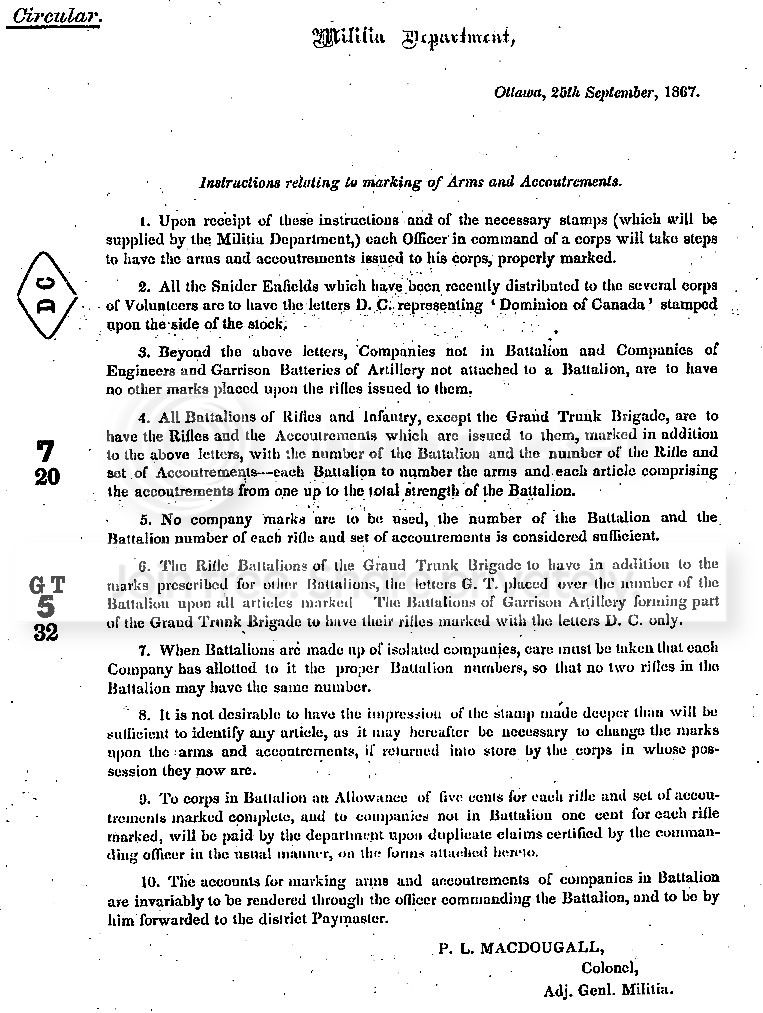
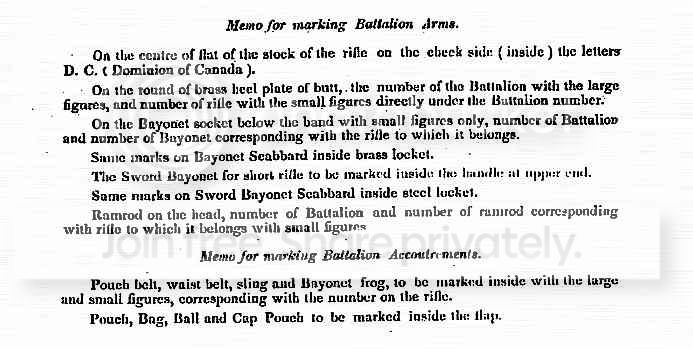
The markings would denote that the rifle was originally issued to the 5th Battalion of the Grand Trunk Brigade and, together with its bayonet and other associated accoutrements, was marked "stand of arms" number 153 within that Battalion.
Here, for further clarification, is the 1867 Militia Department circular outlining how military arms were to be marked -
Supplementary memos -
The London Armoury logo on the buttstock indicates that the rifle was made by that Company under government contract, rather than at the Royal Manufactory Enfield (i.e. government factory) and the "1" below it signifies that the rifle was graded as a "First Class" arm.
The lock-plate markings: Crown over V.R. is the royal cipher of Queen Victoria ("Victoria Regina") confirming that this was a government-contract rifle: "L.A. Co." - London Armoury Co made the lock, in 1863. (Note: most Snider rifles started out as muzzle-loading Pattern 1853 Enfield rifles, with conversion to breech-loading, using the Snider breech system, beginning in late 1866.) The 1863 date indicates that the rifle was originally made as a Pattern 1853 Rifle Musket, albeit fairly late production. (Most Mark III - i.e. "third version" - Snider-Enfields have lock-plate dates of 1866 or later, since they were made from scratch, because the supply of P'53 rifles suitable for conversion had been exhausted, an armoury fire having destroyed tens of thousands of them awaiting conversion.)
The arrow symbol you describe does sound like the British broad arrow, signifying acceptance and ownership by the War Department.
The "A inside C" symbol you describe is not a Canadian Broad Arrow (which was not adopted until about 1908, if I recall correctly) but rather, is most likely a mark of the London Small Arms Company, if it looks like this:
Note: after its contract to produce Enfield rifles for the British government ended, coupled with the end of the American Civil War (for both sides of which it, and other commercial gunmakers in Britain, had made and sold tens of thousands of Enfield Pattern rifles), the original London Armoury Company failed financially, but was re-organized as the London Small Arms Company, which got a contract to convert Enfield muzzle-loaders to Snider-Enfield breech-loaders .... hence this mark on the receiver.
The II** means that this is a Mark II** Snider conversion (essentially meaning: "second version, modified, modified").
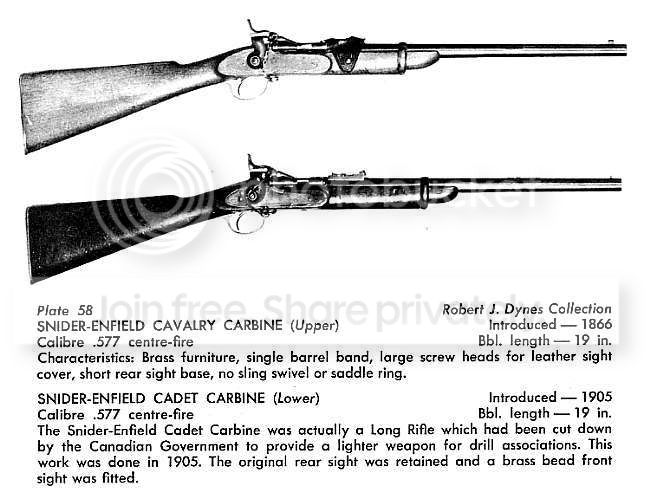
Your Snider would originally have looked like this one, which was issued to the 43rd (Ottawa and Carleton) Battalion of Infantry -