So I want to start reloading; but where do you start?

23/4there

Regular
EE Expired
Rating - 0%
0   0   0
Location
Victoria, BC
I want to start reloading for .45 ACP. But where do you start? There is so much nice stuff in the wholesale sports cataloge, but what do I need?

Lots of books out there on reloading, but which one to get?

What is a good brand of equipment?

What type of powder to use?

etc etc etc

I also what to do shotgun shells and maybe later on .223.

So point me in the right direction. What the hell should I do?


Thnaks ahead of time!
 
I started with the Lee anaversery kit, the one with the manule. other than that, all you need are dies and components.
i bought a set of Lee 45acp dies.
another good manule is the hornady one.
the press that comes with the anaversery kit is a single stage so it is a little slower to load that a $400 progresive, but once you get the hang of loading its not to bad at all.

as for components, im using winchester or federal primers, win 231 powder, and some 230grain lead round nose bullets that i bought from armco. (he is out of stock at the moment)

if you can find some one to show you their setup and show you how to set up your gear and stuff that makes it alot easyer.

I see your in duncan. if you go to gone fishing in Nanaimo there is aparently a guy there who knows a bit about loading pistol cartriges. they also sell a few diferent kinds of powder (its expencive from them, but if you just want 1lb or so to try its better than paying for the shipping one 1lb)
they also should have the hornady manule, and they stock most primers.
i think they also have some other stuff there for loading as well, but my sugestion is that you look at the Lee anaversery kit ( i know i spelled that wrong)

Joe
 
I'm a big fan or RCBS stuff, so I would also recommend the Rock Chucker Kit. The only drawback is that many guys use progressive presses when they load pistol rounds as it is faster. However, a single stage press like the Rock Chucker is probably better for new reloaders as you perform each step separately. I think single stage press is the way to go for rifle, and would be OK for pistol although it will take a little longer than it would with a progressive press. I think you'll need a different set up once you start reloading shotgun shells.

A good manual is always a good place to start as they will show you step by step how to reload cartridges. The Lyman manual is a good one to start with, plus you should probably pick up a second one so that you can cross reference the data.
 
I also would say RCBS. I have a Special press and bought it in a starter kit. The only part of it that sucks is the case trimmer. The key part for a pistol shooter I think is carbide dies are a must. When you buy a starter kit it will usually come with a speer manual or other major manf. Read the manual from stem to stern and have at her. It certainly would help if you had some one to ask quick questions of. What ever you do don't start reloading anything unless you have a dedicated safe!!!!!!, quiet area to do it in-----Cowboy
 
Not going to argue with those recommending the Rock Chucker. RCBS makes good stuff. Had I gone single stage that is what I was going to get. Single stage is great for rifle rounds but not so great for high volume pistol ammo. If you are going to load very few, then by all means go SS. However, if you see IPSC competition in your future you might want to go for a progressive.

Try a decide how likely you are to reload in bulk then look at how much you are going to spend. Dillon has a great rep but is expensive. Hornady is about the same level. Lee is the bargain brand but has a cheap entry price. I'm sure you will get lots of advice on which brand to buy but the bottom line is they all do the job.

I wouldn't be afraid of a progressive for a first press. Some counsel against it due to the complexity of them when a reloader is just starting out. I went progressive for my first press and just sent one through at a time until I had it all going on and then went full out. I didn't want to have to upgrade within a very short period so I thought this the best route. Good luck in your reloading. Just be careful, like all things firearms related, it can be addictive!

PS Cowboy has it right. The best place to start is get a good manual and start learning about the process itself first.....
 
RCBS PRO 2000 best of all worlds. Interchangeable toolheads, manual indexing, can handle from small pistol to large rifle.
this idea that single stage is the place for new people to start is ridiculous. If a person can walk and breathe at the same time they can reload on progressives.
If you want to spend a little more you can go for a Dillon (and get the same features as the RCBS), or get a Hornady Lock N Load.
my money is on the Pro 2000.
come over the mainland and I can show you the single stage, the manual indexing Pro 2000, and a full blown 1050 with bullet feeder. you can try each and see what you want to do from there.
 
I too am a big fan of RCBS. I use a Rock Chucker for rifle ammo and then put a Piggy Back on top of it for pistol rounds.....
 
23/4there said:
I want to start reloading for .45 ACP.
[...]Lots of books out there on reloading, but which one to get?
[...]
What is a good brand of equipment?
[...]
What type of powder to use?
[...]I also what to do shotgun shells and maybe later on .223.

in order:
- I like the combination of the Lyman guide and the Sierra. Both have good 'how-to' sections, but they cover slightly different areas - Lyman includes a lot of info on lead bullets (cast). Also check out this website: http://www.reload-nrma.com/

- There aren't really any 'bad' brands, so "good" depends on what you're doing, and this includes volume and quality intend - will you plink 100 rounds/year, will you do ISSF bullseye, or will you be running 200 rounds/week through your gun for IDPA? Ditto on the .223 - some presses that would be fine for your pistol stuff are marginal (albeit useable) on rifle rounds.

- for pistol, a great, low-cost, accurate, reasonably-clean easy-metering powder that will work on .38's, 9mm, and 45 equally well is Titegroup. For .223, I'm liking Reloader15 for general purpose and target work, but will be using either 335 or BL-C2 for volume stuff (they're cheaper and meter better in progressives). Varget is also good.

- as far as I know, shotshells are so cheap it isn't worth reloading. Same applies to .223... except if you're really careful about sourcing you can shave almost 50% off the new price - buy volume .223 takes time as well (trimming, mostly).

Enjoy. It's a great way to extend the hobby and make cheaper, more accurate, purspose-built ammo.

 
Reloading Suggestions

Do you shoot at the Cowichan Fish and Game range? If so, there is a semi-pro reloader there named Doug who is very helpful. You can PM me for his contact details if you like.

As for me, I load about 100 rounds a week (total) of various calibres (9mm,
.38Sp/.357, .44Mag, .45ACP, .308 Winchester) and have found that the Lee Challenger Press is fine for everything. I actually started out with the Lee Hand Press and find I still use it for lots of stuff, very convenient. Buying the Anniversary Kit with accessories is a good deal. Look at Higginson's in Ontario for good service and reasonable prices:

w w w.higginsonpowders.com (remove spaces)

email: higginsonpowders at on.aibn.com (use @).
 
Hi, Buy yourself a starter kit, single stage to start. The reason I say "single stage" is you should understand what each stage/step involves and what can go wrong. This way you will not likely produce ammo that will not work and have no idea why. I love reloading, and still use a single stage RCBS press after 25 years, and get excellent results. After that, if you still want you can upgrade to a progressive, but at least you will have the basics sorted out.

Be safe and have fun
Steve
 
right on, wicked advice. Thank you. So you can buy cheap stuff too learn the basics, then up grade to the progressive.

So shotgun shell just aren't worht it? I kind of had that feeling.

I want to have the flexability of loading the .223. light loads and stuff.

So why is it important to have a dedicated safe? will thives make loads and then run away? just wondering.
 
I wouldn't call it 'cheap stuff' - how about less expensive?

Unless you can get a real good deal on shotshell components, if you do the math, it is quite simply not worth the effort.

If you don't plan on shooting lots of .45, a single stage isn't so bad. But if you are going to blast a hundred or so a visit, once or twice a month, think about progressive.

I think he meant 'a safe, quiet, clean area'.
 
Don't forget about the "little" things that are required for re-loading. A chamfer/deburring tool for new brass, case "neck" brushes, primer brushes, tumbler or vibratory case cleaner/polisher, shell holders, case trimmer, powder measure, scale etc. While some of these items can be substituted with things you find around the house (in the case of the brushes), and some may come with a reloading "kit" (may include powder measure etc.) others can't be substituted and aren't bundled but are still required (scale, case trimmer, chamfer/deburring tool). I mentioned shell holders above because if you order dies ... they don't in clude the shell holders (plate if you prefer). You should also consider a decent caliper or at least a case length gauge like what Lymann offers.

As for reloading shotgun, one of the bigger expenses is the shot, rather the cost to have it shipped! You can do what one of the guys here does, that is screen the dirt where we shoot trap. The shot is a little mishapped sometimes, but for the most part it's all good. Now that only helps if you're re-loading needs can be filled with # 7.5 - # 8 shot .....
 
Last edited:
RCBS RockChucker; don't know if that's the best, but it's what I've been using for 30 yrs. and I like it. I enjoy reloading.

But before you buy any equipment; pick up a couple of reloading manuals,
Hornady, Speer, Nosler, Lyman, and read the How-To in the begining.
After you've read them a few times and understand the proceedures, then
decide what to buy. It pays to go to your local Gun Shows for some good deals on used components.

Once you start, think safety. Load low and work your way up. Don't start
with the full throttle loads; but you'll read all that in the manuals. :)
 
Book Recommendation

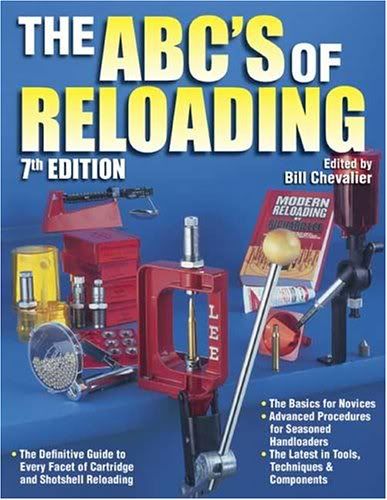
Here's a very good introductory book to reloading that isn't written by a particular company. Available for $16.14 from Amazon.ca:

reload.jpg

http://www.amazon.ca/ABCs-Reloading...ef=sr_1_6/701-2517767-7779527?ie=UTF8&s=books
 
Start with the manuals. Pick one that explains the steps and use of the tools and equipment. I like the Lyman manual, it's the one I started with and I still have my original. The more you read about the steps the easier it will be when it is time to pick up the equipment.
It is a great hobby but can be a frustrating pastime.
257 Roberts
 
typical cost to get started?

after one reads the books, and decides to go for it, what are the typical startup costs for tools, equipment, components, powders, etc? $750? $1000? more?

if the average cost of factory ammo ranges from $1.30/rnd (.243 Win) to $1.57 /rnd (.260) Remington, what do you typically save by reloading?
yes, quantity will bring the price down, so assume 1000 rounds a year....where's the breakeven point?
and of course the equipment should last longer than a year.

i know there's no point in justifying a hobby, I'm just trying to understand a budget range. what's your experience? thx.
 
Back
Top Bottom