So many theories!

H4831

CGN Ultra frequent flyer
Rating - 100%
151   0   0
Location
BC
A well known theory is that when a cartridge is fired, the primer igniting drives the bullet into the lands, blah, blah, blah.
This has been repeated on these threads so many times that I may be the only person on here that doesn't believe it. I don't believe it because I have proven otherwise.
A couple years ago I wanted to see just which primers drove the bullet hardest into the lands. So I sized Hornet brass and loaded primers, but no powder in them. Small pistol standard, small pistol magum and small rifle. I then seated a 40 grain bullet in the cases, without crimping.
When I fired the primers, not one of them moved the bullet!
Next I went to a 45-70. Two brands of standard and magnum large rifle primers. Seated a 405 grain bullet behind them without crimping.
No bullet moved from the primers being fired.
I then went to a 30-06 with the same procedure. Eventually, one magnum primer moved a bullet, but not enough to mark the bullet from the lands.
However, the test with the 30-06 was not that true, because I was using old, non descript brass of many shootings and the one that moved could have had less neck tension.
So this morning I renewed the testing. This time I used Winchester once fired 308 brass, 150 grain Nosler flat base, not the partition type, bullets and just two types of primers. CCI 250 (magnum) and standard RWS primer. Again, I did not crimp the bullets, just seated them the depth of the neck.
The bullets appeared not to have moved, but when I measured them, the one from the RWS primer measured being out .006". My measurement over the point could be out, so I put the cartridge in the seating die, with the seating depth unchanged from when I loaded them, and I felt the bullet move a bit as I pushed the cartridge home. Thus, the RWS primer had slightly moved the bullet.
There is no noise whatsoever, from primes going off in the confinement of the case. But they had all fired. I pulled the bullets and the base of every one was covered with the thick, black soot that primers create.
So, a million handloaders out there can all say how the primer drives the bullet into the lands.
But, they will never convince me!
 
I know you are correct, Bruce, since I did the same type of experiment several years ago.
I believe I had one bullet that actually moved forward. [about .010"], and that was a WLRM primer in a 7x57 case with a 120 gr bullet seated without a crimp.
I even tried in in my 357 Mag S&W. again, no movement of the bullet.
Regards, Eagleye.
 
Not to argue with you, but a primer in an empty case, will create far less pressure than a primer in a case filled with powder.

To make this a fair trial, and to settle my curiosity, I think a fine grain powder like salt, or sugar in the case could create similar pressure.

Just a thought.

Edit: Just to be clear I have never made such claims. ;)
 
For giggles try a 22 Hornet with small rifle primers.
Mine will move the bullet into the lands. Proven more than once when I inadvertently forgot to put the powder into the case.

Cheers

Was it no powder or just far to little?

I have had squib loads that get lodged in the barrel, and always assumed the same, but this thread has me thinking.
 
H4831 quote: A couple years ago I wanted to see just which primers drove the bullet hardest into the lands. So I sized Hornet brass and loaded primers, but no powder in them. Small pistol standard, small pistol magum and small rifle. I then seated a 40 grain bullet in the cases, without crimping.
When I fired the primers, not one of them moved the bullet!

shootist22-250 quote: For giggles try a 22 Hornet with small rifle primers.
Mine will move the bullet into the lands. Proven more than once when I inadvertently forgot to put the powder into the case.

shootist, your Hornet must have unusualy "soft" neck tension on the bullet for it to push the bullet out like that.
EE.
 
Like I said I am sure case capacity and pressure is the issue here.

I have had 9mm squibs that I am 99 percent sure had no powder, and bullets lodge halway in the barrel let alone just getting into the lands.

Not sure how much more case capacity a .22 hornet would have over a 9mm, but I am not willing to bang out squibs in my new Beretta to find out for sure. ;)
 
Well I beg to differ. I have had one mishap with my 6PPC on one of my bench rest rifles.

Bullet into the lands, I can extract a loaded round with my chambering as my chambers are 269's and not the thinner .261 or .262. I pulled the trigger and heard the pop of the primer. Extracted the case and no bullet. Had to push it down the bore of my newly chambered barrel.

Like I said this only happened once as that is the only time I went to the line with NO powder in the case. Thankfully it was just practice and not the match. Then there would have been a lot of scrambling.
 
Sorry but it can and has happened. I did it with a Winchester M70 30-06 at a public range in NS in approximately 1984. I didn't have a cleaning rod with me and it ended my shooting session for the day. At home one tap with a cleaning rod bumped the bullet out.

I'm not making it up and i don't have any reason to exagerate or make up stories. It happened and i am stating it simply because it is relevant to this conversation.
 
take a 44 lead bullet, put in 44 Mag case (crimp) no powder. just large pistol primer, Fire in 444 rifle, will send bullet across basement. We used to have a range in Basement on the farm,years ago


I've used glue sticks cut to 1/2" long "bullets" in 44 Mag brass with just primers, they easily punch holes in paper targets at 25 yards out of my Marlin lever. Not relevant to this thread, but your post reminded me. :)
 
Firing a primer in an empty case is hardly evidence of what happens when a primer is fired in a case 80% full of powder. The powder does not compress very much.

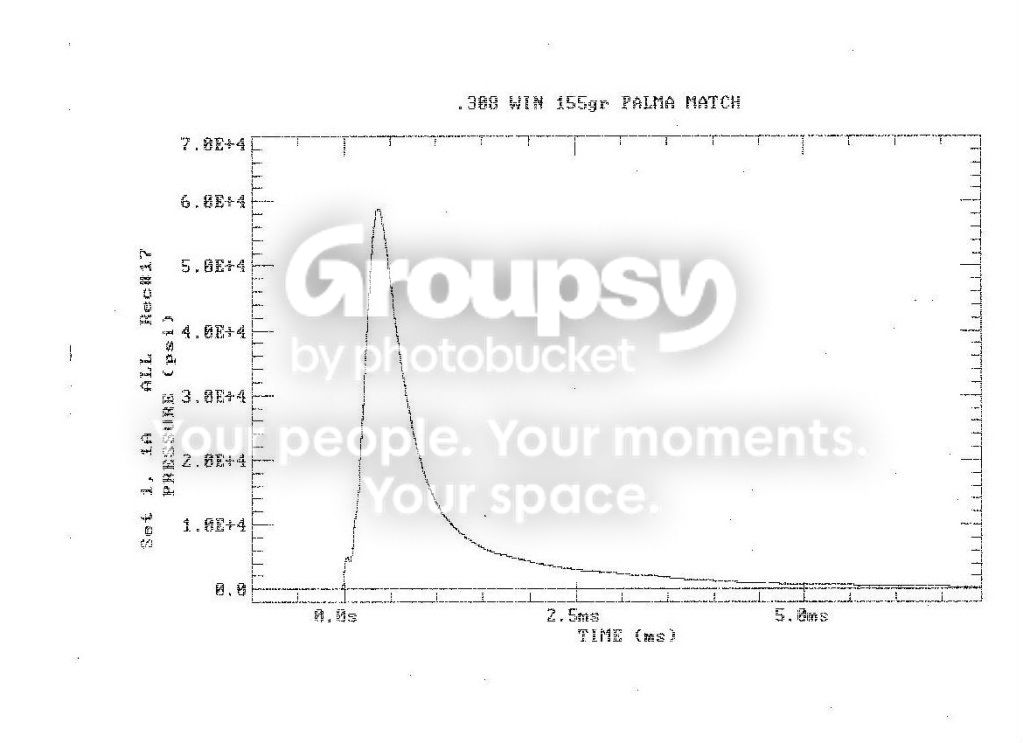
When ammo is fired in a lab pressure gun one can see the pressure spike from the primer (about 5,000 psi in a 308 Win) then it drops a bit before the powder ignites. The same primer in a smaller case like a 45ACP would generate much more pressure.

The suggestion of adding a charge to the case and running the test is a good idea. Cream of wheat might be less messy than sugar.

I pulled a pressure curve from the file as reference to help me write this. I will see if I can scan it and post it here. The primer pressure may be hard to see on the scan. I have thousands of these on file (one for every test round fired) but unfortunately, we never had a dud, so don't have a curve for a primer in a loaded case or a primer fired in an empty case.


PRESSURECURVEGOLDCROSS308.jpg
 
Firing a primer in an empty case is hardly evidence of what happens when a primer is fired in a case 80% full of powder. The powder does not compress very much.

When ammo is fired in a lab pressure gun one can see the pressure spike from the primer (about 5,000 psi in a 308 Win) then it drops a bit before the powder ignites. The same primer in a smaller case like a 45ACP would generate much more pressure.

The suggestion of adding a charge to the case and running the test is a good idea. Cream of wheat might be less messy than sugar.

I pulled a pressure curve from the file as reference to help me write this. I will see if I can scan it and post it here. The primer pressure may be hard to see on the scan. I have thousands of these on file (one for every test round fired) but unfortunately, we never had a dud, so don't have a curve for a primer in a loaded case or a primer fired in an empty case.


PRESSURECURVEGOLDCROSS308.jpg

You Sir, have a job obviously based in the technical end of the firearms industry. I envy you greatly. You have access to equipment I have only dreamed of, in my tests and experiments over the years. In would dearly love to sit down with you for an evening or two and talk internal ballistics.

Douglas
 
Seems to me that one reason for the divergence in opinions could be the presence, or lack of, crimps on the empty rounds. I had made up a couple of handfulls of powderless rounds to try, and each time it caused the bullet to become lodged part way down the barrel of my gun. H4831 specifies that he had not crimped the loads, just sized the cases. I always crimp my cases, which could explain why I got a different result than he did.
I had tried with five rounds each of 7.62x25mm, 8mm mauser, 6.5x55. From what I recall, the 8mm and 6.5 were new brass, the 7.62 were reloads. All used the primers that were indicated in my reloading manual. Not exactly rigorous scientific standards, just done tosee what would happen.
 
Interesting post that I think the experiments should be run again. One test with crimped empty cases. The second one with an inert filler to simulate powder in a crimped case.
 
Why did you choose not to crimp the cases?

Is it possible that not crimping is allowing the primer gasses to escape? :confused:

A cork that's lightly stuck in the neck of a champagne bottle will pop a few feet out. A cork that's fully seated down the neck of a champagne bottle will blast clear across the room.

For the record, I know absolutely nothing about reloading... or champagne for that matter. :redface: I'm just trying to imagine what's going on inside the case.


 
Back
Top Bottom