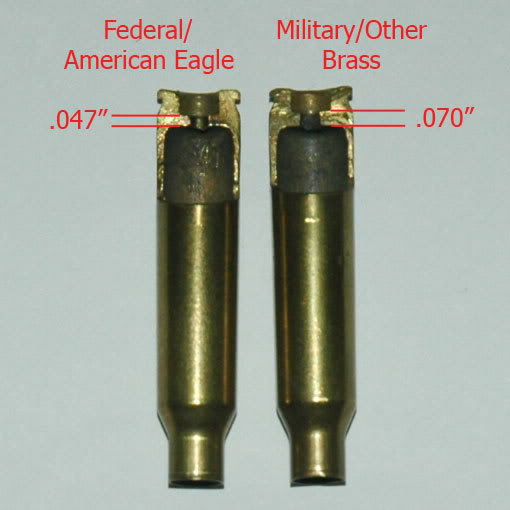
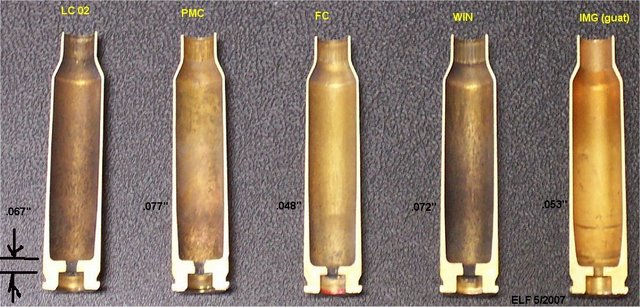
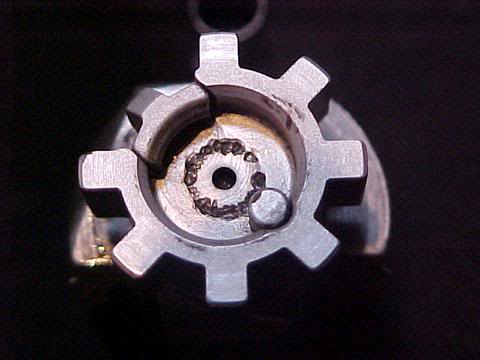
It is not the hardness of Federal brass and why the primer pockets stretch after a few reloads. It's the thickness of the flash hole web like the case on the left.
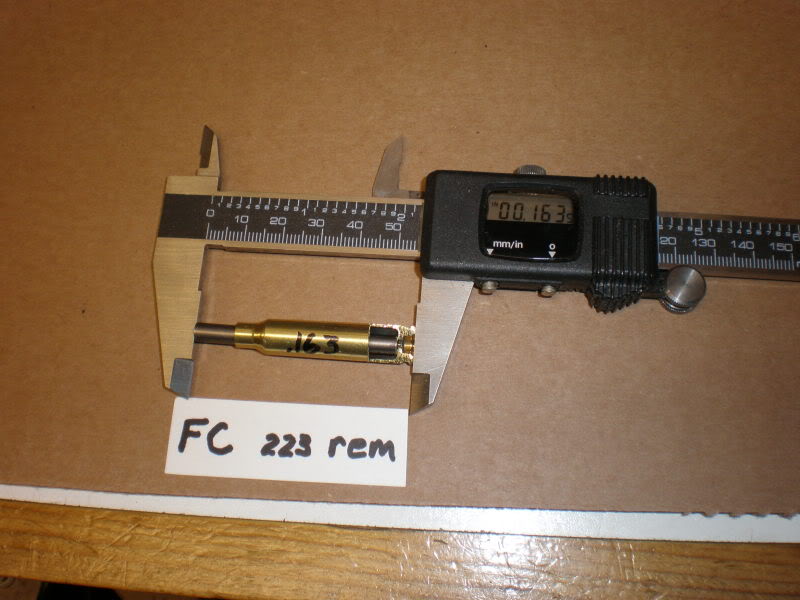
The image below is from AR15.com and belongs to the reloading moderator. A two inch rod was made to measure the flash hole web thickness. The rod was drilled out cup-shaped at one end to not measure any flash hole sprew sticking up on the inside. The cases with thin flash hole webs were not reloaded and tossed in the scrap brass bucket.
I have had factory loaded Federal/American Eagle .223/5.56 cases with over sized primer pockets after their first firing. The two inch rod saves you from preping the cases for loading only to find out the primer pockets are over sized.
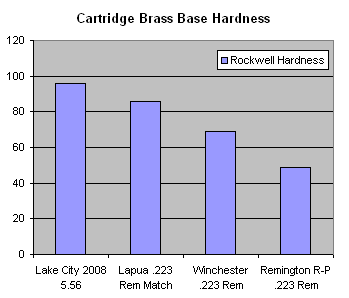
I made a two inch rod but came up with a better solution, I do not reload Federal .223 cases and buy bulk once fired Lake City brass. The Lake City cases are made of harder brass and are made to higher standards than the average commercial .223 case.
The Hodgdon's link below would be true if all cases were made to the same standards. What the test below tells you is if the brass has stretched beyond its elastic limits. Simply put the Federal cases with the thinner flash hole web can not take the same pressure as cases with a thicker flash hole web.
SIMPLE TRICK FOR MONITORING PRESSURE OF YOUR RIFLE RELOADS
http://www.hodgdonreloading.com/reloading-education/tips-and-tricks/simple-trick-monitoring-pressure-your-rifle-reloads
One of the first rules of handloading is to always follow the approved reload data. The cautious reloader gradually works up to approved maximum loads to ensure his particular gun does not show pressure signs. Generally this is visual observation of the fired shell case head and primer. There is another slick way to check for pressure signs if you are interested.
Using a blade micrometer that measures in ten thousandths (.0001"), new, unfired cases can be gauged before and after firing to determine reasonably accurate maximum loads. Micrometers measuring in thousandths (.001") are insufficiently accurate to perform these measurements, and should not be used. Previously fired cases cannot be used accurately due to various levels of brass hardening. Measurement is taken just ahead of the extractor groove on the case head and must be taken at the same place on the case before and after firing. By placing a small mark on the case head – entering the cartridge in the chamber with mark at 12 o’clock – a consistently accurate measurement can be taken with each firing.
Lower pressure rounds, like the .30-30 Winchester, usually yield maximum pressures at .0003"-.0004" expansion. Modern cartridges, like the .223 Remington, will show maximum pressure at .0004"-.0005", while .308 Winchester, .270 Winchester, etc., typically yield .0005"-.0006" expansion at max pressure. Magnums, like the .300 Winchester Magnum, show maximums at .0006”-.0007” expansion and should be measured on the belt.
In conjunction with these measurements, case head signs of pressure should be monitored as well. These signs include very flat primers, slightly cratered primers, ejector marks on the case head, and stiff extraction. All these case head signs indicate high pressure, and loads should be reduced until these signs disappear.
As always, start with the beginning load listed, and cautiously work up to the maximum shown for that set of components, using the methods listed herein.