SOFT Brass Federal

Fassteel

CGN Ultra frequent flyer
Rating - 99.1%
222   2   4
Location
Alberta
Lads

It has been well know for some years that Federal brass is soft in the primer pocket.
I am thinking of switching out all of my worn 7 mm mag brass soon and I have some once fired Federal Nickel plated brass.
Is there any possibility the the Nickel product is a little more robust with the nickel plating for use with 7mm mag data...
thanks .....FS
 
Not likely that nickel plated Federal is more robust. In my experience, they are the same. One thing to keep in mind, the Federal brass is usually not only a little softer than some others, but also thicker / heavier. If you use loads developed in lighter brass (with more internal capacity) and shoot them by substituting Federal brass, it is likely you will have higher pressure and higher velocity that the load you worked up in other brass. I use my Federal brass for full or near full loads, and it serves me well, but I develop a load based on the measured velocity, not what the book says is maximum. For instance, a max. load developed in thinner WW brass is almost always unsuitable for Federal brass in my rifles. Back off a grain or two and all is OK, and velocity is still quite close to the same. Not pushing pressures and velocity to the ragged edge of safety helps extend the life of Federal cases quite a lot.
 
"Well known" or "widely rumoured"?

My take is that particular line of thought probably lies somewhere between somewhat overblown and mostly nonsense.

It seems to me that there was a batch of 5.56mm brass somewhere in the 05-07 years that was truly soft in the head and/or thin at the web. It is important to remember that there was a bit of an ammo crisis at the time and the parent company was running cases off of several production lines and marking them with Federal markings.

So I'll buy that there was one or more batches off a line or out of a plant in that one caliber that maybe was substandard, but I've not heard much about anything else. I have however heard of people who ten years later won't reload a Federal case, regardless of caliber, age or origin. Seems to me they might be overreacting.
 
I've found Federal brass from the last 20 years is softer than it used to be. I've had primer pockets open up on the first firing (read factory ammo) and some after 2 or 3 firings. I just cull it now and generally give it away.
 
All I know is that my 300 WM once-fired Federal factory ammo is a much looser fit on my primer pocket gauge than twice-handloaded (hot loads, too) PPU brass. The FC brass is toast after one factory load and two handloads. Looks like the PPU brass will last 5+ loads. I also find myself scrapping most of my FC 308 brass after just a few handloads and those are below book max for both charge weight and velocity.
 
"Well known" or "widely rumoured"?

My take is that particular line of thought probably lies somewhere between somewhat overblown and mostly nonsense. [Your take is not correct]

It seems to me that there was a batch of 5.56mm brass somewhere in the 05-07 years that was truly soft in the head and/or thin at the web. It is important to remember that there was a bit of an ammo crisis at the time and the parent company was running cases off of several production lines and marking them with Federal markings.

So I'll buy that there was one or more batches off a line or out of a plant in that one caliber that maybe was substandard, but I've not heard much about anything else. I have however heard of people who ten years later won't reload a Federal case, regardless of caliber, age or origin. Seems to me they might be overreacting.

Federal brass of late manufacture is quite soft when compared to several other makes.
Primer pockets open quickly, even with moderate loads. I throw all Federal brass, with the
exception of that made for the 30-30, into the brass recycle bin. This is not historical BS,
but rather, present fact. Dave.
 
I've found Federal brass from the last 20 years is softer than it used to be. I've had primer pockets open up on the first firing (read factory ammo) and some after 2 or 3 firings. I just cull it now and generally give it away.

With My 338 Rem RUM Fed brass the brass was unloadable due to loose primer pockets after ONLY one firing ! RJ
 
Not likely that nickel plated Federal is more robust. In my experience, they are the same. One thing to keep in mind, the Federal brass is usually not only a little softer than some others, but also thicker / heavier. If you use loads developed in lighter brass (with more internal capacity) and shoot them by substituting Federal brass, it is likely you will have higher pressure and higher velocity that the load you worked up in other brass. I use my Federal brass for full or near full loads, and it serves me well, but I develop a load based on the measured velocity, not what the book says is maximum. For instance, a max. load developed in thinner WW brass is almost always unsuitable for Federal brass in my rifles. Back off a grain or two and all is OK, and velocity is still quite close to the same. Not pushing pressures and velocity to the ragged edge of safety helps extend the life of Federal cases quite a lot.

I agree with this. It's good brass but doesn't last if you abuse it with overpressure.
 
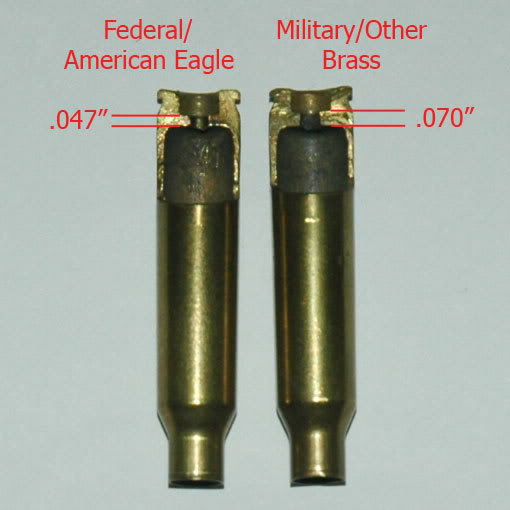
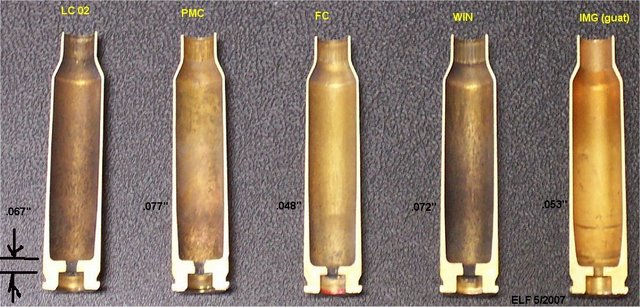
It is not the hardness of Federal brass and why the primer pockets stretch after a few reloads. It's the thickness of the flash hole web like the case on the left.

cYeTsDp.jpg


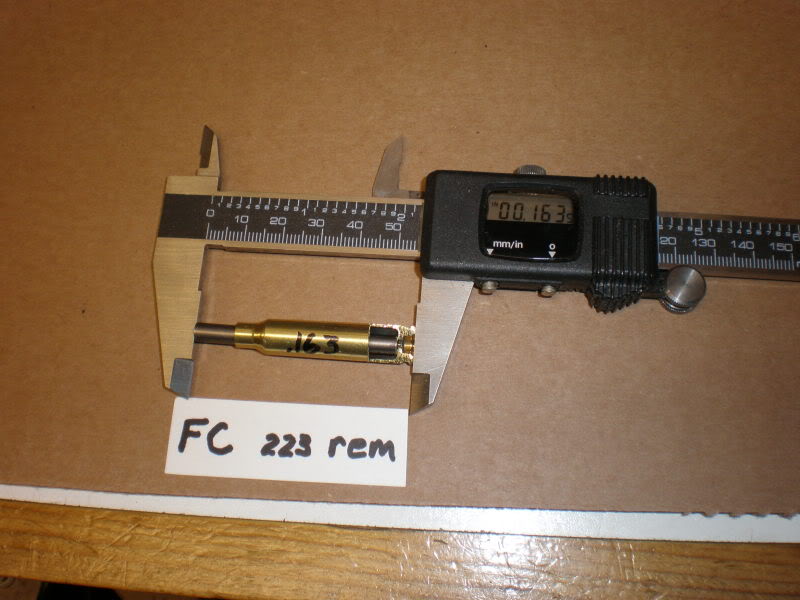
The image below is from AR15.com and belongs to the reloading moderator. A two inch rod was made to measure the flash hole web thickness. The rod was drilled out cup-shaped at one end to not measure any flash hole sprew sticking up on the inside. The cases with thin flash hole webs were not reloaded and tossed in the scrap brass bucket.


POsazjb.jpg


ohI86Bf.jpg


I have had factory loaded Federal/American Eagle .223/5.56 cases with over sized primer pockets after their first firing. The two inch rod saves you from preping the cases for loading only to find out the primer pockets are over sized.

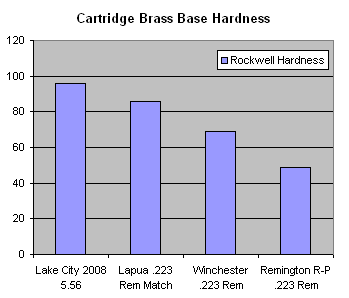
I made a two inch rod but came up with a better solution, I do not reload Federal .223 cases and buy bulk once fired Lake City brass. The Lake City cases are made of harder brass and are made to higher standards than the average commercial .223 case.


4kXrGuI.png


The Hodgdon's link below would be true if all cases were made to the same standards. What the test below tells you is if the brass has stretched beyond its elastic limits. Simply put the Federal cases with the thinner flash hole web can not take the same pressure as cases with a thicker flash hole web.


SIMPLE TRICK FOR MONITORING PRESSURE OF YOUR RIFLE RELOADS
http://www.hodgdonreloading.com/reloading-education/tips-and-tricks/simple-trick-monitoring-pressure-your-rifle-reloads

One of the first rules of handloading is to always follow the approved reload data. The cautious reloader gradually works up to approved maximum loads to ensure his particular gun does not show pressure signs. Generally this is visual observation of the fired shell case head and primer. There is another slick way to check for pressure signs if you are interested.

Using a blade micrometer that measures in ten thousandths (.0001"), new, unfired cases can be gauged before and after firing to determine reasonably accurate maximum loads. Micrometers measuring in thousandths (.001") are insufficiently accurate to perform these measurements, and should not be used. Previously fired cases cannot be used accurately due to various levels of brass hardening. Measurement is taken just ahead of the extractor groove on the case head and must be taken at the same place on the case before and after firing. By placing a small mark on the case head – entering the cartridge in the chamber with mark at 12 o’clock – a consistently accurate measurement can be taken with each firing.

Lower pressure rounds, like the .30-30 Winchester, usually yield maximum pressures at .0003"-.0004" expansion. Modern cartridges, like the .223 Remington, will show maximum pressure at .0004"-.0005", while .308 Winchester, .270 Winchester, etc., typically yield .0005"-.0006" expansion at max pressure. Magnums, like the .300 Winchester Magnum, show maximums at .0006”-.0007” expansion and should be measured on the belt.

In conjunction with these measurements, case head signs of pressure should be monitored as well. These signs include very flat primers, slightly cratered primers, ejector marks on the case head, and stiff extraction. All these case head signs indicate high pressure, and loads should be reduced until these signs disappear.

As always, start with the beginning load listed, and cautiously work up to the maximum shown for that set of components, using the methods listed herein.

 
Last edited:
By the end of the year 2021/22 you guys might be not so happy if you just toss your federal Brass

Primer pockets looser maybe it is because they started life bigger

and I have heard S&B is the Smallest and I have heard lots of people tossing them too just because they are crimped

everybody wants lapua, what happens if you can not get it ?
 
By the end of the year 2021/22 you guys might be not so happy if you just toss your federal Brass

Primer pockets looser maybe it is because they started life bigger

Are you saying bigger is better??????

The person who posted this photo below said he didn't worry about loose primer pockets. And when his bolt got bad enough he would just buy a new one. :bangHead:

VMkEdYr.jpg
 
Years ago I bought some Federal Premium nickel plated .223 brass. I got two loadings out of it before the primer pockets were toast. They weren't particularly warm loads either.

Auggie D.
 
Is all federal brass made the same? Interesting findings re the 223 but does it apply to the OP’s belted mag brass?

The Federal .223 cases that I found to be a problem were approximately 2005 to 2010. I heard after this that Federal improved the manufacture of their cases.

This is approximately when the measuring rod was used at AR15.com for checking the flash hole web thickness.

During the 1968 Congressional hearings on the M16 jamming problem one of the faults was soft brass.

nqhNKyV.jpg


I will say that any brand of brass if reloaded too hot will show adverse effects. I will also say the strength and hardness of the brass can vary between brands.

So if you are getting short life from your primer pockets then reduce your load.
 
I use lots of different brass. Of them all Federal brass seems to be the worst and yes sometimes after the first factory firing the brass is toast.
 
I can attest to poor federal brass performance.... but that being said, most of my loads are marginally better with federal.. I can’t explain at all. Tried a bit of a ladder test up and down .3gr In .1 increments and still have edge to federal brass.
 
When Federal made brass as a component before they started making ammunition it was pretty. After they started selling ammo it seemed like the brass became softer. Back in the early 80's I was gifted a couple buckets of LC 5.56 and was told then that it was made by Federal. The guy who told me was in the business so he should know, It was good stuff.
 
Any FC/Federal Cartridge brass produced under ATK management is JUNK.

There was a reason ATK was run out of Lake City Army Ammo Plant.

Federal brass & ammo manufactured in MN,from the 80/90's will last multiple reloads before the pockets loosen up.
 
Any FC/Federal Cartridge brass produced under ATK management is JUNK.

There was a reason ATK was run out of Lake City Army Ammo Plant.

Federal brass & ammo manufactured in MN,from the 80/90's will last multiple reloads before the pockets loosen up.

ATK/Federal was not run out of Lake City, when the new contract came up Winchester was the lowest bidder to run Lake City. The military sets the standards for the brass hardness and quality at Lake City. And whoever has the contract to produce ammunition at Lake City has to meet these military standards.

Bottom line, Remington lost the contract to Winchester/Olin in 1985, and in 2001 ATK got the contract to run Lake City. ATK was split up and Orbital ATK belongs to Northrop Grumman who had many government contracts. The reason to award the contract to Winchester may have been to diversify and not give Northrop Grumman a monopoly on government contracts.
 
Last edited:
Back
Top Bottom