Splitting necks - whats the cause?

Nosler06

Member
Rating - 0%
0   0   0
Location
Kootenays, BC
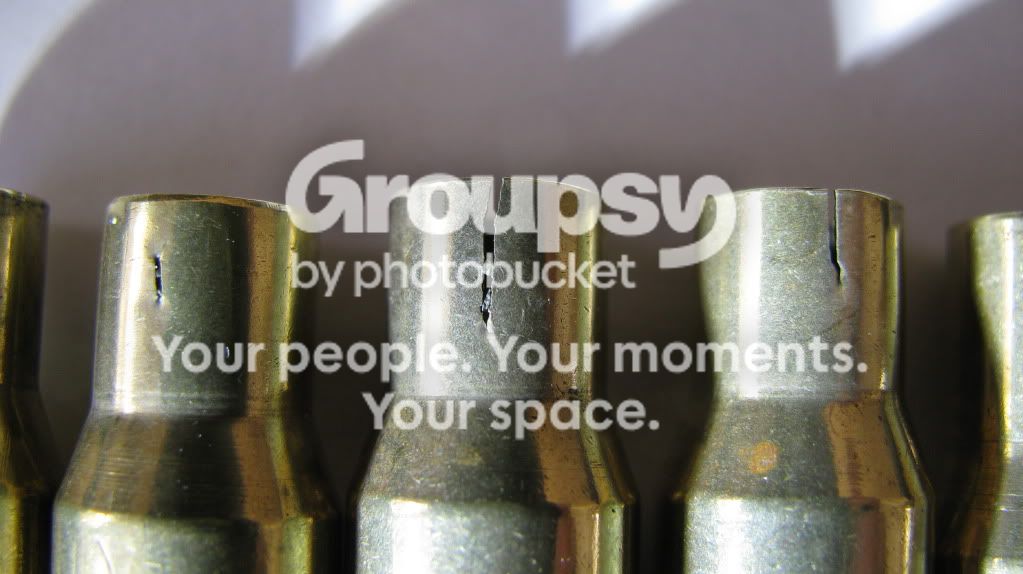
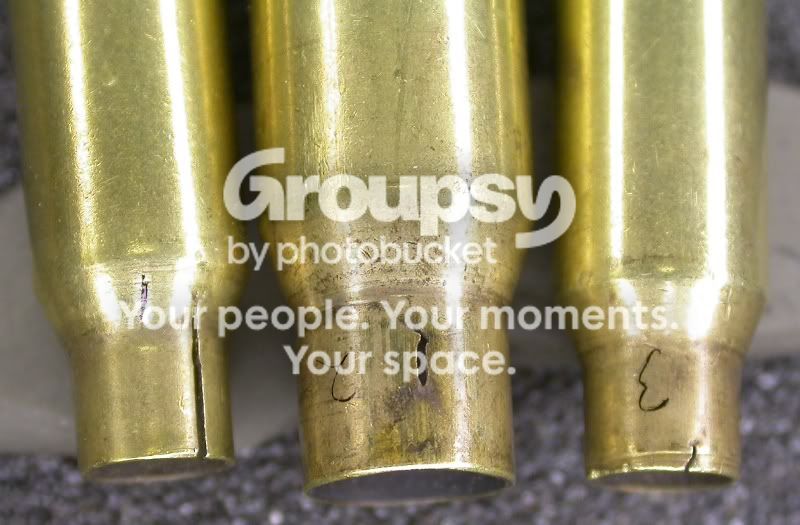
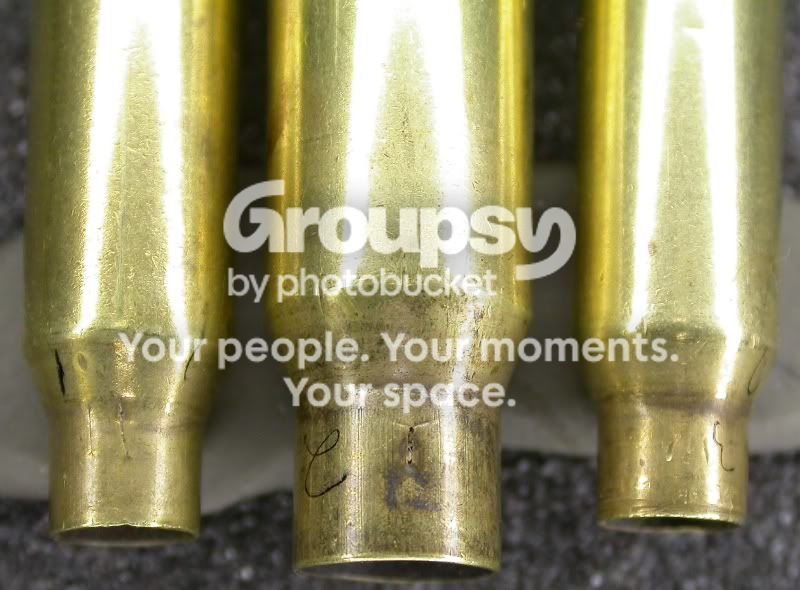
Recently bought a Lymans 1200 Turbo Tumbler, cleaned all of my spent brass for reloading. Now I have found a good 20 cases out of the 180 that I have with cracks in the neck. Most look like the picture named "neck crack" some are a hairline crack. Does this type of damage indicate that the brass has been work hardened or do I have some other problem that I need to deal with? If it is just work hardening then annealing the brass will solve that, right? Open to suggestions. I have added the photo of the cracks on my brass below.
casefail2.jpg
 
Last edited:
how many times have you loaded said brass? how hot are you loding it?

work hardening, and exsessive pressure can casue cracking, but over time brass just "wears" out and will crack too. any other pressure signs? but seeing as its all in the neck seems like work hardeding is your problem and annealing the cases will probably bennifit you but like i said if youve loaded the cases 15-20 times they are probably just at the end of their life
 
The one marked neck crack, is the normal way a case reaches the end of it's useful life.
Expanding, resizing, work hardening the copper does it.
Life can be prolonged by annealing it the odd time.
 
I am trying to get a copy of the pictures of my brass to post. Not sure why I can't get it to copy over. It is not working for me.


IMG_0054.jpg
 
Last edited:
The neck crack is from having an oversized neck in your gun. On each firing the neck expands to fill the chamber neck. Then when you resize it, the die makes the neck too small, and last the expander ball comes through to make it the right size stretching it again. All this working of the brass in the neck causes it to crack. You need to anneal the brass in the neck well before it gets to the cracking stage -- typically around 5 firings.

The oversized bulged case is brutal. The chamber must be way too large, or it has been fired in the wrong chambered barrel. Need a new barrel.

The crack causing the head to separate is caused by excessive headspace and full length resizing to push the shoulder back. It can be avoided by either correcting the headspace (expensive unless it is a Savage), or by short stroking your ram when resizing so you just barely bump the shoulder back one to two thou.

The longitudinal crack down by the head is something I've never seen before. Was it fired in the same gun that is showing the bulged cases? If so, chamber too big.
 
chuck them buy new brass dont reload them so many times how many times do you have to fill and shoot a case to get your moneys worth out of a chunk of brass.
 
The stock answer to the cause of neck cracking is work hardening. That's what the reloading manuals say, that's what the magazine articles say, that's what the internet gurus and RKI's say.

Too bad they're mostly wrong.

Last fall, I took a once-fired .308 Federal Gold Medal Match case and expanded the neck up to 8mm. Then I sized the whole case down to spec in a full-length resizing die. Then I repeated the process 35 more times. Finally, the neck split, a tiny fissure that extended from the case down into the neck a distance of about 2mm. The crack exhibited a distinct shear lip, a clear sign that even though the limit of ductility had been reached, the brass did not fail in a brittle manner. If they handle that much deformation that many times, how many normal firing/resizing steps will they withstand? I'm guessing dozens, or hundreds.

A large percentage of cases I have examined show clear evidence of some degree of stress-corrosion cracking. Many others show signs of ductile tearing. But work hardening? It's essentially a myth.

Here's 3 cases with some different types of splits. Case 1 tends to have long splits from the case mouth along the full length of the neck, and the cracks have squared off edges. Case 2 tends to have short splits in the middle of the neck, with stretched/rounded edges. Case 3 has all sorts of short little tears.
fail21.jpg

Fail22.jpg


And here are photomicrographs through a representative crack on each one:
Case 1:
failcase1-1.jpg


Case 2:
failcase2.jpg


Case 3:
failcase3.jpg


Case 1 has some grain distortion, but is nowhere near the limit of ductility for brass. Case 3 on the other hand, has beautiful, huge, unworked grains, but it still cracked. The photo of Case 2 is not etched to show the grains (they are as big and almost as unworked as #2), but you can clearly see the effects of corrosion pitting and cracking. And you want to know something else? All of these cracks are coming from the inside wall of the case. When you see the characteristic puckering of the brass as I show on case #2 (second pic), or as the original poster showed on his leftmost case, those are cracks coming from the inside out, that got partway through the wall as straight cracks and are now tearing in a ductile fashion due to the stress of firing, like this:

failon6thcrackstart160xas-plabelled.jpg
 
I would guess low cycle corrosion fatigue, not stress corrosion cracking. If it was stress corrosion cracking the cracking would occur in loaded rounds sitting stressed from neck tension. I find the crack always becomes visible after a firing.
 
From those pics, I suspect the OP has four issues. First, he likes to load to maximum pressures, second, he is using the loaded cases in more than one rifle and third one of the rifles has an oversize or NATO spec chamber. Four, newer brass is metallurgically different than brass was 10 years ago. Bruce is right, a lot of the fatigue issues are from excessive use without re annealing and full length sizing every time. This would be necessary if you are switching the loaded cases between rifles and especially if one is an auto-loader.

I have cases made up for Hunter Bench Rest rifles, with extremely tight tolerances, that have over 100 reloads through them. They have all been re annealed at least twice. They have never been full length re sized, ever. Neck sized only with Wilson precision dies on an Arbor Press. The necks on these cartridges need to be turned to allow .002 overall clearance to fit the chamber after loading. Tight tolerances make a lot of difference. Of the 60 original cases, I still have 58 left. I lost two in the sand at a match.

If you are using the same cases in one rifle, and keeping your pressures down, those cases will last a long time, especially if you neck re size only and as H4831 mentioned anneal after every 4-6 reloads or if you feel the brass is hard to size.

Auto-loaders, are hard on cases. M305's seem to be especially bad. Garands aren't any better, nor are Mini 14s. Commercial auto-loaders aren't a lot better either. Their chamber tolerances are usually a bit more generous to ensure positive feeding. Not nearly as generous as Mil Spec though.
 
Battlerife - So are you saying the OP's brass is basically old and corroded and that caused most of the failure and the splitting upon firing was just the inevitable result?
 
If it was stress corrosion cracking the cracking would occur in loaded rounds sitting stressed from neck tension. I find the crack always becomes visible after a firing.

If it was fatigue, the cracks would be purely transgranular. Most of the cracks I have sectioned have had at least some intragranular component, which in turns indicates an environmentally assisted cracking mechanism. Do you really want to argue that something like this is anything but SCC?
SCC.jpg


Battlerife - So are you saying the OP's brass is basically old and corroded and that caused most of the failure and the splitting upon firing was just the inevitable result?

Not necessarily old or corroded. Under conditions of high stress and continuous presence of ammonia, new brass cases can crack in 48 hours or less. This is not enough time to suffer any appreciable level of aqueous corrosion, and the cases will still look brand new, with no signs of tarnish, pitting or material loss.
 
Battlerife - Okay, so I'm confused.

Your information is very technical and detailed, but I'm not understanding how you are answering the original post - "What is causing the cracks?"

Do you have a simple answer for someone on too much cold medicine?
 
More information.

Some of my brass is older and has been loaded 10-12 times. I have found these cracks on once loaded Winchester brass, but the loads were in my 30-06 - 57.0gr IMR4350, 180 gr Nosler Part and CCI250 magnum primers. From my previous posts I have been told that the loads are way too hot and no need for mag primers. All of my brass is shot through the same guns. It is not switched between rifles. I tried other ammo that I loaded for my dad's 30-06 56gr IMR4350, 180gr Nosler Part and CCI200 primers with no neck splits. The brass had been loaded and sat for over 10yrs before I was able to get back at it (long story). Would this long shelf sit contribute to the weakening of the brass?
 
If it was fatigue, the cracks would be purely transgranular. Most of the cracks I have sectioned have had at least some intragranular component, which in turns indicates an environmentally assisted cracking mechanism. Do you really want to argue that something like this is anything but SCC?

Yes, I will discuss this again (as we have before), but first let me tell you a short story. Early in my career I had a project involving a tube failure in a heat exchanger. The 1" or so tubes were bursting. Some of the pre failure areas had large pointed blister type raised spots, with the bumps on the outside of the tube. The company had more money and research scientists than they knew what to do with, so the sample by standard procedure had to be sent to the research lab for failure analysis. A scientist with his PhD wrote a nice report saying the failure was caused by impact from a semi-pointed object from the inside. We all had a significant chuckle, imagining this little man with a center punch inside this 1" tube, pounding out on the tube. We knew of course that the heat exchanger was being subject to severe steam and water hammer, and it was the obvious cause, and I'm sure we told them. But, he based his conclusion only on the sample microstructure. I learned from that experience that a failure analysis has to explain all observed facts, not just selective ones.

But back to cartridge brass cracking. We may be saying the same thing, but in slightly different ways. I don't think SCC alone explains case cracking. If it did, then we would see case cracking associated with just old loaded cases. You probably have heard of the 1920 Indian Army case where stored loaded brass cracked when exposed to high ammonia in a horse barn. They just cracked sitting there, and I would agree that is pure SCC. However, that is not my experience with brass cracking. I have only seen it in cases that have been loaded about 20 times, and it becomes visible on a resizing, and I reject it. I've never seen a loaded round crack -- like the Indian Army experience. And I have cases that have close to 20 firings on them which have sat loaded for 30 years. Some even had some brasso (which contains ammonia) leak on them. No cracks. I know others report cracking in as little as four firings, but I will bet they have larger neck clearances than the guns where cases last 20 firings. So to me low cyclic stress plays a part in the common cracking seen in reloaded brass.

I would suggest the more complete explanation would be corrosion fatigue. That said the corrosion part could very well be SCC, but the overall failure also includes a low cycle fatigue part that opens up the crack and allows a fresh start for more SCC. Another more complete paper here. Corrosion fatigue can be either trans or intergranular. I suspect if the corrosion part is SCC then it propagates intergranular.

All this said, annealing before the cracking starts to form is the secret to prevention. It reduces the stress that leads to the SCC part of the cycle. If you can keep a crack from starting and causing a stress concentration, and keep the brass ductile, then you likely can avoid cracking indefinitely. Some benchrest shooters claim up to 200 reloads from 6PPC brass, and they quite often are using ammonia cleaners.
 
Back
Top Bottom