Sporterized Ross M-10 rifles

buffdog

CGN Ultra frequent flyer
EE Expired
Rating - 98.1%
105   2   0
Location
Southern Ontario
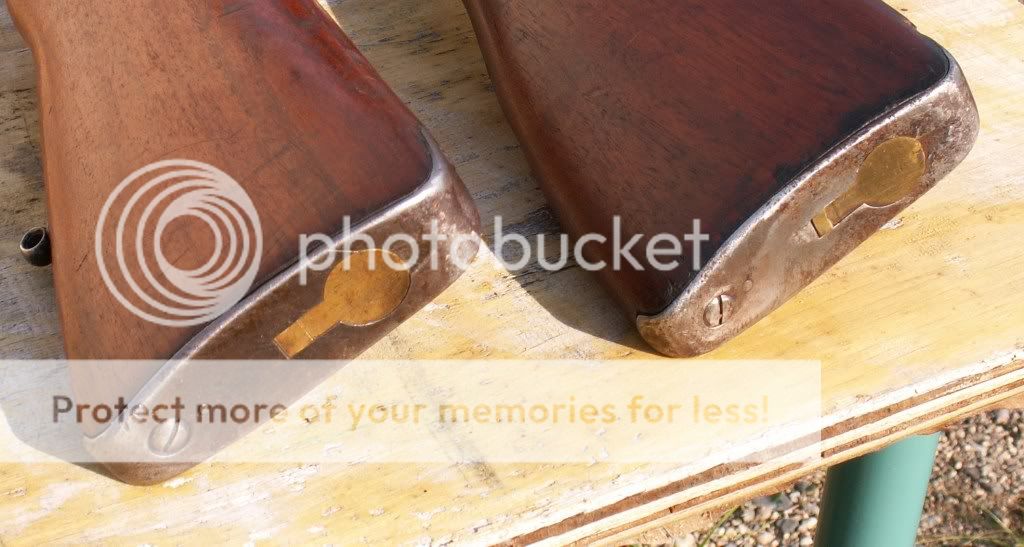
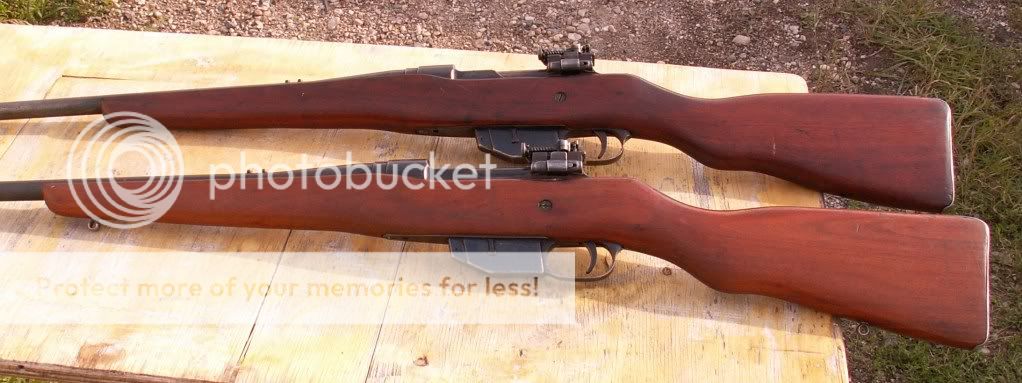
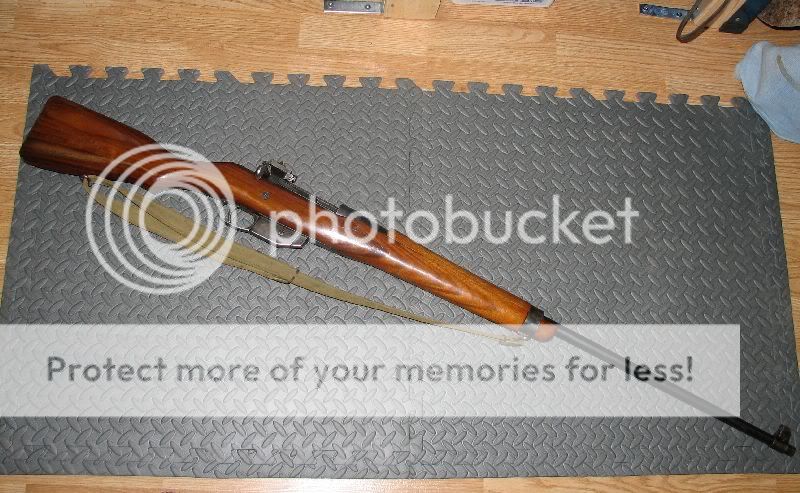
I visited SMELLIE today, and brought along a Ross Military Mark III (M-10) rifle that I had picked up at the Winnipeg Military Collectors Show on Sunday September 12th. He looked at it, and said that he had a similar rifle, so we compared the two.

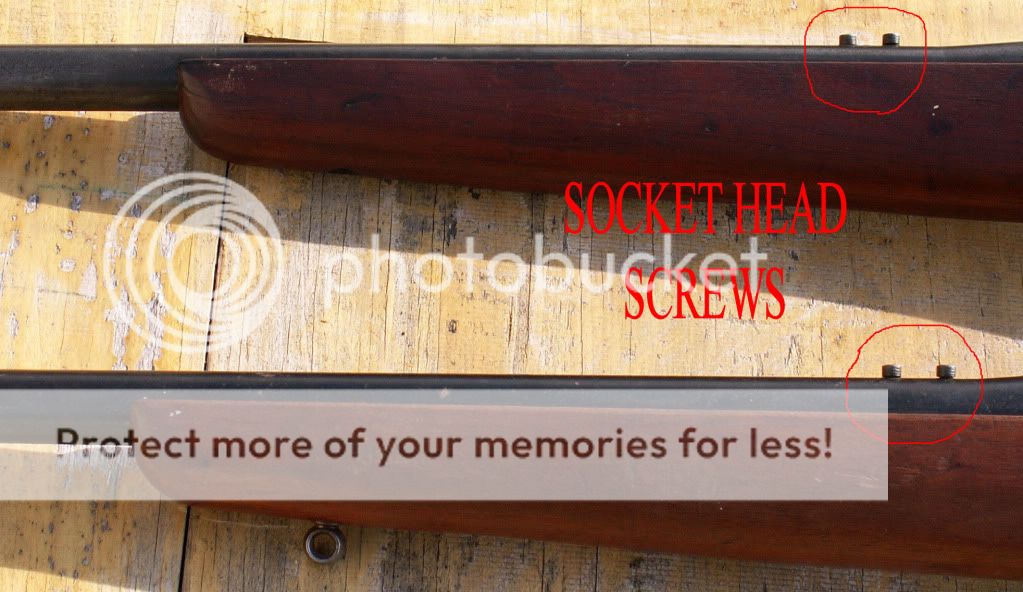
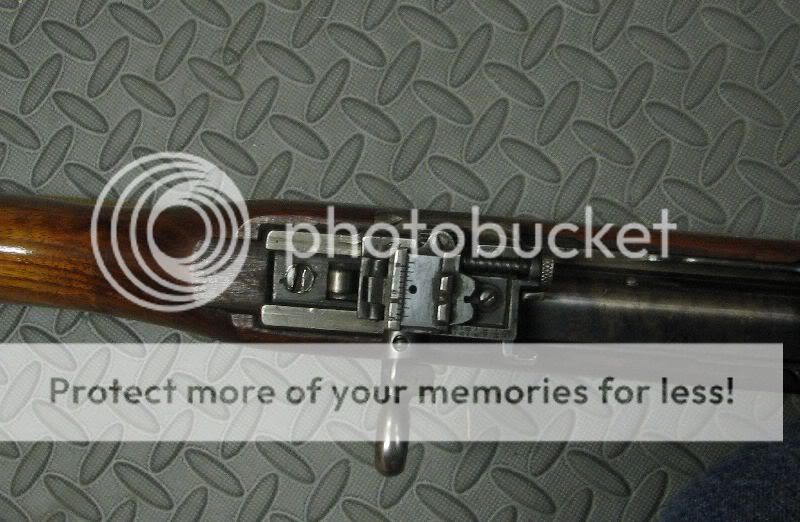
Barrels 25 inches long, stocks cut and sanded, Cooey manufacture rear sight, but the interesting thing was that there were two socket head screws on the barrel for attaching an open rear sight to the rifle. Except for a sight hood missing, and sling attachments, both rifles were identical.

Both had British commercial proof marks on them along with the usual DCP proof, and the "Not English Made" stamp on the barrel. However, my rifle had "CRB ###X" serial number on the barrel (attributed to the Canadian Ranger Battalion) while his had a "PLY ###X" number of the British Royal Marines.

This is an intriguing mystery, and to satisfy our curiosity and possible theorys about these rifles, we are posting a couple of pictures. If you have a similar Ross Rifle with the two screws in the barrel, we are asking that you reply with a post, or a PM to me. The more specimens we find, the better we can get some correct information on these rifles.

Due to the striking similarity, I think it is quite obvious that these two rifles were a factory conversion of a Military rifle to a Sporting one. But, whose factory, when, and how many are questions that remain to be answered.

Thanks for any co-operation.
.
010.jpg

.
SIGHTSCREWS.jpg

.
021.jpg
 
Last edited:
"CRB ###X" serial number on the barrel (attributed to the Canadian Ranger Battalion) "

I have read this too, but I have also read that CRB means Canadian Railway Battalion, and not Canadian Ranger Battalion.
 
Ross CRB markings

The other possibility is "Canadian Reserve Battalion." What I think what we have to consider in this case is the time frame.

The Ross Military Mark III was in use with the Canadian Army until 1916, when they were then exchanged for the Short Magazine Lee Enfield, and the rifles then given to the British. The PLY ###X number is the possible rack number of the Plymouth Depot of the Royal Marines. During this time, the Canadian military markings was on the wood of the butt stock. The British stamped their markings on the metal of the receiver. If the CRB rifles were used by the Canadian Railway Battalion, the markings would have been on the wood, as it would have been if it was the Canadian Reserve Battalion. The British would have stamped the metal receiver, as the case of the PLY markings.

The Canadian Rangers were created by an Order in Council in 1947. Canada had adopted the Metal Marking Method before WW2, so the CRB on the receiver is consistent with the time. On both of these rifles, the wood has been sanded and the butt stock markings scrubbed. If the CRB markings are valid and do mean the Canadian Rangers, then these rifles were converted after 1947, and probably before 1960, when the FN-FAL replaced the No.4 Lee Enfield rifles. Another clue might be the screws used. It has been mentioned that the use of socket head screws was not too much used before WW2, although this has not been confirmed so far.

On the Milsurps.com Forum, there are some threads and posts regarding the CRB stamps. There are a couple of posts by people who have actually served or been attached to the Canadian Rangers and who apparently have first hand observations of these rifles.

There is also an amusing account of one disgrunted individual, who was the only one in his company issued a Ross rifle instead of a Lee Enfield, happened to accidentally lose the bolt from the Ross while crossing a lake.

We do know that Ross Military Mark III rifles were cut down and modified by the Government and issued with a bayonet to guard Prisoners of War (maybe a piece of string to attach the bayonet too?) The Pacific Coast Militia Rangers, the Parks Service, and the Alberta Forestry Service also used this rifle.

What we were hoping for was some responses from Members who might have a similar rifle, or CRB marked rifles so we could get a comparison.
 
The British commercial proofs and "Not English Made" indicate that the rifles were sold surplus and probably converted to sporting configuration in the UK. Those marks would be consistant with those on other sported military rifles done up in England.
The rear sight holes could be part of the sporting conversion. Perhaps for a stamped sheet metal open rear sight.
Of course rifles disposed of as surplus in Canada could have been bought up and shipped to England, sporterized and resold in Canada. But it is more likely the rifles were ones of the many thousands sold as surplus by the British Government.
Is there any reference in any Cdn. Government documentation to "The Canadian Ranger Battalion", as opposed to "The Canadian Rangers"?
 
I have CRB 366X (see how either PLY and CRB both have 4 digits S/Ns...) with similar two holes in the barrel (but no screws - I installed filler plugs) - but the rifle was re-modifified later. I'll try to post some pics later.
 
CRB, still unconfirmed and in question as to what it really means. Here are some pics of a rifle I owned a few years ago. While the action has bee grooved for a sight?? You can see the CRB on the side.

P2040001.JPG


P2040008.JPG
 
The CRB question has been asked many times. The author of Defending the Dominion mentioned that CRB is for Canadian Ranger Batallion, meaning the Canadian Rangers of today. There was an order of council to this regard (O.I.C. PC 1644 May 23. 1947). He has done more research than anyone I know on the subject, and gave me this info:

Three years ago while expanding the catalogue information on Canadian rifles for the Canadian War Museum, I had the following exchange with Warren(the orginal) who is, in my opinion, the leading Canadian Ross expert.

"I have come across three Ross rifles - two cut down to carbine size, one not - in the Canadian War Museum collection stamped CRB in one or more places. It has been suggested that this indicates issue to the Canadian Rangers, can you confirm?"

"YUP....they are Canadian Rangers, and I have a number of them. The uncut version are the scarce one, as most were cut to carbine length with a number of different sight configurations."


I personally have noted a couple of things looking at these things over the years. 1) most are sporterized, thus the need for a serial number on the receiver. Even if the sporterizing was done much later - it was allowed, so keeping track of the numbers would have been important. 2) The bolts are always pinned (in ones I have seen) to prevent incorrect assembly thus making them "safe"- this was done to Ross's in service around WWII. It only seems logical these would be part of the Post WWII Canadian Rangers, and not the Canadian Railway Batallion (of WWI) or the Canadian Reserve Batallion (again of WWI). I will add that this isn't "definative", as the bolts are not numbered, and are interchangable.

There is more evidence to these being part of the Canadian Rangers, than any other formation, but the debate continues because there is no definative proof (outside of a book, an OIC, and a leading authority on Ross rifles - but I'm just being facetious now :D). Therefore I beleive this riddle will never be solved.
 
I should also add that I have owned 2 of these. Neither one had Brit marks on it.

Is there any way to date the Brit marks to before 1947? Is it possible some were purchased back from the Brits thus the marks?
 
CRB Bolts

"I will add that this isn't "definative", as the bolts are not numbered, and are interchangable."


The bolt on my rifle is numbered, although mismatched to the rifle number.

I have bolt CRB 1463.

Another thing we might factor in is the weapon itself. In 1947, the Lee Enfield was the front line Canadian military rifle. Traditionaly, second line troops are given obsolescent firearms. The Russians were acting up a bit (thus a reason for forming the Canadian Rangers), and would the Government want to keep the Lee Enfields in Stores?
 
Does OIC PC1644 May 23, 1947 use the term "Canadian Ranger Battalion", and mention the issue of Ross rifles?
 
I hope you don't mind me posting pics of my M-10 Ross here. There doesn't seem to be a serial number on the receiver or barrel, only on the bolt. It has a nice mark on the buttstock. smellie will like this one!!

Rossax-1.jpg

rossbx-1.jpg

rosscx-1.jpg
 
My PLY is carbine length, no screw holes, and no bolt rivet. It has the single fixed aperture sight, rather than the original sight. Interestingly, thee is a rifle on the Collectors Source website, claimed to be CRB origin, with the same sight, and same stock profile, etc.?
 
sights

My PLY is carbine length, no screw holes, and no bolt rivet. It has the single fixed aperture sight, rather than the original sight. Interestingly, thee is a rifle on the Collectors Source website, claimed to be CRB origin, with the same sight, and same stock profile, etc.?

On page 189 of the second edition of "The Ross Rifle Story", it shows a picture of a Canadian Rangers rifle similar to the one you describe.

However, in an earlier post, STOGGIE indicates that there were several sight configurations for the cut down CRB rifles.
 
Hello!

I happen to own a Ross M-10 Sporter as you describe. The screws have been removed but the holes are there. The reciever is marked CRB and the bolt is also marked CRB, though they are mismatched. Here are some pictures, sorry I could not resize them. Interestingly, there is a 44 stamped into the wood behind the bolt channel.
Serial on the reciever is CRB 3031 and bolt is CRB 2118.

What can you tell me of my rifle?

P6110122.jpg

P6110117.jpg

P6110106.jpg

P6110105.jpg

P6110103.jpg

P6110128.jpg


Thanks,
Drachenblut
 
I have two sporters as well, one looking just like yours, but without the barrel screws, and one that still has the upper handguard but was cropped just after the mid band, which I believe is the one with the CRB markings. Will check when I get home next week. also one has a more ornate font saying M1910 while the the other in block lettering just says M10. Any insight on when they would have changed the stamps?
 
Back
Top Bottom