Hi guys- I'm looking to buy a new rifle in 300 win mag. and was wondering which barrel will last longer ,a SS barrel or a regular steel blued barrel ,is there any data out there on barrel life,moisture and weather not really a problem(a fair weather shooter)Thanks for any and all replies. John













































You are using an out of date browser. It may not display this or other websites correctly.
You should upgrade or use an alternative browser.
You should upgrade or use an alternative browser.
stainless rifle barrels
- Thread starter montrock
- Start date


Jordan Smith
CGN Ultra frequent flyer
- Location
- Calgary, AB
I have read and heard from barrel makers that SS tends to wear a little better than CM steel. FWIW....

SS is slightly more resistant to erosion than is CM, but SS is also more brittle in extremely cold temp than is CM. Each has their place.
For example, I like SS for target rifles and I have one all-weather rifle that is Stainless Synthetic, but really, I love glossy blued metal in a nicly figured piece of wood. I have a couple of extremely gorgeous firearms like that, and I hunt with them because I love the look and feel of them.
If I wear the throat out in time, a new barrel is easy to come by. Regards, Eagleye.
For example, I like SS for target rifles and I have one all-weather rifle that is Stainless Synthetic, but really, I love glossy blued metal in a nicly figured piece of wood. I have a couple of extremely gorgeous firearms like that, and I hunt with them because I love the look and feel of them.
If I wear the throat out in time, a new barrel is easy to come by. Regards, Eagleye.
Note that there are several alloys that could be called "stainless steel", and they have different characteristics. A rifle barrel is probably a 400 martensitic series alloy (nickel-free and hardenable), a type that has good characteristics for machining, and is optimized for hardness (other applications include knives and surgical instruments). We should note that non-stainless barrels are usually made of chromoly, which is harder than ordinary steel but not corosion resistant.
The advantages to stainless is hardness and corrosion-resistance (you can corrode a stainless barrel, it's just harder to do). A harder barrel means that, all things being equal, it will wear more slowly than a chromoly barrel. Of course, all things aren't really equal, and there are a lot of factors in what could damage a barrel, but obviously a harder steel has some advantages. That said, a well-maintained chromoly barrel will probably outlast a poorly-maintained stainless barrel.
Some people say that stainless is easier to clean (probably because of the hardness). It sounds reasonable, but I think there are so many factors involved in that that there probably isn't a definitive opinion.
Hardness also increases stiffness, and a stiffer barrel will oscilate less, so the rifle will have the POI move less if you change the load -- especially if it is only changed a bit. This may be one of the reasons why stainless barrels have become popular in precision shooting. Better stiffness would also allow you to reduce the barrel size and weight.
Stainless is also easier to care for -- there is less concern that things be oiled and protected while being stored.
The disadvantages: Stainless is quite brittle compared to most steels. That means that although it is harder, when it fails it tends to fracture -- increasing the potential for catastrophic failure. This is also why you should never use a sword with a stainless blade to cut -- such swords are for display or things like iaido (where you draw and cut air). A stainless sword can literally shatter if it strikes something -- often with a spray of razor-sharp shards. Even iaido guys shy away from stainless and prefer carbon steel or coated aluminum blades.
Please note that a significant failure in a stainless barrel is probably no more likely than in a chromoly one -- it's just that the failure might be more spectacular, and possibly dangerous.
Stainless is also reported to be more temperature sensitive (internal stress due to uneven heating and a brittle metal don't play well together). Some people claim you shouldn't shoot in cold weather (below freezing). I'm not convinced by that one.
The last disadvantage is, of course, that stainless is more expensive -- the alloy itself, and the extra labour to machine it.
I personally like stainless, especially for precision rifles. I think that if the rifle is properly cared for, most of the disadvantages to stainless are easy to manage (well, other than the price ) For a hunting or camping rifle, I'd probably go chromoly.
(Note, the above is only my opinion, based on my reading in the past, not any specific test data. YMMV).
The advantages to stainless is hardness and corrosion-resistance (you can corrode a stainless barrel, it's just harder to do). A harder barrel means that, all things being equal, it will wear more slowly than a chromoly barrel. Of course, all things aren't really equal, and there are a lot of factors in what could damage a barrel, but obviously a harder steel has some advantages. That said, a well-maintained chromoly barrel will probably outlast a poorly-maintained stainless barrel.
Some people say that stainless is easier to clean (probably because of the hardness). It sounds reasonable, but I think there are so many factors involved in that that there probably isn't a definitive opinion.
Hardness also increases stiffness, and a stiffer barrel will oscilate less, so the rifle will have the POI move less if you change the load -- especially if it is only changed a bit. This may be one of the reasons why stainless barrels have become popular in precision shooting. Better stiffness would also allow you to reduce the barrel size and weight.
Stainless is also easier to care for -- there is less concern that things be oiled and protected while being stored.
The disadvantages: Stainless is quite brittle compared to most steels. That means that although it is harder, when it fails it tends to fracture -- increasing the potential for catastrophic failure. This is also why you should never use a sword with a stainless blade to cut -- such swords are for display or things like iaido (where you draw and cut air). A stainless sword can literally shatter if it strikes something -- often with a spray of razor-sharp shards. Even iaido guys shy away from stainless and prefer carbon steel or coated aluminum blades.
Please note that a significant failure in a stainless barrel is probably no more likely than in a chromoly one -- it's just that the failure might be more spectacular, and possibly dangerous.
Stainless is also reported to be more temperature sensitive (internal stress due to uneven heating and a brittle metal don't play well together). Some people claim you shouldn't shoot in cold weather (below freezing). I'm not convinced by that one.
The last disadvantage is, of course, that stainless is more expensive -- the alloy itself, and the extra labour to machine it.
I personally like stainless, especially for precision rifles. I think that if the rifle is properly cared for, most of the disadvantages to stainless are easy to manage (well, other than the price
) For a hunting or camping rifle, I'd probably go chromoly.(Note, the above is only my opinion, based on my reading in the past, not any specific test data. YMMV).
Last edited:
Interesting topic... I'm not sure hardness increases stiffness. Tensile Strength is the property that it is beneficiated by heat treating, for both martensitic and 4140 CM steels. At the same time, the material must retain a certain degree of toughness ie resistance to brittle fracture.
Stiffness is a function of E - the Modulus of Elasticity. I dont have my engineering texts handy, perhaps someone else can ascertain the E values for the two materials.
Stiffness is a function of E - the Modulus of Elasticity. I dont have my engineering texts handy, perhaps someone else can ascertain the E values for the two materials.

After reading the comments by ajarmst and Eagleye, anyone making additions would have to quote someone with a degree in metalurgy or put substantial initals behind their name. Thank you guys for a thoughful commentary.
ss barrels
Thanks guys for all the comments, I believe I will probably go with the ss and synthetic stock even tho I prefer the looks of blued barrels and wood stocks,I probably will never hunt with this rifle ,just target shooting so the comments about the precision shooters switching to ss is probably the turning point. Thanks again John
Thanks guys for all the comments, I believe I will probably go with the ss and synthetic stock even tho I prefer the looks of blued barrels and wood stocks,I probably will never hunt with this rifle ,just target shooting so the comments about the precision shooters switching to ss is probably the turning point. Thanks again John
The modulus of elasticity is the measure of stiffness. Actually the carbon steel (4140) used in barrel making is stiffer at 33,000 ksi, compared to the 416 SS used in barrels at 29,000 ksi.
4140
416 SS
Barrel Making - Lilja
4140
416 SS
Barrel Making - Lilja
The modulus of elasticity is the measure of stiffness. Actually the carbon steel (4140) used in barrel making is stiffer at 33,000 ksi, compared to the 416 SS used in barrels at 29,000 ksi.
That's a good point, and I stand corrected. Hardness and stiffness are often related but they aren't the same thing. ("Strength" is another thing that gets lumped in, but is subtly different).
If I recall correctly (someone correct me if necessary):
Hardness - resistance to penetration (stop giggling!)
Stiffness (elasticity) - resistance to bending
Strength - resistance to failure (shearing)
Note that sometimes these are lumped together as different types of the same thing (usually called "hardness"), which is a bit annoying.
And don't even get me started on ductility.
I wasn't aware that 4140 was stiffer (less elastic) at load than stainless. It may be that at least one of the advantages of SS that I've long assumed isn't actually a fact. I swear that I once read that barrels were stiffer, but I can't find the reference -- I may simply have assumed it.
Stainless' popularity for match-grade barrels may be more related to its machinability -- perhaps it is easier to manufacture to strict tolerances? (This last is just my theory).
Well - FWIW - I think CM is superior for the application. One additional consideration is the coefficent of thermal expansion - if memory serves stainless is much higher than CM.
I'm not sure I buy the argument that stainless is more expensive than blued CM. The material cost is more for stainless, however, the labor cost is higher for a blued barrel...
It reminds me of when synthetic stocks were first introduced - they were more expensive than the wood equivalent. Now they are less expensive. Perhaps in a few years, a nicely polished and blued rifle will be more expensive than its stainless counterpart.
I'm not sure I buy the argument that stainless is more expensive than blued CM. The material cost is more for stainless, however, the labor cost is higher for a blued barrel...
It reminds me of when synthetic stocks were first introduced - they were more expensive than the wood equivalent. Now they are less expensive. Perhaps in a few years, a nicely polished and blued rifle will be more expensive than its stainless counterpart.

BattleRife
CGN Ultra frequent flyer
- Location
- of No Fixed Address
A rifle barrel is probably a 400 martensitic series alloy
To be specific, 416 and 416R are used almost exclusively. These are resulphurized for machineability, which greatly improves the cost effectiveness of machining precision bores and chambers. In fact, these stainless alloys are usually listed as being easier to machine than many carbon and low-alloy steels.
Hardness also increases stiffness
No, it does not. Stiffness is a product of Young's Modulus and cross-sectional area. Young's Modulus is a function of chemical makeup. Over on Matweb, listed data gives a Young's Modulus of 200 GPa for 416SS as compared to 205 GPa for 4140, hardly worth mentioning.
It's also worth noting that even if your assertion was true, it wouldn't matter because any data I ever saw showed that all barrels are machined in the normalized + annealed or quenched + tempered conditions anyway and end up with about the same hardness, 25-30 HRC.
The disadvantages: Stainless is quite brittle compared to most steels.
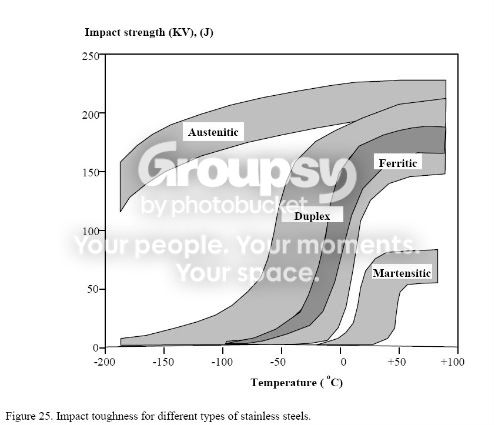
On paper it is true that martensitic stainless has a much lower impact toughness (not quite the same thing as brittleness) than low-alloy steel, especially at temperatures below freezing, but it seems to be theoretical distinction. I have shown this chart a few times, but I have never heard of a single story, anywhere on the rumourweb (or anywhere else, but I always expect to hear such stories on the web, first), of a stainless barrel shattering in the cold.