
I am aware or seem to remember that if loading military brass with a all ready worked up load for regular brass you have to back it off a certain amount. What about starting out with military brass do you start with starting load or is it safe to pick a load in the middle of the chart to start. First time with mil brass.













































You are using an out of date browser. It may not display this or other websites correctly.
You should upgrade or use an alternative browser.
You should upgrade or use an alternative browser.
Starting loads in military brass
- Thread starter wce323078
- Start date
The Hornady Reloading Manual #26 has a section on match loads using military brass and H4895 powder the comparison reads:
150 grain bullets - commercial brass = 44 gr. powder, versus 43 grains using military brass
165 / 168 grain bullets - commercial brass = 42 gr. powder, versus 40 gr. using military brass
180 grain bullets - commercial brass = 40 gr. powder, versus 39 gr. using military brass
A little less velocity and a little more work with primer pockets but I use military brass (and CCI Nato #34 primers) in all my M-14's and RFB's. They are Mil Spec. and built for semi's and machine guns. You will definitely get more reloads per brass than with commercial and feel a little safer. I also use the small base dies in all my semi auto's but you would be fine using neck sizer in your bolt actions, just keep them packaged separate.
Cheers
150 grain bullets - commercial brass = 44 gr. powder, versus 43 grains using military brass
165 / 168 grain bullets - commercial brass = 42 gr. powder, versus 40 gr. using military brass
180 grain bullets - commercial brass = 40 gr. powder, versus 39 gr. using military brass
A little less velocity and a little more work with primer pockets but I use military brass (and CCI Nato #34 primers) in all my M-14's and RFB's. They are Mil Spec. and built for semi's and machine guns. You will definitely get more reloads per brass than with commercial and feel a little safer. I also use the small base dies in all my semi auto's but you would be fine using neck sizer in your bolt actions, just keep them packaged separate.
Cheers
As far as I know, military brass is supposed to be somewhat thicker than civilian brass. The difficulty is checking that's actually true for whatever brass you have on hand... otherwise you're like me, relying on what everyone else says. 
I wonder why Hornady recommends less powder for the military brass than for the civilian brass? The issues that I heard about was how tightly military cartridges are crimped (to resist bullet movement in automatic weapons), and at what COAL compared to whatever you're loading. Tighter crimp means higher peak chamber pressure, same with shorter COAL. But if you reload milspec brass, you presumably won't be crimping as hard, so why reduce the powder load? In the end, I'm juggling with several unkonwns.
I can only speak from personal experience: I began in the low end of the chart for my 9mm loads on Israel Miliraty Industry (IMI) brass, but not at the actual minimum.
The data for Hodgdon CFE Pistol powder, Winchester case, CCI 500 primer, Berry's 9mm 124gr Hollow Base Round Nose Thick Jacket (HBRN TJ) at a COAL of 1.150" is 4.9 to 5.5gr.
I used IMI cases, CCI 550 (magnum) primers, Winchester 9mm 124gr FMJ bullets, with a shorter COAL of 1.123", and started with a load of 5.1gr of Hodgdon CFE Pistol powder:
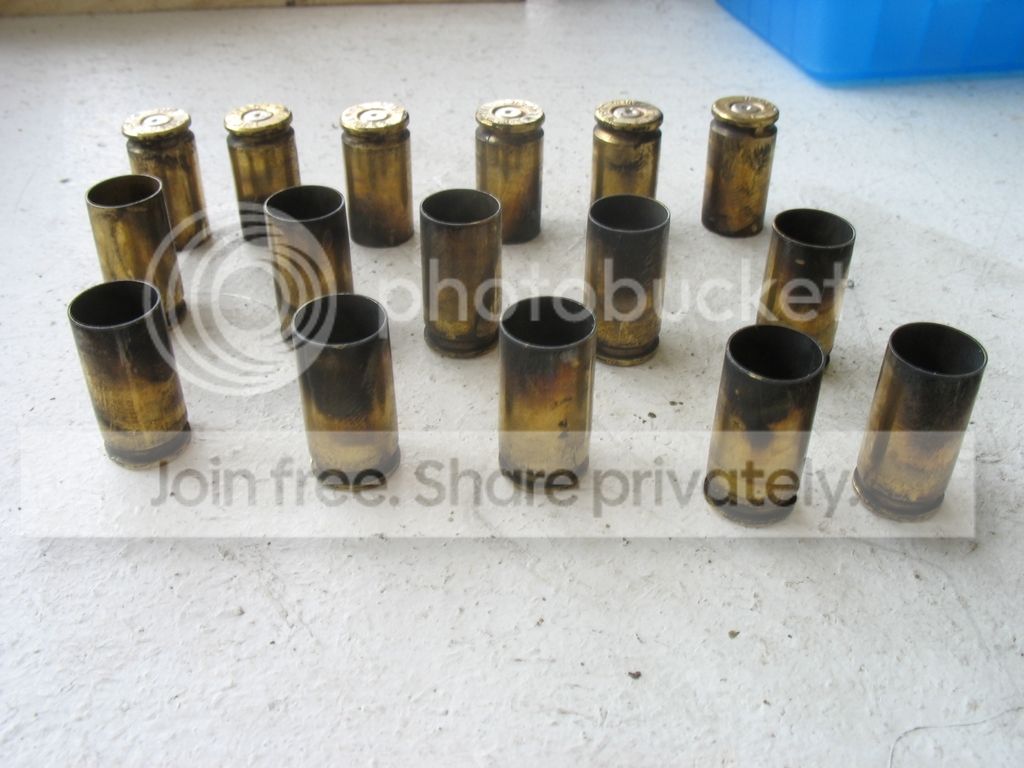
Same load, but with Geco cases at 1.121" COAL:
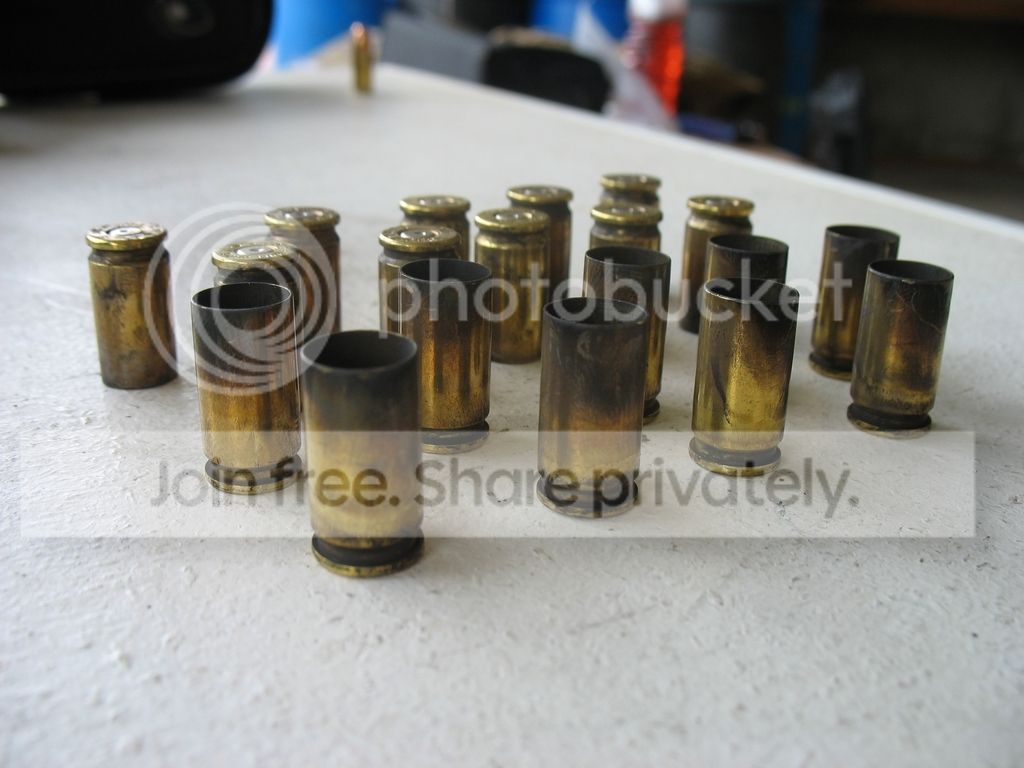
As you can see, the cases come out dirty as hell... I suspect that it's in part the fault of the Beretta Cx4 I use: it's a straight blowback design adapted from a military SMG (the Mx4) so I suspect the chamber might be just a tad oversize for reliability. With loads of 5.3gr, I have noticeably less soot on the cases than with 5.1gr, but it's still more soot than what the original factory loads from IMI were showing when I shot them:

I'll definitely try 5.5gr next, and I want to try slower powders too. First, I need to get a chronograph.
I wonder why Hornady recommends less powder for the military brass than for the civilian brass? The issues that I heard about was how tightly military cartridges are crimped (to resist bullet movement in automatic weapons), and at what COAL compared to whatever you're loading. Tighter crimp means higher peak chamber pressure, same with shorter COAL. But if you reload milspec brass, you presumably won't be crimping as hard, so why reduce the powder load? In the end, I'm juggling with several unkonwns.
I can only speak from personal experience: I began in the low end of the chart for my 9mm loads on Israel Miliraty Industry (IMI) brass, but not at the actual minimum.
The data for Hodgdon CFE Pistol powder, Winchester case, CCI 500 primer, Berry's 9mm 124gr Hollow Base Round Nose Thick Jacket (HBRN TJ) at a COAL of 1.150" is 4.9 to 5.5gr.
I used IMI cases, CCI 550 (magnum) primers, Winchester 9mm 124gr FMJ bullets, with a shorter COAL of 1.123", and started with a load of 5.1gr of Hodgdon CFE Pistol powder:
Same load, but with Geco cases at 1.121" COAL:
As you can see, the cases come out dirty as hell... I suspect that it's in part the fault of the Beretta Cx4 I use: it's a straight blowback design adapted from a military SMG (the Mx4) so I suspect the chamber might be just a tad oversize for reliability. With loads of 5.3gr, I have noticeably less soot on the cases than with 5.1gr, but it's still more soot than what the original factory loads from IMI were showing when I shot them:
I'll definitely try 5.5gr next, and I want to try slower powders too. First, I need to get a chronograph.
The thing with military rifle brass is it may have less case capacity so for a given powder charge in a smaller area increases the pressure. I assume the same is true with pistol brass. so if you are near max I would be checking for pressure signs. Myself I am starting from the beginig and was wondering if I could take a short cut to a degree. save some time but I am not wanting to take any chances
As far as I know, military brass is supposed to be somewhat thicker than civilian brass. The difficulty is checking that's actually true for whatever brass you have on hand... otherwise you're like me, relying on what everyone else says.
I wonder why Hornady recommends less powder for the military brass than for the civilian brass? The issues that I heard about was how tightly military cartridges are crimped (to resist bullet movement in automatic weapons), and at what COAL compared to whatever you're loading. Tighter crimp means higher peak chamber pressure, same with shorter COAL. But if you reload milspec brass, you presumably won't be crimping as hard, so why reduce the powder load? In the end, I'm juggling with several unkonwns.
I can only speak from personal experience: I began in the low end of the chart for my 9mm loads on Israel Miliraty Industry (IMI) brass, but not at the actual minimum.
The data for Hodgdon CFE Pistol powder, Winchester case, CCI 500 primer, Berry's 9mm 124gr Hollow Base Round Nose Thick Jacket (HBRN TJ) at a COAL of 1.150" is 4.9 to 5.5gr.
I used IMI cases, CCI 550 (magnum) primers, Winchester 9mm 124gr FMJ bullets, with a shorter COAL of 1.123", and started with a load of 5.1gr of Hodgdon CFE Pistol powder:
Same load, but with Geco cases at 1.121" COAL:
As you can see, the cases come out dirty as hell... I suspect that it's in part the fault of the Beretta Cx4 I use: it's a straight blowback design adapted from a military SMG (the Mx4) so I suspect the chamber might be just a tad oversize for reliability. With loads of 5.3gr, I have noticeably less soot on the cases than with 5.1gr, but it's still more soot than what the original factory loads from IMI were showing when I shot them:
I'll definitely try 5.5gr next, and I want to try slower powders too. First, I need to get a chronograph.

CFE is at the slow end of the spectrum for 9 mm so the soot may just be from incomplete combustion versus whatever IMI used originally.
Personally, I don't worry about military vs. commercial brass in reloading pistol ammo. I'm loading light loads and have found no issues of concern beyond the fact that some military 9 mm brass seems to have very tight primer pockets which take a little extra attention when seating primers.
Personally, I don't worry about military vs. commercial brass in reloading pistol ammo. I'm loading light loads and have found no issues of concern beyond the fact that some military 9 mm brass seems to have very tight primer pockets which take a little extra attention when seating primers.

Starting loads in military brass
Below military 7.62 Lake City case weight vs other military and commercial cases.

American 7.62 NATO Lake City brass is thicker with slightly less capacity than .308 cases, and the thumb rule is to reduce the load by 1 or 2 grains. On the flip side of this Lake City 5.56 cases have the most case capacity of .223/5.56 cases. The reason is the 5.56 case are made harder in the base of the case and not give up any case capacity.


Bottom line, always start low and work up and learn to read your primers and brass.
Below military 7.62 Lake City case weight vs other military and commercial cases.
American 7.62 NATO Lake City brass is thicker with slightly less capacity than .308 cases, and the thumb rule is to reduce the load by 1 or 2 grains. On the flip side of this Lake City 5.56 cases have the most case capacity of .223/5.56 cases. The reason is the 5.56 case are made harder in the base of the case and not give up any case capacity.
Bottom line, always start low and work up and learn to read your primers and brass.
The thing with military rifle brass is it may have less case capacity so for a given powder charge in a smaller area increases the pressure. I assume the same is true with pistol brass. so if you are near max I would be checking for pressure signs. Myself I am starting from the beginig and was wondering if I could take a short cut to a degree. save some time but I am not wanting to take any chances
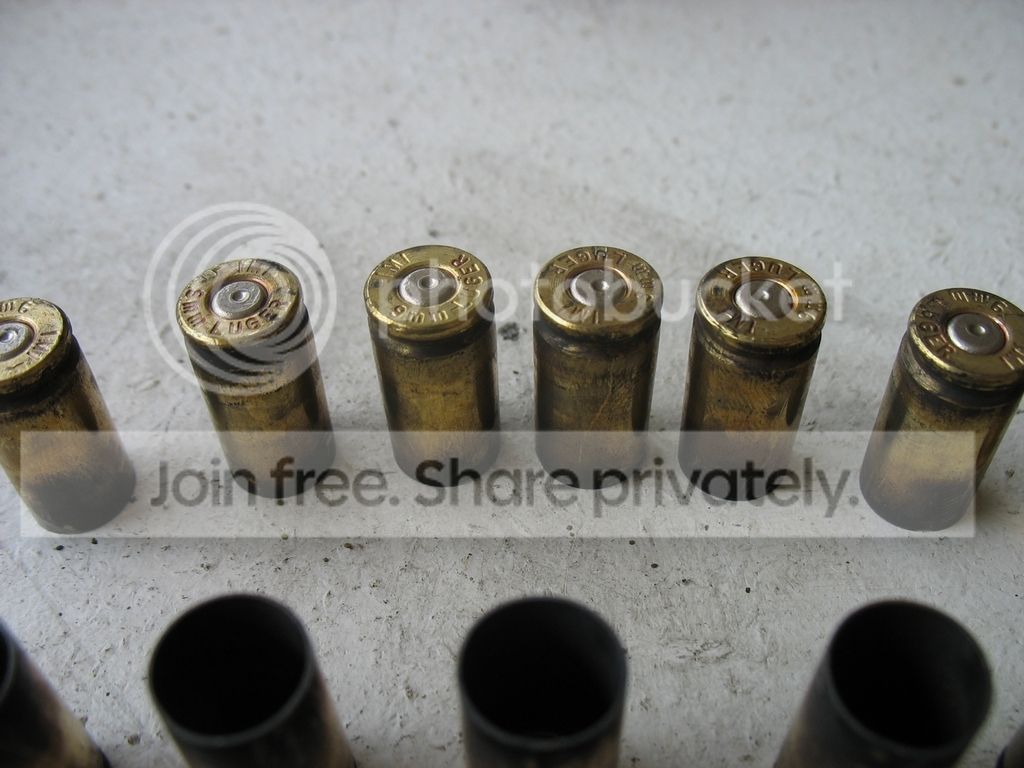
Excellent point about the case volume, I'd forgotten to mention it. That explains why they recommend to go down by a bit on the charge when using milspec brass. I did check the brass closely after shooting, and I can't find any sign of overpressure at 5.3gr yet. That's what they all looked like after firing them:
Last edited:
CFE is at the slow end of the spectrum for 9 mm so the soot may just be from incomplete combustion versus whatever IMI used originally.
Personally, I don't worry about military vs. commercial brass in reloading pistol ammo. I'm loading light loads and have found no issues of concern beyond the fact that some military 9 mm brass seems to have very tight primer pockets which take a little extra attention when seating primers.
That's in part why I chose it, the low burn rate. And I intend to try even lower burn rates (Accurate No7, VV 3N38, Hodg Longshot or similar) because the Cx4 has a 19-3/4" barrel. I'm curious to see if I can't coax some extra speed out of the bullet with a lower overall peak chamber pressure by taking advantage of all that barrel length.
I can't imagine why the combustion wouldn't be complete, the more since I'm using small pistol magnum primers. I could be wrong of course: there's a lot I surely don't understand yet in reloading.
Starting loads in military brass
American 7.62 NATO Lake City brass is thicker with slightly less capacity than .308 cases, and the thumb rule is to reduce the load by 1 or 2 grains. On the flip side of this Lake City 5.56 cases have the most case capacity of .223/5.56 cases. The reason is the 5.56 case are made harder in the base of the case and not give up any case capacity.
Great info, thanks a lot!

That's in part why I chose it, the low burn rate. And I intend to try even lower burn rates (Accurate No7, VV 3N38, Hodg Longshot or similar) because the Cx4 has a 19-3/4" barrel. I'm curious to see if I can't coax some extra speed out of the bullet with a lower overall peak chamber pressure by taking advantage of all that barrel length.
I can't imagine why the combustion wouldn't be complete, the more since I'm using small pistol magnum primers. I could be wrong of course: there's a lot I surely don't understand yet in reloading.
With Longshot I can get over 1900fps out of my CX4 with a 90gr Speer GDHP. The charge is over max listed in books but I can seat the bullet out far enough that I don't get any pressure signs. I won't post the charge but I will say any higher and I get a fireball out the ejection port due to unburned powder. That's chrono'd with my Magnetospeed. I advise caution. Start with book loads and get your seating depth right. Work up slowly and you can definitely wring out a significant speed increase thanks to the long barrel.
Thanks Sawzall! Right now I'm seating at 1.121"-1.123", but that's very much subject to change depending on the brand/model of the bullets I'll use. The IMI 9mm FMJ came almost maxed on COAL at about 1.160". My first loads were at about 1.150" and very sooty so I tried increasing the chamber pressure a little to get a better seal by "tightening" the COAL to 1.123". Mixed results... I think it's a little cleaner, but the difference is hard to see (and I didn't take pictures of those early loads, unfortunately. From now on it's SOP for my own records).
One thing I've been wondering about but not finding much info about: from what I could find, 9mm Luger was originally designed with a 124gr conical bullet to be shot out of 1 in 250mm twist barrels (roughly 1:10"). 115gr bullets appeared around WW2. You've used (presumably very short) 90gr bullets. What's the effect of using lighter bullets on the stability or accuracy of those rounds?
One thing I've been wondering about but not finding much info about: from what I could find, 9mm Luger was originally designed with a 124gr conical bullet to be shot out of 1 in 250mm twist barrels (roughly 1:10"). 115gr bullets appeared around WW2. You've used (presumably very short) 90gr bullets. What's the effect of using lighter bullets on the stability or accuracy of those rounds?

lots of good information. But unless I am missing something it doesn't tell me if I have to use starting loads from a reloading book. I have the impression which maybe wrong that when switching from regular brass to military you go down about 2gr and work up. But is that for a load that is near to max or all loads including starting loads. I will put this an other way. You have a new rifle in say .308 or .270 or what ever. and you want to reload. what do most people do they start from the starting load for a 165 gr interlock BTSP for .308, example taken from the Hornady book. say with IMR4895 at 37.7gr at 2300fps. or would most of us go look at the starting load of 37.7gr and max at 46.4 and pick the load in the middle of 41.2gr. at 2500fps. and work from there. I know pressure has a lot to do with the rifle used but what do most of you guys do to start out?
Well, as I understand it we can't consider the data in the the books (and much less the load data I find on the internet) like some written-in-stone holy writ: we're not likely to be using a test barrel and pressure sensor with the exact same cases, bullets, COAL, etc. than they did when they wrote the book. What the books give us are conservative estimates of a range of loads that will cause acceptable chamber pressures in our firearms (not +P-level) for each case/primer/powder/bullet/COAL combination they tested.
Seen that way, I see no particular reason to start at the exact minimum load listed, so I start at about one quarter of the load range given. If I'm told the min is 40 and the max 45, I'll begin at 41.5 and move up from there.
Seen that way, I see no particular reason to start at the exact minimum load listed, so I start at about one quarter of the load range given. If I'm told the min is 40 and the max 45, I'll begin at 41.5 and move up from there.
Well, as I understand it we can't consider the data in the the books (and much less the load data I find on the internet) like some written-in-stone holy writ: we're not likely to be using a test barrel and pressure sensor with the exact same cases, bullets, COAL, etc. than they did when they wrote the book. What the books give us are conservative estimates of a range of loads that will cause acceptable chamber pressures in our firearms (not +P-level) for each case/primer/powder/bullet/COAL combination they tested.
Seen that way, I see no particular reason to start at the exact minimum load listed, so I start at about one quarter of the load range given. If I'm told the min is 40 and the max 45, I'll begin at 41.5 and move up from there.
I have a seen a situation where the STRT load was very much way over pressure in a particular rifle.
With a new rifle I make a survey set of loads, starting with the STRT load, in 0.5 gr increments, 5 each and shoot them to see what hints at shooting best and to see where the rifle hits max. I am prepared to bring some of the ammo home.
I have a seen a situation where the STRT load was very much way over pressure in a particular rifle.
With a new rifle I make a survey set of loads, starting with the STRT load, in 0.5 gr increments, 5 each and shoot them to see what hints at shooting best and to see where the rifle hits max. I am prepared to bring some of the ammo home.
Overpressure at start load... ouch! That just doesn't seem right in so many ways.
That's a good system you have. What I do right now is batches of 20 so I can shoot 4 groups of 5 and see what seems promising for accuracy. I've not had to bring anything back unfired yet, possibly because I haven't gotten to max loads yet.
I really need to get a chrono, too. It's not exactly necessary, but it would sure help assess the bullet's behaviour. Went to get one today and the shop didn't have any in stock. So I came back instead with press bushings, shell plate and dies for a caliber I don't even have a gun to shoot yet. Damn this hobby is addictive...





















