










































You are using an out of date browser. It may not display this or other websites correctly.
You should upgrade or use an alternative browser.
You should upgrade or use an alternative browser.
Steyr L9-A1
- Thread starter idunno1987
- Start date


Briefcase_Wanker
Regular
- Location
- Edmonton, AB
I don't know how I feel about Austria's other handgun....

I asked about the sights in another forum but never got a reply. I'm pleasantly surprised to hear that we are not getting pistols with those God awful trapazoid sights foisted upon us in Canada again.
There will always be some people that like anything, no matter how silly it is, but for those who have never shot Steyr trapazoid sights... definitely try before you buy. There is a reason why only one firearms manufacturer sells trapazoid sights, and it isn't patents. They are horrendous to the point of being unusable. If you know what range the sights are calibrated for, and you shoot at that distance all day long and nothing else, the sights might be "ok", at the best, but the ability to compensate for different distances is just not there with the trapazoid sights. Additionally the rear sight is almost completely useless. Instead of helping your eye line up the front and rear sights, it actually causes your eye/brain to continuously question whether you do have it lined up or not. When I had my M9-A1, the only way I could use it was to not think in terms of the rear sight at all, and just look flat down the length of the slide to the front sight - and sort of line it up with the shape of the slide. Very frustrating, so slow, so lame. It was an "interesting" idea when Steyr came out with it in 1999, but it has long since shown itself to be a total failure - and even Steyr is finally moving away from it now. The "C" series don't have them, and it looks like the "L" series maybe don't have them either.
I have said here on CGN for years that I would be interested in trying/buying a Steyr "M"-type pistol again if they fixed:
(1) the trigger - the original M-series is one of that all time mush-ball triggers, so much worse than GLOCK;
(2) the ejection - reliable extration that is well "up and to the right" is a must. And get rid of that silly loaded chamber indicator on the breachface.
(3) the sights - I will never waste another round of ammunition on trapazoid sights. Horrible!
But, fortunately, it looks like all my concerns have been addressed - so I want to try one.
I have two Steyr GB pistols, a Scout and and SSG 69 (and had various other Steyr firearms in the past) so I'm always interested in everything Steyr has to offer.
By the way, I am also of the view that GLOCK pistols are bordering on unuseable with those silly plastic U-notch sights where the top of the rear sight doesn't line up with the top of the front sight (you'll shoot low at most pistol distances if you do that). The front dot is supposed to be bisected by the top of the rear sight. Which again, will work "o.k." at the distance the sights are calibrated for, but what about every other distance, starts to get hard to judge... and so slow. Just like the Steyr. Get Trijicon sights for your GLOCK and your shooting will get alot faster and more accurate.
If trapazoid sights work for you, great, but people that haven't tried them need to hear the other side of the story.
There will always be some people that like anything, no matter how silly it is, but for those who have never shot Steyr trapazoid sights... definitely try before you buy. There is a reason why only one firearms manufacturer sells trapazoid sights, and it isn't patents. They are horrendous to the point of being unusable. If you know what range the sights are calibrated for, and you shoot at that distance all day long and nothing else, the sights might be "ok", at the best, but the ability to compensate for different distances is just not there with the trapazoid sights. Additionally the rear sight is almost completely useless. Instead of helping your eye line up the front and rear sights, it actually causes your eye/brain to continuously question whether you do have it lined up or not. When I had my M9-A1, the only way I could use it was to not think in terms of the rear sight at all, and just look flat down the length of the slide to the front sight - and sort of line it up with the shape of the slide. Very frustrating, so slow, so lame. It was an "interesting" idea when Steyr came out with it in 1999, but it has long since shown itself to be a total failure - and even Steyr is finally moving away from it now. The "C" series don't have them, and it looks like the "L" series maybe don't have them either.
I have said here on CGN for years that I would be interested in trying/buying a Steyr "M"-type pistol again if they fixed:
(1) the trigger - the original M-series is one of that all time mush-ball triggers, so much worse than GLOCK;
(2) the ejection - reliable extration that is well "up and to the right" is a must. And get rid of that silly loaded chamber indicator on the breachface.
(3) the sights - I will never waste another round of ammunition on trapazoid sights. Horrible!
But, fortunately, it looks like all my concerns have been addressed - so I want to try one.
I have two Steyr GB pistols, a Scout and and SSG 69 (and had various other Steyr firearms in the past) so I'm always interested in everything Steyr has to offer.
By the way, I am also of the view that GLOCK pistols are bordering on unuseable with those silly plastic U-notch sights where the top of the rear sight doesn't line up with the top of the front sight (you'll shoot low at most pistol distances if you do that). The front dot is supposed to be bisected by the top of the rear sight. Which again, will work "o.k." at the distance the sights are calibrated for, but what about every other distance, starts to get hard to judge... and so slow. Just like the Steyr. Get Trijicon sights for your GLOCK and your shooting will get alot faster and more accurate.
If trapazoid sights work for you, great, but people that haven't tried them need to hear the other side of the story.

Instead of helping your eye line up the front and rear sights, it actually causes your eye/brain to continuously question whether you do have it lined up or not. When I had my M9-A1, the only way I could use it was to not think in terms of the rear sight at all, and just look flat down the length of the slide to the front sight
I'm trying to figure out what you are describing, because I'm having a hard time visualizing it. When I try to look flat down the slide on my M, the front sight sits way too low. I thought the Steyr sights are straight forward - the triangle fits inside the trapezoid.

Wow, it is really hard to align the sights of a pistol you're not holding using a camera phone. It's a little off center, but you get the gist.
And then the tip of the triangle is the point of aim/impact.

Stick them with the pointy end.
I thought it was self-evident, "the block goes in the hole of the same shape" kindergarten stuff, but I constantly hear stories of people thinking you have to build a pyramid or other odd tales when the proper sight alignment is even drawn on the case the gun comes in.

I bet they'd put it in the manual, too, if they thought for a second that someone would actually read it.
People see something different and their brain just turns off, I guess. True, its more difficult to adjust to extreme ranges, like 50+ yards, but they were designed as sights for a service handgun, so they're like a red dot sight on a carbine - terrible for the extreme ranges a rifle can potentially reach, but excellent for actual engagement distances. I've had a bunch of people try mine, including some older gents with failing eyes. Their responses have unanimously been "Can I get these sights for MY handgun?" because they are so easy to align, even with glasses that would distort a normal sight picture.
I bought this handgun with the impression that there would at least be trapezoid sights available to swap out. If nothing else, the supposed "majority" who disliked the trapezoidal sights would be willing to sell theirs to me. No luck. In the US, Steyr USA has them readily available. But it's Steyr USA, so they don't even answer my e-mails. It's driving me up the wall. As a last ditch attempt, I've contacted Steyr Austria.
I've had an ad up in the EE for weeks, but I'll say it again here: If anyone has an M and doesn't like the trap sights, I WILL TRADE YOU.
Take my three-dots, please!
Last edited:
Yah, I appreciate that what I am saying is not easy to understand when described in words. And, some people like different things on their firearms. Not everyone will shoot their best with the same sights - but the numbers don't lie. You simply do not see anyone, anywhere, selling trapazoid sights for pistols (except Steyr, and even they are moving away from it now). The reason is because they are really hard to use, and are not used by anyone except hard-core Steyr fans. What I am trying to warn people of here is the obvious: something like 99.9% of the firearms community, firearms makers, etc. worldwide, have rejected the trapazoid pistol sights since they were first instroduced in 1999. Maybe a 0.01% group (or less) have turned the M-type pistols into a cult following type of thing. Buyer beware.
Here is a 1980s era Steyr pistol, the GB, from my collection. It is a lot more accurate and easy to use than an M-type pistol. Why? A big part of it is the sights. Even when looking at this photo your brain immediately recognizes that to hit the target dead on you will need to move the muzzle a little bit to the left - because their is more space on the left of the front sight than on the right. And this will work even if the front sight is raised up above the rear sight for a longer distance shot. You will not (likely) have this kind of immediate eye/brain/hand reaction with Steyr trapazoid sights. It will be lots of guessing, trial and error and frustration.
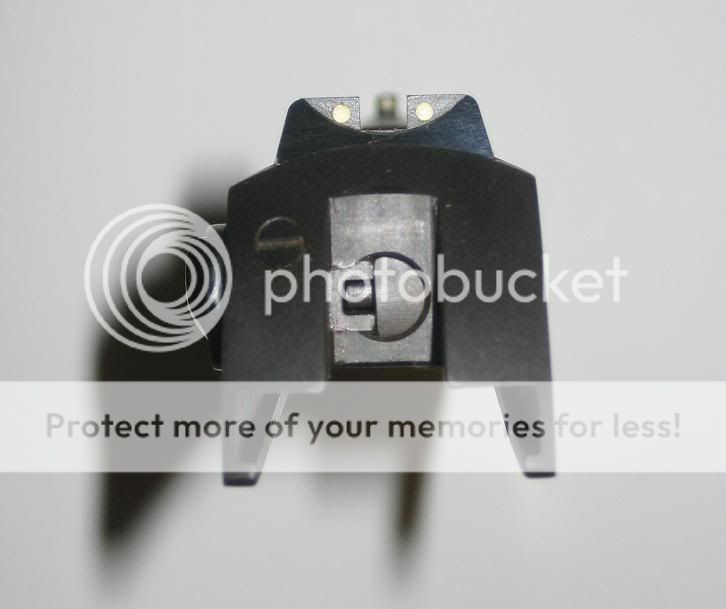
And here is a SIG 229:
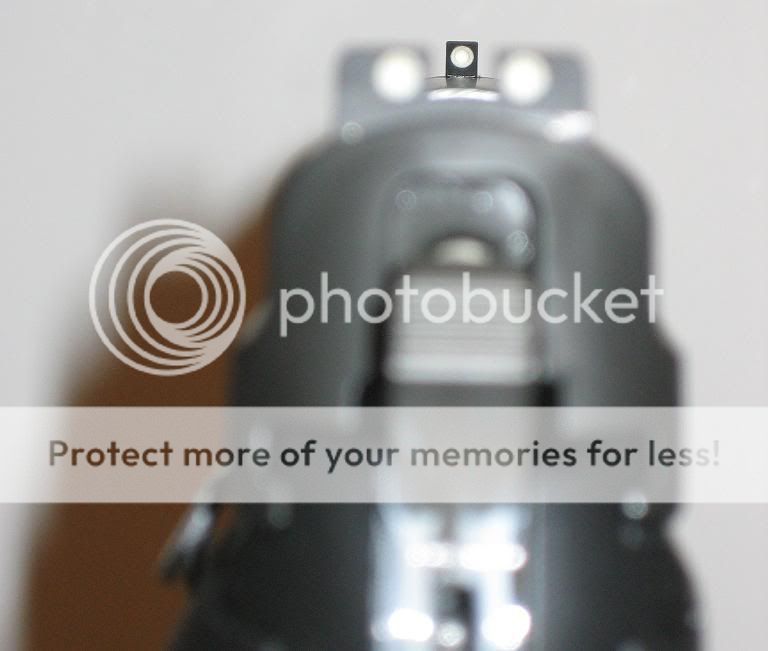
If you want impact to be higher, or you are shooting at a longer distance - it is obvious what you have to do, and MOST IMPORTANTLY you are gauging straight lines vs. straight lines. You can clearly see, and remember, how much above the rear sight you had to put the front sight in order to hit the target at 25m, 50m, etc.
This kind of sight picture is easy to gauge, estimate, whatever.... and it is easily REPEATABLE.
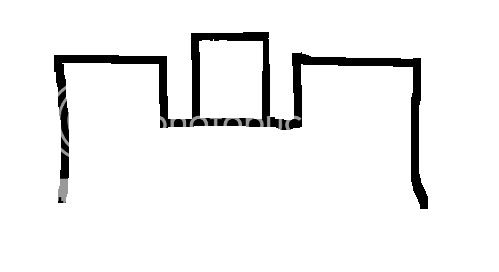
With the trapazoid sights, you are dealing with angles that relate to other angles, and as you move the sights around the angles change. Making the kind of shot shown in the drawing above with trap sights, the rear sight actually partially covers the front sight, and you just have the tip of the pyramid sticking up over it, and the angles have all changed in relation to each other. If you find that easier, great. Have at it.
Lining the sights up like it shows on the logo on the box, yes that will work... at one distance, the one the pistol is sighted in form, as I mentioned above. But there are two big weaknesses:
(1) windage- instead of gauging a space on each side of the front sight, you've got these angles, and they only line up perfectly at one position (what the gun is sighted in for) instead of all positions, like a notch and post sight. If you are a little bit off, your shot will be off. The longer the distance of the target, the more you are off.
(2) elevation - instead of being able to gauge how much the flat front sight is above the flat top of the rear sight, you are judging how much the tip of a pyramid is above the top of a trapazoid. It sounds like it wouldn't make much difference, but for the vast, vast majority of shooters it is slower and less accurate.
I sold my M about 7-8 years ago, but I'm going to see if I have any photos of it on my Photobucket to try and illustrate:
This is the best I could come up with, with the Steyr obviously being at the far right (second from the end):
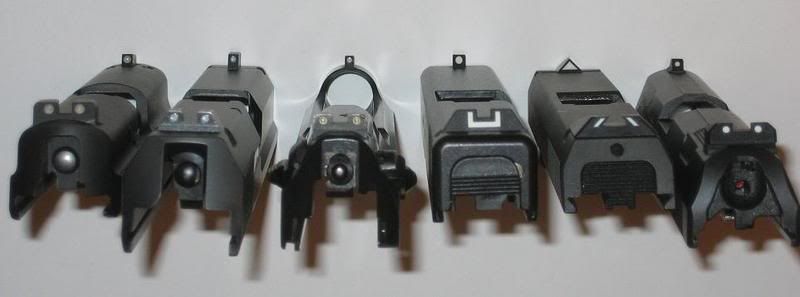
Steyr great company. Great products. They do have a bit of a reputation for getting wacky and/or not fully tested products into the market place. I like them, but the trapazoid sight thing is a total failure that people should definitely stay away from unless they have signifigant rounds through the gun past the initial "honeymoon" period.
Here is a 1980s era Steyr pistol, the GB, from my collection. It is a lot more accurate and easy to use than an M-type pistol. Why? A big part of it is the sights. Even when looking at this photo your brain immediately recognizes that to hit the target dead on you will need to move the muzzle a little bit to the left - because their is more space on the left of the front sight than on the right. And this will work even if the front sight is raised up above the rear sight for a longer distance shot. You will not (likely) have this kind of immediate eye/brain/hand reaction with Steyr trapazoid sights. It will be lots of guessing, trial and error and frustration.
And here is a SIG 229:
If you want impact to be higher, or you are shooting at a longer distance - it is obvious what you have to do, and MOST IMPORTANTLY you are gauging straight lines vs. straight lines. You can clearly see, and remember, how much above the rear sight you had to put the front sight in order to hit the target at 25m, 50m, etc.
This kind of sight picture is easy to gauge, estimate, whatever.... and it is easily REPEATABLE.
With the trapazoid sights, you are dealing with angles that relate to other angles, and as you move the sights around the angles change. Making the kind of shot shown in the drawing above with trap sights, the rear sight actually partially covers the front sight, and you just have the tip of the pyramid sticking up over it, and the angles have all changed in relation to each other. If you find that easier, great. Have at it.
Lining the sights up like it shows on the logo on the box, yes that will work... at one distance, the one the pistol is sighted in form, as I mentioned above. But there are two big weaknesses:
(1) windage- instead of gauging a space on each side of the front sight, you've got these angles, and they only line up perfectly at one position (what the gun is sighted in for) instead of all positions, like a notch and post sight. If you are a little bit off, your shot will be off. The longer the distance of the target, the more you are off.
(2) elevation - instead of being able to gauge how much the flat front sight is above the flat top of the rear sight, you are judging how much the tip of a pyramid is above the top of a trapazoid. It sounds like it wouldn't make much difference, but for the vast, vast majority of shooters it is slower and less accurate.
I sold my M about 7-8 years ago, but I'm going to see if I have any photos of it on my Photobucket to try and illustrate:
This is the best I could come up with, with the Steyr obviously being at the far right (second from the end):
Steyr great company. Great products. They do have a bit of a reputation for getting wacky and/or not fully tested products into the market place. I like them, but the trapazoid sight thing is a total failure that people should definitely stay away from unless they have signifigant rounds through the gun past the initial "honeymoon" period.
Last edited:
Lining the sights up like it shows on the logo on the box, yes that will work... at one distance
That "one distance" is 1-50 yards. Mine shoots like a laser. I've seen the odd question about Steyrs seemingly shooting low. Mine did too... at first. It's the shooter, not the gun. After some practice, it was dead on target every time.
windage- instead of gauging a space on each side of the front sight, you've got these angles, and they only line up perfectly at one position (what the gun is sighted in for) instead of all positions, like a notch and post sight.
Fiddiling with front sight placement to adjust for windage? Wouldn't aiming off be more consistent? Honest question, I've never shot a pistol at such long distances at ranges without a berm that windage even becomes a factor.
elevation - instead of being able to gauge how much the flat front sight is above the flat top of the rear sight, you are judging how the tip of a pyramid is above the top of a trapazoid. It sounds like it wouldn't make much difference, but for the vast, vast majority of shooters it is slower and less accurate.
I will agree it's much more difficult at extreme ranges, as it doesn't have the night straight walls to make your adjustments consistent. But it's a service pistol, not a precision rifle. The sights are optimized for speed, and in that role they excel. It's like going "The ghost ring sights on my shotgun are garbage because they cant hit skeet and trap." Or "My 4MOA red dot is useless because my AR can't make 1" groups at 200m with it." If the sights are designed for one thing, and you try to use them for something else, of course you're going to get less than optimal results.
So yes, people should be aware of the nature of the sights before buying.
I don't think Steyr is moving away from the trapezoidal sights at all. As stated, the Americans are getting them with their L9A1s. It's not a Glock, and Steyr is terrible at marketing, so the aftermarket accessories just aren't there. I think they're just offering an alternative, because obviously, there is some demand for them and until now, the only alternative have Been $100+ Trijicons. Unfortunately, we only got the alternative. And unfortunately, being Canada, no one thought to supply us with a choice. Typical, really.
Last edited:
Well, if it works for you, that's great. I just wanted to see the counterpoint to the "why are we getting the pistols without the GOOD sights" theme in this thread.
Steyr is definitely moving away from the trapazoid sights. There was a time not so long ago that you could NOT get a pistol out of the Steyr factory without those sights. You had to go to an aftermarket sight maker to get anything other than the trapazoid sights. I believe Meproight was the first one to offer them, but their are others. Now it seems that there are as many three dots coming out as trapazoids. Give it a few more years and I think you will see trapazoids as a factory option only. They'll never drop it altogether, but it will become less and less common to see them - in my view.
I agree with you that there should be both options available, and that the importation and distribution of Steyr products in Canada really leaves a lot to be desired. I personally prefer to deal with Phil O'Dell of O'Dell Engineering for all things Steyr, but I don't think he deals in the pistols, at least not new ones, just the rifles and older stuff.
Steyr is definitely moving away from the trapazoid sights. There was a time not so long ago that you could NOT get a pistol out of the Steyr factory without those sights. You had to go to an aftermarket sight maker to get anything other than the trapazoid sights. I believe Meproight was the first one to offer them, but their are others. Now it seems that there are as many three dots coming out as trapazoids. Give it a few more years and I think you will see trapazoids as a factory option only. They'll never drop it altogether, but it will become less and less common to see them - in my view.
I agree with you that there should be both options available, and that the importation and distribution of Steyr products in Canada really leaves a lot to be desired. I personally prefer to deal with Phil O'Dell of O'Dell Engineering for all things Steyr, but I don't think he deals in the pistols, at least not new ones, just the rifles and older stuff.
Last edited:
problems with the first gen M9? I am assuming you are talking the second generation A1's because I have the original austrian made M9 along with a few other friends and there have been zero issues with any of them, people who have tried mine and bought the A1 because they liked how it shot but original was no longer available have had issues.Im surprised there hasn't been a thread on this yet. The Steyr L9 is available at a few retailers, and was wondering if anyone has been able to try one out. Im debating if I should replace my G17 with one as the Steyr seems to fit my hand a lot better. Just worried about reliability problems as with the first gen M9's
Thanks