












































Stuck, not sure why.

Simplesam

Regular
Rating - 100%
16   0   0
So last night I was prepping some brass (Lapua 308 brass with Lee collet neck die, Forster co-ax press). I sized one neck and put the ram down, it felt a bit tight on the down stroke and on the way up it jammed. Would not budge. Wiggled it a bit and got it up. Inspected the brass and the neck was messed up, gouged and warped. Tried another piece of brass (all new), same thing. Could not get the ram up and in frustration used a bit too much force and the neck of the brass broke off in the die/decapping pin. Pics included.. What happened?

You can see the neck stuck in the pin.
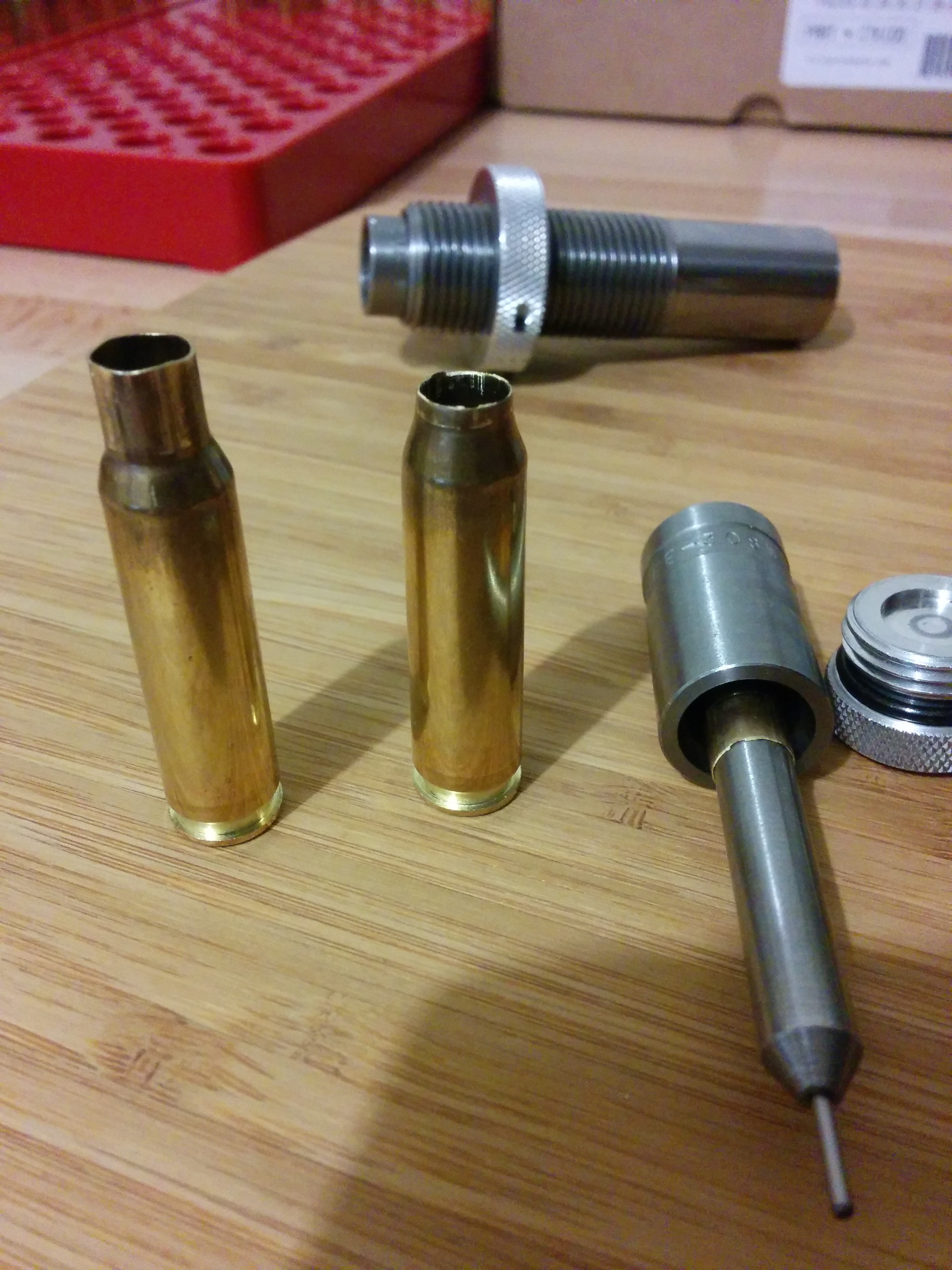
8q1GdHx.jpg
 
Is the collet die new?

Watch the ammo smith's set of videos on them, first one is below

[youtube]mhTUgytUGnM[/youtube]
 
I have never lubed a Lee Colet neck die, this is very odd. The #1 reason I choose Lee Colet dies for all my bolt guns is to skip the lube step.

What does the Colet look like? damaged? How about the mandrel? Is there a burr on it that is getting a grip on the case mouth?

If I had to take a very wild guess, I would say the die was adjusted too tight and cycled in the press without a piece of brass, allowing steel on steel contact of the Colet jaws on the mandrel galling the mandrel enough to grab the brass.
 
Simplesam

I have several Lee collet dies and I'm not a big fan because of the marks left on the case necks. Meaning the collet needs polishing to remove burs and rough edges between the finger cuts. Also the collet needs to have the fingers or pedals opened up many times (bent outward) to allow clearance between the mandrel and inside of the collet.

Below to each his own but I do "NOT" like what the Lee Collet die does to the brass on the inside and outside of neck of the case. The marks below are caused by the cuts between the fingers or pedals that leave sharp rough edges. When the collet closes brass is pinched between these collet cuts and leaves these marks. Preventing this depends on the polishing the collet slots to keep them from "biting" into the brass. The last Lee collet die I bought was for the .223 and because it was smaller to work with and very roughly made I used it once and put it away and never used it again. The design of the collet die is a good idea "BUT" Lee needs to make a more polished and refined die with better quality control.

leecolletdie1_zps5aaf6dcb.jpg


leecollet3_zps098565b9.jpg


I get less runout by full length resizing with Forster full length dies with the high mounted expander ball. The spindle floats and the expander ball enters the case neck while the case neck is still inside the neck of the die. Meaning the necks are not pulled off center by the expander ball.

Below a RCBS decapping unit on the left and the Forster unit on the right. I ordered the Forster decapping units separately and installed them on my RCBS dies.

IMG_2141_zps77852ff6.jpg


Bottom line, I believe I get better accuracy by full length resizing and because I have brass OCD I do not like cheap dies marking up the necks of my cases.

I have one .303 British Lee Collet die that I spent a long time polishing and smoothing and tweaking the collet that works well. And I think that Lee needs to be the one cleaning up the rough edges of these dies and not the person who buys them. And there are too many quality die makers who make a "smooth polished" die to mess around with crudely made products. And Redding bushing dies do a better job and do not mark up the case necks. My 2 cents.
 
The Lee collet dies work well BUT they do need some attention to the collet and mandrel. I've had to polish both the mandrel and collet (outside) because they started to get sticky, caused by lube and dirty necks and also burrs on new dies.
Enjoy
 
Back
Top Bottom





















