Don't beat me up for this but from what I have understood over the years I have always tried to keep my lead bullets in the 900 fps area to prevent leading in the barrel . I have never reloaded lead bullets with gas checks on the ends . if so then I would increase the Velocity to Magnum speeds .
I see no reason to beat you up, and I'll expound on your statement, perhaps a bit further than the threads original path. Although not entirely a fps limit as other factors come into play, but for a normal cast bullet of medium hardness and lubed in a conventional manner, in order to exceed 800 to 900 fps does require that more things are more perfect. IOW, the condition and size of the bore/groove, and may require matching the lube to the load. There hare many lubes, some hard, some soft, some with alox, some without alox, etc. And not all bullets can tolerate velocity.
But in a nutshell, the limit is around that 900 fps. That is of course from a pistol, in a rifle, which is less prone to bore leading, (usually), that speed would be closer to 1200 fps. Accuracy would be your criteria. With a rifle, a chronograph only tells one part of the story, the target will tell you the rest of the story. Usually, without too much fanfare, 2" groups are easily obtained. To get smaller groups, takes a bit more work, or luck.
A gas checked, properly designed bullet can usually be driven a bit faster. One factor is that the copper gas check can grip the rifling better than lead. The gas check also lets your alloy be a bit softer than your pressure would normally allow. Here the real life limit is around 1600 fps, perhaps 1800 fps under some circumstances. Part of the fun and enjoyment of shooting cast is that the loads don't beat you up. I had a Winchester 1894 in 38-55. A light rifle and somewhere after 1800 fps with a 285 gr bullet, the fun factor went away. At around 1600 fps accuracy was good and I didn't have to perform and bullet or reloading heroics to get good accuracy. It is in the zone for most rifles. Rifles shooting pistol calibers with gas checked bullets is a bit out of my sphere of experience, but if you switch between cast and jacketed bullets, using a gas checked bullet is something I'd recommend.
Coating or painting a cast bullet extends it range of trouble free use. I've used Hi-Tek coated bullets, and they are real forgiving. Leading is not the norm, although if you try, you can make them lead the bore/grooves. This I know from experience. But, as a rule of thumb, near gas check velocities are possible, with good accuracy.
Harder cast bullets are a bit more forgiving than softer ones, for the most part. Some casters water drop their bullets to temper them, make them harder, others heat treat them even harder. Others cast with linotype for hard (and a bit more brittle) bullet. If sized near to groove diameter, hard bullets can shoot rather well.
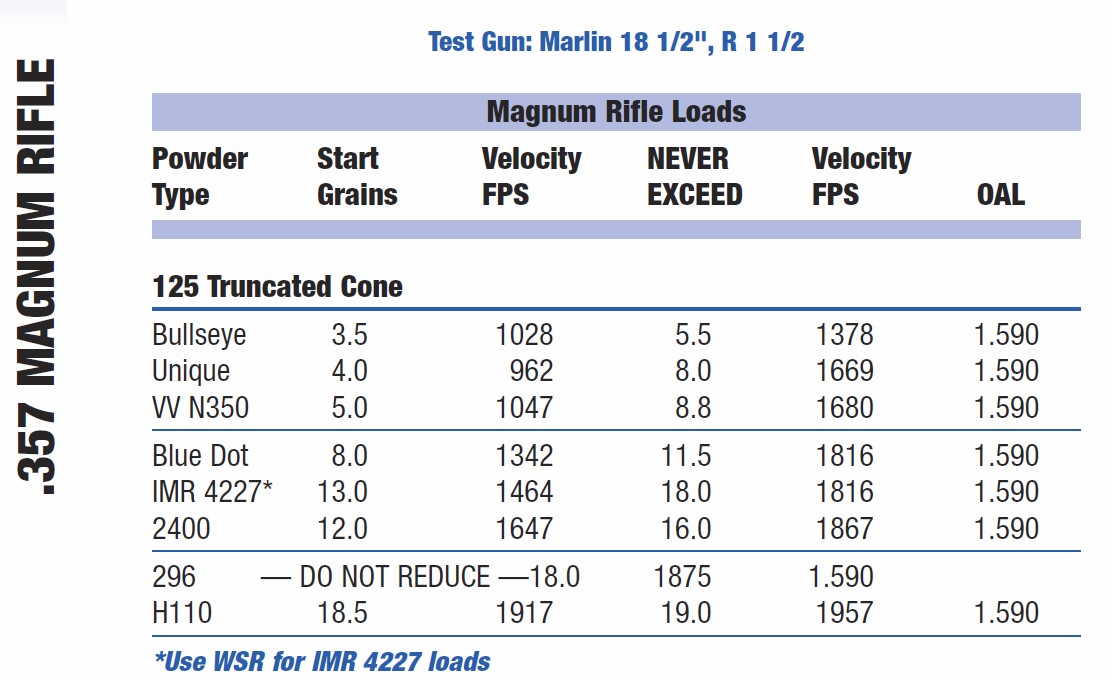
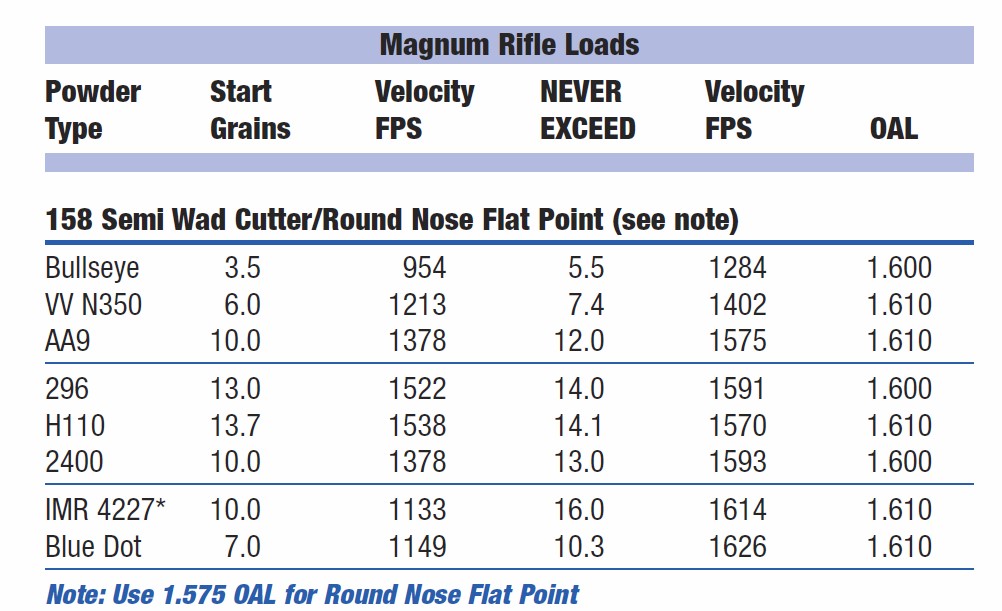
But: To stay on topic, that is what powder is best for my 140 gr commercial cast bullet in a 357 Mag rifle, I'll post some data, a bit outdated, for Oregon Trails laser cast bullets. First off, a 140 gr truncated cone or SWC bullet is not common, and the data I'll post is no exception. They have 125 data and 158 data, that's it.
I still think your best luck will be with Clays. Lots of shooters use Titegroup, and I've tried it in my 357. It's OK, showed some promise. It's used as a substitute for bullseye mostly. It burns a bit cleaner and is less position sensitive. H110 is a somewhat specialized powder. It is the same as WW 296. reducing the charge below listed minimum is not recommended.
And please don't beat me up, I'm still new to the game of shooting cast. I probably haven't shot more than 500 # of lead. For a while I bought molds, have at least 20, and have learned that there is no magic bullet. Shooting cast is a bit Zen like, depends on the magic for success.
Nitro