SVT Finnish capture

Snider shooter

CGN Ultra frequent flyer
Super GunNutz
Rating - 100%
18   0   0
I have been trying to get a svt 40 from a fellow for over 2 years and he has finally said yes. I believe it maybe a Finnish capture. What marks am I looking for to confirm this.
1941 Izzy
6 port brake
5 round mag
SA marked on mag and receiver
i am going by what I can remember from seeing it in October.
Serial number started with a k.
Tomorrow it should be in my hands.
 
There is a Finnish-made version of the Russian stock. It is lighter birch wood and has slightly different profiles. Harder still to find than a more typical Russian rifle picked up off a snowy battlefield.

What colour is the bolt carrier? For an old import piece, it should be unfinnished (get it? Finnished?).

If my sequencing is correct there were several waves of imports.

The last batches have plum red bolt carriers. A dead giveaway. These are the most numerous, and have the widest variety of makers, years, and variations. Everything has electric pencil scribbled numbers.

The next to last group came in the 90's. Mine came through Jose Reis with G5 Imports (?) on the south shore of Montreal. It was refinished with modern bluing, and German proof house marks were laser engraved in places.

There was a long drought to the next batch. In my opinion, this is when the Finnish capture rifles came to Canada. These have SA marks, are often in rack-grade surplus condition, and often in poor overall shape than the later batches. If the chronology is right, they arrived when 7.62x54R ammunition simply wasn't being sold by the Soviets and anything else was pricey as heck. For that reason, a company in Vanier (Ottawa) calling themselves Globe Firearms converted large numbers of SVTs to .303 British, shortened the front ends, and sold them as Mohawks. Just about as pathetic a conversion as conceivable. They put the chop on everything they bought, trying to make a living when no one was buying rifles they couldn't shoot.

FWIW, Americans cannot buy SVT rifles. So ours are cause for real border envy.

 
FWIW, Americans cannot buy SVT rifles. So ours are cause for real border envy.

They can't bring more SVT's in to the US- there are lots there already but it's a big market so even run of the mill refurbs go for well over $1000 (US).

maple_leaf_eh: Any idea when the "Bulgarian Light refurbs" came into Canada?

milsurpo
 
My SVT-40 has a birch and is slightly different shape than my other SVT. Bolt carrier unfinished. I tried some rounds in the mag and the fifth is too tight and wont feed. Came with a leather sling with narrow buttons that are removed by turning sling sideways. No elactro pencil markings so probably came in a few years ago. Has the rails but no notch. I believe she will be staying with me for a while.
 
There is a Finnish-made version of the Russian stock. It is lighter birch wood and has slightly different profiles. Harder still to find than a more typical Russian rifle picked up off a snowy battlefield.

What colour is the bolt carrier? For an old import piece, it should be unfinnished (get it? Finnished?).

If my sequencing is correct there were several waves of imports.

The last batches have plum red bolt carriers. A dead giveaway. These are the most numerous, and have the widest variety of makers, years, and variations. Everything has electric pencil scribbled numbers.

The next to last group came in the 90's. Mine came through Jose Reis with G5 Imports (?) on the south shore of Montreal. It was refinished with modern bluing, and German proof house marks were laser engraved in places.

There was a long drought to the next batch. In my opinion, this is when the Finnish capture rifles came to Canada. These have SA marks, are often in rack-grade surplus condition, and often in poor overall shape than the later batches. If the chronology is right, they arrived when 7.62x54R ammunition simply wasn't being sold by the Soviets and anything else was pricey as heck. For that reason, a company in Vanier (Ottawa) calling themselves Globe Firearms converted large numbers of SVTs to .303 British, shortened the front ends, and sold them as Mohawks. Just about as pathetic a conversion as conceivable. They put the chop on everything they bought, trying to make a living when no one was buying rifles they couldn't shoot.

FWIW, Americans cannot buy SVT rifles. So ours are cause for real border envy.

You should check out “Horilkas” thread on collecting SVT-40’s :)

Many left the factory originally with plum bolts, although yes the majority of refurb bolts were also re-blued. (Hotter bath makes them plum.)

Americans can buy SVT-40’s, there are lots down there. They just can’t import more due to import regs.

The Finns did not make SVT-40 stocks, only Mosin ones.

I agree the Mohawk sporters are sketchy as best :p
 
Colour is not important as most of stocks on Finnish captures are sanded and refinished. Important are new or remains of old technological, acceptance, make or serial markings.
Are there any on stock of your SVT-40?
 
As far as I am aware, Globe Firearms in Ottawa brought in the first SVTs which entered this country in any number. At first they tried to sell them as-is but, with Remington ammunition unavailable in this country, there was no ammo apart from rebulleted Soviet stuff. These were early-production rifles for the most part and had the Finnish property markings. They sold for $39.95. That would have been in the middle/late 1960s.

Stuck with a warehouse full of these things, they came up with the Mohawk sporter, otherwise known as the GLOBCO 555, a radically reworked SVT action with the gas assembly shortened a bit too much, a .303 barrel and the original magazines shortened to handle 5 or 6 rounds of .303. These had spiffy new 'sporting' stocks, a deep blue finish and polished carriers. I saw one in 1967 at A&L Cycle in Brandon, marked at $99.95. The Finnish SA marking generally was visible even though the rifles had been extensively polished. They quickly got a bad name due to violent ejection and the occasional full-autoing due to over-gassing combined with the trough receiver.

I got through university and got an actual JOB teaching high-school out on Fogo Island, so moved just about as far East as is possible in this country. Once moving expenses were paid, there was a bit of cash left over, so I wrote to Globe; I was in search of one of those unmolested SVTs. They still had exactly ONE left and were happy to get their $39.95 for it. They dragged it out of a corner and shipped it, complete with clipped firing-pin and chopped 303 magazine.... but it was an actual Tokarev, built in 1940 and sporting the 6-port brake. The finish seems original and is much nicer than I had expected on a Russian rifle, but that likely can be accounted for by the early production date. It is a nice-looking rifle, light for its length but evidently Ukko had been at work, as the serials are an absolute dog's breakfast. It does have an awfully-nice bore, so I have no complaints. I only found out about that nice little SA stamp afterwards but knew instantly that there was something not quite right, there being no letter "S" in the Cyrillic alphabet. A fellow teacher in Fogo had a little lathe and was good enough to manufacture a firing-pin and that was installed. I got a set of RCBS dies and 100 rounds of Norma brass and started playing with the brute. That was 1976. I found that it wanted to operate but obviously was undergassed..... and there were NO gas-adjustment tools available, nor instructions anywhere for adjusting the gas. The Tok has fired 1 box of ammo in the past 43 years; I suppose it's almost time to dig it out and adjust that damned gas setting!


I did run into the results of an overgassed SVT once and grabbed the casings when I had the chance. These came from a Mohawk sporter which had the gas set much too high for the very short length of the pistin assembly. Port pressure must have been horrendous: the first casing was straightened-out almost completely and the final one had actually fired in an unlocked condition. BOTH rims had been SLOTTED by passing over the Ejector at high speed. The rifle had been condemned by the gunsmith in Grand Falls.... and very properly so.

I would think the rifle under discussion would have been another of Globe's end-of-the-run specimens, bearing both SA marking and the 6-round magazine.

The best part is that gas-adjustment tools are now available; it is no longer necessary to fire your Tokarev in BC and walk to Saskatchewan to find your brass!
 
I have 2 SVT 40's one of the early Finnish imports with the unfinished bolt SA marked, the other from a later batch of imports with the plumb bolt

both are earlier production and have the 6 slot muzzle brake.
 
...

The Finns did not make SVT-40 stocks, only Mosin ones.

...

I won't be able to ask my SVT parts changer about the Finnish replacement stock for several months. He went off and joined the Army. Silly fool! Letting his career ambitions get in the way of my trivial research questions.
 
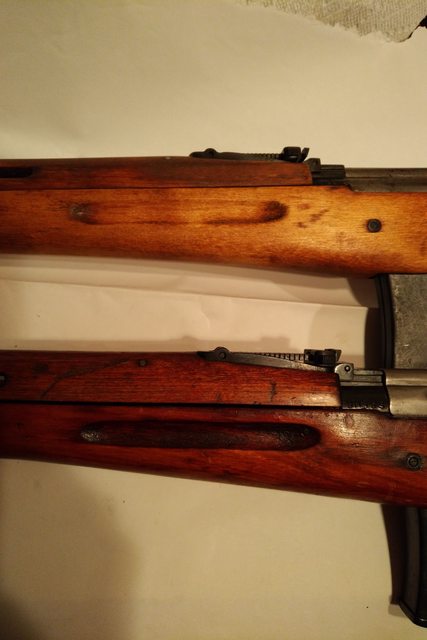
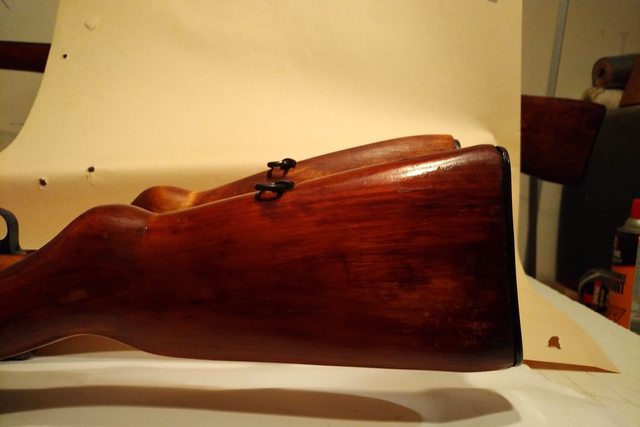
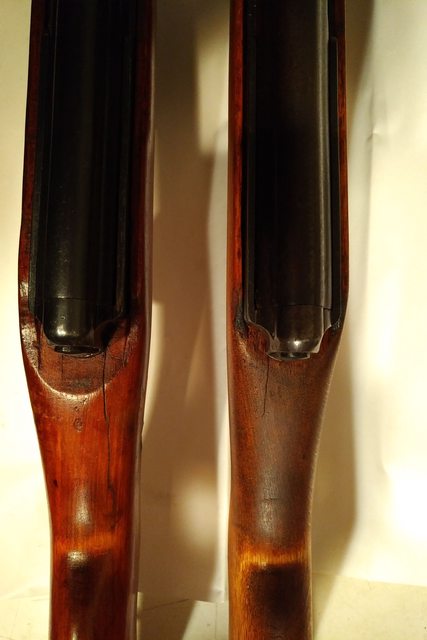
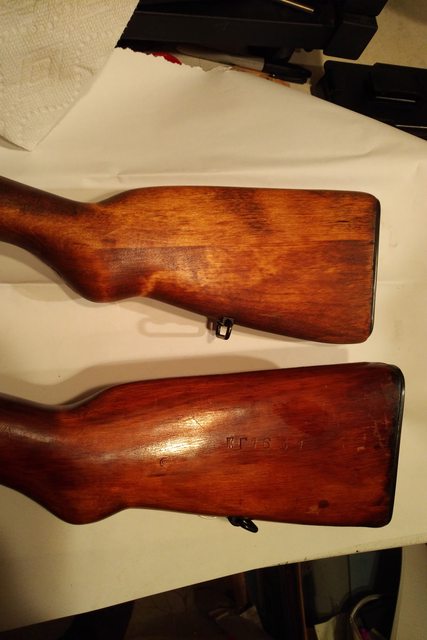
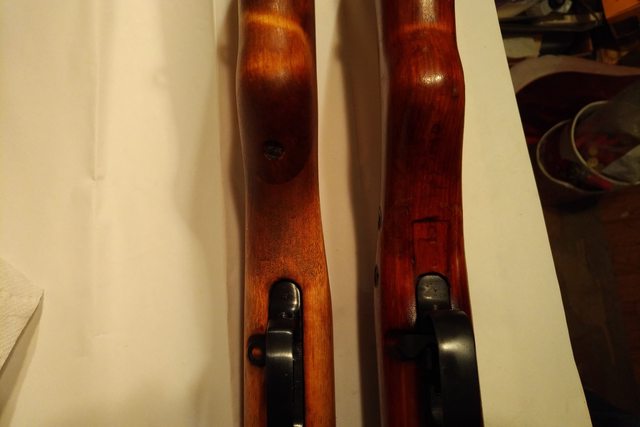
Finnish SA replacement SVT40 stock - here are six photos, beside a similar Russian stock.

The wood is lighter colour than the same vintage of Russian stock. My parts refinisher said the Finns used pine tar rather than shellac. The grasping grooves are similar, but different.

The butt has a visible join through the middle, reinforced with a screw from front to back on an angle.

The wrist is a different profile and somewhat thinner.

The toe of the butt has a slightly rounded shape, whereas the Russian stock is straight to the butt plate.

Finally, the shelf at the rear of the receiver is noticeably shorter.

Je1aVKsl.jpg

RniUdEfl.jpg

ZNzkn2cl.jpg

Puip70ul.jpg

XeRuq5Ml.jpg

nrGeuVql.jpg

NE2OdCrl.jpg
 
Last edited:
And one more comparator came to my attention today. Standing upright on the butts, the angle of the Finnish rifle was not the same as the Russian rifle. Its buttplate is on a flatter angle and cannot be dismissed as an aggressively sanded Russian stock.
 
First of all thank you for pictures.
Pine Tar is a myth and was in details defeated on GB forum, I'm not really following this as I'm not into Finnish stuff. What I remember from the conclusion - there were couple of types of oils used, none of them was pine tar. Soviets did not use shellac either during production - it was VK-1 mainly.
Differences in stock you observed can be attributed to variety of stocks manufactured on 3 factories over the course of 5 years. Except for the join. It might mean Finnish manufacture, Finnish repair or recent custom made or custom repair stock. Are there any acceptance or technological markings on the stock? Any remains of older markings, sanded out and barely visible?
 
Back
Top Bottom