Swede rolling blocks?

H Wally

CGN Ultra frequent flyer
Rating - 100%
193   0   0
I've recently begun to research rolling block rifles and was directed to the blackpowder forum as a good place to dig.

Mainly, I'm wondering what the opinion is of them in the community. I know that many people don't like norcs, and that some favour glocks to 1911's, and I assume that's the same way in the blackpowder world.

As an entry level gun I was looking at the $250 - $400 range swedish rolling block rifles at tradex, like this one:
http://www.tradeexcanada.com/index.php?option=com_paxgallery&task=view&gid=16&iid=3289

I've read about them chambered in 12.7x44R and 8x58R, but never 16 gauge... are these odd chambered rifles, or shotguns?

Long story short, I like the look of the rifles, and wouldn't mind reloading for it, but I'm not prepared to spend $1000++ on a pedersoli remake.

Oh, and I keep reading about "take caution when reloading with smokeless powder". While I know putting smokeless into a muzzle loaded designed for blackpowder is a rediculously bad idea, is this even a sane possibility in the swede rolling blocks?

Edit - just read about remington producing one in .303 and 7.62x54R... I'm guessing those would be rare and expensive as heck right?
 
Last edited:
There is nothing wrong with the action; they are well made and my impression is that the rifles are accurate. The gun in the add could have been made that way or could be a rebarreled military gun to make an inexpensive shotgun. The shotgun action could be rebarreled to a rifle and if over .34 caliber plus assuming the action is pre 1898, could be deregistered. That option is not practical however unless you have access to a lathe and the ability to use it.
The 12 mm R is a rimfire unless I am mistaken but can be converted to 50-70 centerfire and remain an antique. The 8 mm is an accurate rifle but would have to be registered.
You can load them with smokeless but need to have tables to tell you how much plus use a filler (like a pinch of drier lint) to keep the powder against the primer.

cheers Doug
 
There is a 12mm RF in the Swedish rolling blocks, but most you see advertised are 12.77X44 which is a center fire round. The R in 12.77x44R is Rimmed. The conversion to .50/70 can be done by hand without a lathe. Yes, I have done two and they both work well. You will need a reamer, barrel vice and action wrench, but it's easy from there.
Also, there are 5000 of these early Swedish rolling blocks that were original Remington Illion made actions. The Swedish copied these under license after the first 5000. Tradeex had some of each, I got two from the 5000 Remington actions one 12.77 and one in 8x58R. The second 12.77 I converted to .50/70 was a Swedish action and it was just fine too. These are a great deal for the money in my opinion with very deep rifling that shoot cast bullets beautifully.
 
Last edited:

Yep, what they said ^^.
I've had the pleasure of owning two of these and they are great. Search the old posts for more info. I modified .50-70 brass to fit my guns rather than change the chamber. Easy to reload black powder cartridges.
 
Lovely actions - smooth and among the most simple you could imagine. I have two: one is full military in 12.7x44R I bought from P&S Militaria, and the other is a sporter in 8x58R I bought from Tradex.

Not a simple reloading matter. I am fortunate that the 12.7mm accepts 50/70 brass and the dies are not expensive, nor are bullet molds. The 8mm requires expensive dies, but you can make acceptable brass from 8x56R brass.

I shot the 12.7x44 at a Milshoot (which included a rapid fire stage) against Garands, Lee Enfields, Mausers, etc. and came in 11th out of 27.
 
The actions are very nice and usually solid, you can use 'em as they are but, in the long run you may want to convert to 45/70 or some such for long range/accurate work, and you will have that option. Watch for a good quality heavy barrel in .45 Cal. with 1-18" twist for those long range shots, some may come up on EE.
 
So much good info!

Another direction to go with it, I've discussed the possibility of getting the 16 gauge swede and firing rifled slugs through it. What do people think of that? I wouldn't be competing with it (not yet anyways) but would rather have an interesting plinker that would be a good medium bore gun too.

My thought process is that at the moment I'd like to own a rolling block, but I don't have the time to go about buying, forming, and reloading for a new and (to me) confusing set of calibers. Instead, if I bought one chambered in a modern caliber, I could at least enjoy it and get to know the style of rifle before dropping half a grand or more.
 
1867=usually Iron......2008 + 60,000PSI = KABOOM or at least a firing pin through your forehead.
Somethings to check when looking at old rolling blocks, check for any block movement with block and trigger rolled forward, there should be none. Check for movement on either/both pins at side of the action. These 2 large pins and the corresponding holes that accompany them are what take alot of the force and should be tight and without movement. Either problem can be rectified but it will give a good indication of wear. Again, this is only for loads below 25,000 in the 67's and slightly more in the 02's.
As a side note: some RB's have hardened pins or pins slightly harder then the action walls, wear will show as oblong holes to hold the pins instead of tight fitting round holes.
If your orig. has the large dia. firing pin hole(orig.) you may want to have it bushed down to smaller size..this is a safety issue as gases can find their way around the old style(large) and in your face. I would do this if thinking of using smokeless loads.
 
Last edited:

As much as guys go on about the evils of smokeless in a black powder gun, remember, the ammunition companies have been doing just this since they stopped using black powder as a matter of course.

What is important, is to load appropriately for the caliber, and to not exceed the pressures that the firearm is designed to deal with. For the most part, it's tough to overload a cartridge with BP, though.

Following the appropriate reloading info for smokeless is as safe as anything you can do with reloading.
Factory ammo is all loaded to lowest common denominator, unless so stated on the package. That means that any factory load available in 45-70, should be safe to fire in a trapdoor Springfield, a rifle not known for it's strength.
A 45-70 reload designed for, say, a Ruger Number 1, would reduce a Trapdoor to rubbish, if it were fired in it, though, so you need to be VERY aware of which load data you are working with, as well as VERY aware of checking for double charges, etc.

The load data is out there, and there are powders with burn characteristics that are quite appropriate for use in place of Black Powder.

Typical Black powder cartridge pressures peak out at around 25,000 psi, or that range, more or less, normally much lower, and typical modern shotshell loads peak out around 10k to 12k psi, or lower.

Don't take my word for it, check out the reloading data available from the powder companies, a group of folk that are VERY well acquainted with their own sets of corporate liability lawyers.
Link should be safe, it's info, not a supplier.
http://www.gunnersden.com/index.htm.45-70government.html

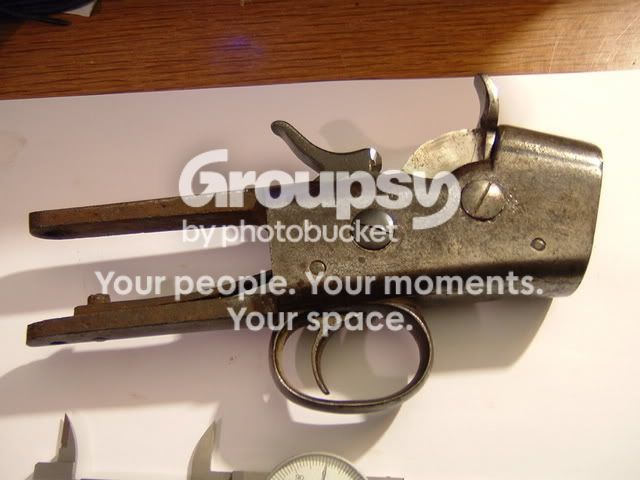
DSCF0031.jpg


This is the action (of the shotgun) I got from TradeEx. It was a 16 Gauge, but was a civ model rather than a military model conversion. TradeEx has several guns based on this particular design, as well as several shotgun conversions of the 1867 action (effectively the same as a Remington No.1).

The radius above the breech block pins is the easy tell when looking at the pictures. This one is pretty rough, and is going to need some work before it would be a good candidate for a new barrel.

If you were to get a 16 G, and it was in decent condition, it will be as safe as any to shoot with modern shotgun ammo. Tight chokes and steel shot, maybe not so much, but "rifled" slugs would work fine. FWIW, steer towards the 20 Gauge if you are shopping shotguns in the rolling blocks. You can actually find 20 gauge ammo in most places, with 16 G a little less common. Hey, it's not like its a 14 gauge, right?

Cheers
Trev
 
I think Trevj is on with the loading advice. I shoot smokeless .50/70 loads all the time from my antique rolling blocks. It's very important to use a reasonable charge of the appropriate powder but there is lots of good reloading data out there for the .50/70 in original rolling blocks. I only use cast bullets in these guns but that is what they were originally loaded with anyway and they work well for my purposes. The rolling block action is reasonably strong for an antique action. The rifles in 8x58R were reheat treated close to the turn of the century and a rifle made on one of these actions, would be quite strong.
I think you might find that the action you have pictured was originally a Swedish made military action though, I don't know of any of these made originally for commercial use, but no matter anyway, they seem like a great action.
I think converting a 12.77x44R to .50/70 and shooting it that way is about the cheapest way to make something good from one of these. I don't really see a lot of accuracy potential from the shotguns, but I have not tried either. It might not be hard to get a 20ga. rifled slug barrel fitted, that would be capable or some impressive performance I would think.
I think this current crop of rolling block actions is just wonderful, they are original and much cheaper than we could even access original actions for before they came out. As I mentioned before there were 5000 original Remington actions in there too and I got two from Tradeex early on last year, I am not sure if he has more of those, but that is a super deal if you can lay hands on one.
One of those from that 5000 Remington actions I got was reheat treated and in 8x58R. This would be an excellent action for a project and could be deregistered to antique status too if you rebarreled over 8.3mm. The 8x58R was a hot round, outperforming the .30/06 in some loadings. That opens up a lot of cartridge project possibilities.
I don't know if the Swedish rolling block actions are considered to be as strong as original Remingtons, does anyone know for sure? I suspect they are on par.
The rifling is so deep in the 12.77x44R guns that they shoot cast bullets in .50/70 very well. The rechamber work can easily be done inside two hours too without any major equipment, just the reamer and a way of removing and reinstalling the barrel. I did my extractors at the same time as reaming the chambers. Great projects, I don't know if we will see any more actions like this come around.
 
http://dutchman.rebooty.com/rb.html and http://www.skydevaaben.com/index.xml have been two of my best sources for Rolling Block info outside of the North American Remington sources.

The second site, in particular details quite a few models of these rifles that were built entirely away from the military influence, both as shotguns and rifles. It also details some of the characteristics associated with the Husquvarna made guns, that may ID them as made there, in the absence of markings.

It is WELL worth reading and understanding the issues with the 8x58RD load data that is applicable to the Rolling Blocks, as opposed to the data that has been repeatedly republished for the same cartridge in the Krag rifles. Hint! It could save your life to know!

There is a Swedish Firearms sub-forum on one of the US boards as well, that has some more good info.

The design of my action is a little different from the military Swede RB actions. I don't think you could build it from a military start without doing a bunch of welding. I should take a picture of the two actions side by side to show. Not tonight, though.
Mine looks a lot like the Model 10, with some slight differences. It had a barrel on it that I an reasonably certain started out as something completely different and had been bored out to make a shotgun out of, and the breech block seems poorly fitted, and I think may not have been original to this action, based on some filework that is visible when dissasembled.
It's been a long time since the newest of these came off the lines though, and there's really not the detailed histories available from these makers, that the collectors of North American guns have come to expect to have at hand these days.

Cheers
Trev
 
Trev, great links, lots of information there. I am yet to load any good ammo for the 8x58R but I sure will be printing out that Norma data before I ever go there. Thanks.
My 8x58R bore is beautiful and that is why I want to try it out. I had originally bought the rifle to rebarrel, but with this like new 8mm bore, I have to see what it will do first. I bought another 12.77 instead of using that 8mm.
 
The fast twist is supposed to like a long heavy bullet, and the long heavy bullet is supposed to like being pushed pretty hard...:D

All said and done, not a gun yer gonna get much in the way of "comfortable" results out of.

Do tell how it works for you. I've about given up on finding a set of dies on the cheap, and figure to pick up a beater set of 8x57 dies to butcher into something I can use if I want to shoot my 8x58.
I figure the rebarrel is inevitable, in any case. I'm trying to decide on caliber, between 40-65, and 40-72/.405 .

Cheers
Trev
 
Wow - thanks for all the info (but by no means stop posting if you have anything else to say).

I think when time and money permits I'll probably pick up a 12 or 20 gauge rolling block, just to keep things simple. I can always rebarrel it later on right?
 
Trev: not meant to hijack, but a question: I have several RB's and one in 16 gauge just exactly like the one you pictured. Question: What do you mean when you say the action will need work? How can I tell if mine does too? It seems tight, although the firing pin retaining screw is bent - making the pin stick a little

One last question: Could I reline the barrel for .45 colt? Liners can be had with a 7/8" OD - it seems perfect in this application
 
My 16 G was on "special" for the grand sum of, uhmmmm, it was about $125 including shipping, IIRC. It had a welded up barrel, and was not in great physical condition overall.

It needs some work on the pins, probably replacement, possibly a bushing fitted to the pin holes on the breech and hammer. It needs an extractor made. It has a groove plowed across the top og the reciever ring, where someone thought it would be a good idea to file a notch to use as a rear sight apparently, though the breech block cover it when closed. The breech block apears to be one from a much later piece, and crudely fitted, in that the locking surfaces are not smooth all the way through the arc, showing sign of having been fitted by filing, and not well.

That's pretty much what I mean when I say the action will need work.

When examined carefully for fit finish and function beside my 8x58, it seems pretty crudely assembled. I still do not regret buying it, and will get to it eventually. Meantime, it is back together and sitting in the safe.

I see no reason the 45 liner would not work out fine. Workmanship is key.

Cheers
Trev
 
Back
Top Bottom