Swedish Steel and anemic 6.5x55 loads

rimfiremac

Regular
Rating - 99.1%
108   1   0
Location
SOntario
I read a statement today that the 6.5x55 loads in North America were loaded light when the caliber caught on with the influx of surplus rifles because the states 'didn't trust the quality of Swedish steel'.

I find that interesting, as Sweden is known to produce excellent blades and tools with exceptional quality steel.

So I wonder... how did this notion come to be? Was it a ploy on the American ammo manufacturer's part to quash the caliber before it really caught on? Has anyone ever heard of a Swede coming apart or otherwise failing due to pressure?

The Mosin Nagant action has been built and rebuilt into many calibers- even the 260 Rem, 9.3x54R and 300 Win Mag without issue... what's the deal?
 
Safety is the deal. The Swedes loaded their ammunition up to around 45,000 psi. There is no reason a hand loader shouldn't be able to approach those pressures for cartridges intended for M94, M96 or M38 Swede Mausers.
The main reason North American manufacturers load the 6.5x55 down is many of those rifles are built on the older and supposedly weaker Krag actions. It's done for insurance liability reasons, just like the 7.92 Mauser round.

In Europe, the shooter is expected to know what the limitations of his/her rifles are and has access to ammunition loaded to different specs. In NA, the manufacturers don't do that. One load fits all. So they err on the light pressure side.

Another reason is that many of the milsurp rifles that came to North America were in the junk classification. Barely safe enough to shoot even the light loaded ammunition. They can't really be blamed, North Americans will for the most part only shoot the cheapest ammunition they can find. Not only that but they aren't familiar with the strengths of their rifles or the pressures created by factory ammunition. In Europe, the shooter has to know this. It's usually part of getting a license to shoot, handload or hunt. The manufacturers aren't held liable unless it can be proven that the ammunition wasn't loaded properly to the specs indicated on the box. Not so here.

There is a lot more to it and I'm sure a metallurgical engineer could tell you a lot more but that's not my forte'.
 
As has been said, the americans load their old cartridges to "lowest common denomenator" loads, IE it'll be able to fire from old damaged Krags, badly modified guns, klunkers etc.

Any swede mauser that's in as produced or good condition will be fine with higher pressures, but I wouldn't recommend trying to go magnum with the loading, just because they were never designed for it.
 
You just can't beat Swedish steel and Swedish Mausers...period :D.

I had a chance to fire my buddy's Norwegian krag rifle and the action is very smooth but not as strong visibily as the Swedish M96 design so this is probably one reason, as stated above, that North American commerical ammo is down loaded to remain on the side of safety for those that do not hand load their own ammo.
 
I've been in to Swedes for a long time and this is the first time I've heard that the quality of the steel was suspect. They downloaded the ammo in deference to the older design of the actions that many of these chamberings were being imported in.
 
That was the first time I had heard any mention of questionable quality as well, which seems pretty ridiculous considering Swedens history in the steel business, hence I came to wonder if there were other reasons that the ammo is downloaded so much in NA
 
more involving the old norway krags than the quality of swedish steel............since both are 6.5mmx55..........but krags are an older / slightly less robust design.
that being said ......

remember the old thread on these krags being modified into .308 cal...........or the thread about has anyone ever SEEN such fail /blow up?

just sayin .
 
At one time one of the popular target rifles for DCRA type shooting (using military 7.62x51 ammo) was what we called the Carl Gustaf.

These were Swedish mausers fitted with new barrels. We shots thousands and thousands of ammo running in the 55,000 to 60,000 psi range through these rifles, including in the rain and in hot weather. No problems.

Did the same thing with 7.62 barrels screwed into #4 actions too. No problems.
 
NB/nagantsniper, I've seen both Krag and Swede Mausers go KABOOM. The Krags after the fact (one was a 7.62x51) and the Swede at the range on the bench beside mine.

The Swede was a 1943 Husky in its original form. The owner loved to push the envelope as far as pressures go. The bolt didn't fail, nor did the barrel but the top of the receiver blew off and a few brass fragments embedded themselves in his glasses. He was using 140grain bullets over a charge of W748 over a magnum primer.

Ganderite, not that I'm questioning you but were you using commercial factory loads, hand loads or milspec ammo in those rifles? I have also seen more than one Swede converted to 7.62x51 and even one to 243Win.

I believe that the pressures on milspec 7.62x51 don't go over 48,000psi. Please feel free to inform me if I'm wrong. This is very close to what the original Swede round is loaded to. Commercial fodder is loaded to around 57,000psi.

It isn't uncommon to see the Swede 96 actions converted to 7x57, 8x57 or 30-06, probably many more. In Europe, these cartridges can be had loaded to different pressures. I actually sent a query to TIKKA, asking about the strengths of the 96 actions. They were pretty vague in their reply. They wouldn't guarantee the strength of any action they didn't inspect.

They did reccomend that if I wasn't sure about the safety of the action to have it checked by magnafluxing or Xray. They just wouldn't commit themselves.

I have never seen a No4 conversion go KABOOM. From what I can find out, the action flexes and reduces stresses, making it safe for milspec 7.62x51. I don't know about commercial 308Win.

That being said, we all know that if tolerances are kept to a bare minimum, rifles seem to be able to handle higher pressures and we are talking about rifles converted for accuracy here so they may be perfectly OK as you state.
 
The good news is that the best accuracy is often found at less than top velocities. Handloading is the best way to bring this out. If top velocity is the aim, then go with a souped up magnum in a modern commercial action. I've enjoyed excellent accuracy and taken a lot of game with MILSURP ctgs handloaded within their original ballistics envellope.

I often think about a couple of hunting buddies who were shooting the then new 7mm STW. They were using 140gr Nosler bullets loaded to 3500fps with 80gr of powder. I was shooting the same bullet in a 7x57 Mauser @ 2800fps with 49 gr of powder, and my deer seemed to fall over about the same.
 
"Ganderite, not that I'm questioning you but were you using commercial factory loads, hand loads or milspec ammo in those rifles? "

In those days we were shooting military ball. 7.62x51 and 308Win have almst identical pressure specs. I have tests lot numbers of both that were running around 60,000 psi.

The confusion relates to military literature referring to a 50,000 psi limit. But in those days they tested with CUP and what they really meant was 50,000 CUP. In the psi test, the limit is around 60,000, same as 308W.

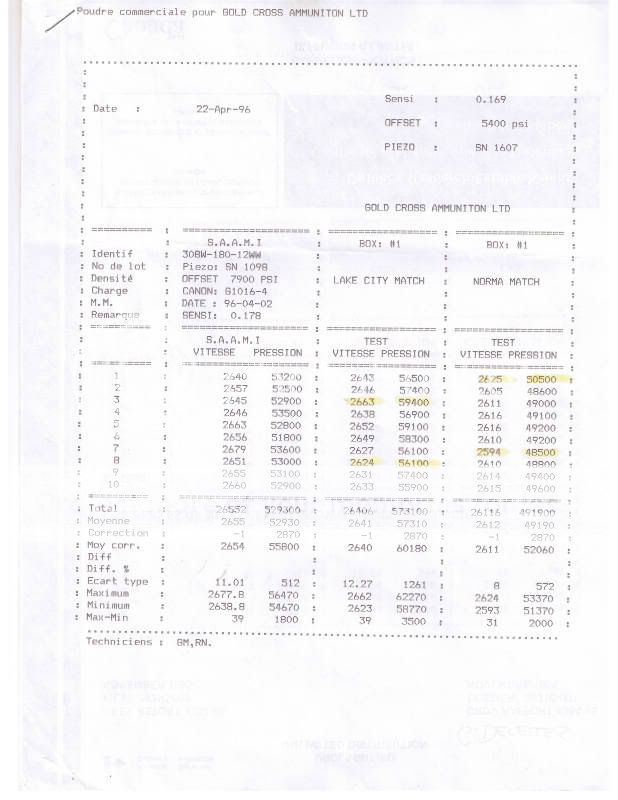
here is a test I ran on Lake City Match (NATO ball) and Norma Match (308W). As you can see, the Lake City pressures are in the high 50's.

The hottest ammo I ever tested was some Winchester Supreme MAtch and IVI ball, both avereraged over 60,000 psi.

testdatasheet.jpg
 
Just another bit of information that may or may not shed some light on this discussion.

The Italian Carcano was built in Switzerland, Austria and Italy. Maybe other countries as well. We all know how anemic the 6.5x52 is. To call it lacklustre would be words of praise.

The thing about those rifles, is that they were made from the very best steels available for firearms manufacture at the time. It didn't matter where or when they were made, they were made well and very strong. Towards the end of WWII, Steyr of Austria built thousands of Carcano carbines in 7.92x57. They were as simplistic as any Carcano I've ever seen but they were well finished and were accurate. At least mine is. Don't get me wrong, it has a lot of dings but no chips or cracks in the stock and a fixed rear sight with 7.9 stamped on it. The 18 inch, 4 land barrel has a one in 9 twist rate and is pristine inside. It is also marked with Italian acceptance stamps. The bolt has never been serial numbered but does bear a Steyr mark. All of metal exterior is roughly finished but perfectly viable.

The receiver ring has been relieved for the longer spitzer bullets and longer 7.92x57 cartridge. It's recoil resembles a berserk mule's kick with standard 150 grain milsurp fodder. Needless to say, it is a curiosity that has been hashed over at several get togethers with interested persons. It bears Arabic paint on the butt. I don't think they could find any Arabs that were willing to shoot it more than once. As mentioned the bore is mint. I can tell you right now, it isn't going to see any more wear from me.

The thing is, the anemic ammunition as loaded by Italy in 6.5 was done that way by choice, for the comfort and probably enhanced marksmanship of her troops. Why beat them up on the field when it wasn't necessary? A couple of hundred feet per second, using a FMJ bullet, certainly won't be noticed by the recipient.

The point I'm trying to make is many claim the Carcano as well as the Arisaka are weak actions. This just isn't the truth. PO Ackley did blow up tests on them both. The Carcano was just as strong as the 98 action. It is certainly tough and the bolt handle root is used as a third safety lug. The Arisaka needs no explanations. The M96 actions may be being maligned unjustly, by rumor only, just like the other two rifles.

Ganderite knows his stuff. I personally would be inclined to bow to his judgement but I would still like to know which ammo he was using in the M96 Carl Gustav actions.
 
Ah, this old debate. Seems I was involved in this same discussion a month or two ago when guys were doing some sort of "M96 isn't as good as M98..."

I think if a guy looks around at all the M96 based rifles out there, not just bubba rebarrels, but factory sporters in all sorts of calibers from 22-250 on upwards, with some of those calibers being 65,000 PSI rated calibers, you'll get your answer on how "weak" the M96 is or is not.
 
Thanks for that Ganderite. Very informative.

Just to give you my opinion of the M96 Swede actions, I will disclose that although I would not build one up for someone else, I have built one up in 6mm Remington and altered the bolt to #### on opening (bored). My loads are at least around 55,000 psi. This is my personal rifle only. It is one of the most accurate rifles I own. The reason for the 6mm Rem is that is what it was originally chambered in when I bought the take off barrel. Remington varmint contour. Very decent barrel.

I don't doubt they are very strong one bit. I was just a bit leery about building one for someone else after the reply I got from TIKKA.
 
Target rifles built on the M96 actions were use to shoot the DCRA Target Rifle matches, using issued military ball ammo. DA and IVI with a little American ball, too. Other actions used were M98, Lee Enfield #4 and P14's.
 
Interesting, I do know the US loaded their 7.62x51 to higher pressures than the rest of the Nato countries did. Our FNs needed their gas ports adjusted for it.

The pressures of the ammo you list, should all be within the save boundaries of the M96 actions provided all of the tolerances are close.

Thanks for the reply.
 
Interesting, I do know the US loaded their 7.62x51 to higher pressures than the rest of the Nato countries did. Our FNs needed their gas ports adjusted for it.

The pressures of the ammo you list, should all be within the save boundaries of the M96 actions provided all of the tolerances are close.

Thanks for the reply.

- Do you mean 'gas regulator' adjustment on the FNC1? Maybe from a four to a six, no big deal.

- Most US Ball after the late 1960s would have been intended for the M-60 MG anyway, aside from old stock and lake City National Match 168 grn. Most of their front line service rifles would have been 5.56mm M16A1 by then.
 
US ammo was loaded with two different types of powder, IMR and ball. The pressure curves are different and this could lead to different gas settings.

As for average presure and maximum pressure, that will vary about 5,000 psi from lot to lot. Some lots are "hotter" tthan others.
 
Who ever in their right mind claimed an Arisaka was weak? PO Ackley did destructive tests with overloads and the two strongest actions were the Arisaka's 38 then 97....Harold
 
Back
Top Bottom