












































You are using an out of date browser. It may not display this or other websites correctly.
You should upgrade or use an alternative browser.
You should upgrade or use an alternative browser.
Swiss Target rifles based on Swiss Milsurp action types
- Thread starter diopter
- Start date

I would do some unholy things for this rifle.
You are too nice, obviously. You cannot begin to imagine the things I would do for one of these rifles.
I would do some unholy things for this rifle.
Schmidt-Rubins are beautifully made Swiss instruments, just like their watches, and incredibly accurate. That being said, the action is, please forgive me, the ugliest classic factory action I've ever seen. It looks like a cross between a veterinary instrument and a plumbing tool. Definitely designed solely for function, not looks.
The thing that always nags at my mind about them: Given the experience of rifles like the Ross, I can't help but wonder how they would have fared in the mud of Flanders. The examples we see today have never been to war. They've been meticulously maintained by highly-trained and dedicated servicemen. I can't help but wonder how long they would have functioned in the hands of hastily-trained conscripts under arduous and filthy conditions. Luckily for them and us, we never had to find out.
Schmidt-Rubins are beautifully made Swiss instruments, just like their watches, and incredibly accurate. That being said, the action is, please forgive me, the ugliest classic factory action I've ever seen. It looks like a cross between a veterinary instrument and a plumbing tool. Definitely designed solely for function, not looks.
The thing that always nags at my mind about them: Given the experience of rifles like the Ross, I can't help but wonder how they would have fared in the mud of Flanders. The examples we see today have never been to war. They've been meticulously maintained by highly-trained and dedicated servicemen. I can't help but wonder how long they would have functioned in the hands of hastily-trained conscripts under arduous and filthy conditions. Luckily for them and us, we never had to find out.
I think the cartridge doesn't really lend itself to use in austere conditions - most successful military cartridges have a significant taper to them to aid in feeding and extraction.
I also feel the bolt assembly is quite complicated and would get sticky once it was dirty..

Schmidt-Rubins are beautifully made Swiss instruments, just like their watches, and incredibly accurate. That being said, the action is, please forgive me, the ugliest classic factory action I've ever seen. It looks like a cross between a veterinary instrument and a plumbing tool. Definitely designed solely for function, not looks.
The thing that always nags at my mind about them: Given the experience of rifles like the Ross, I can't help but wonder how they would have fared in the mud of Flanders. The examples we see today have never been to war. They've been meticulously maintained by highly-trained and dedicated servicemen. I can't help but wonder how long they would have functioned in the hands of hastily-trained conscripts under arduous and filthy conditions. Luckily for them and us, we never had to find out.
Straight pulls are basically manually operated semi autos. Just missing a gas system.

I think the cartridge doesn't really lend itself to use in austere conditions - most successful military cartridges have a significant taper to them to aid in feeding and extraction.
I also feel the bolt assembly is quite complicated and would get sticky once it was dirty..
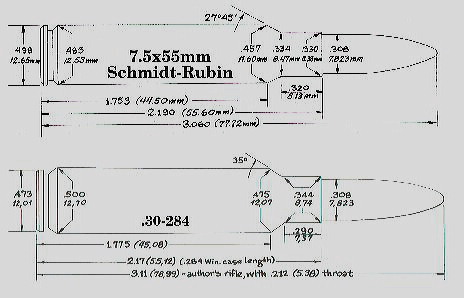
So the 8mm Lebel cartridge should have remained in service?
Bolt:
Notice all the tools that are needed.
So the 8mm Lebel cartridge should have remained in service?
While that cartridge was revolutionary I think it may be an extreme example..
But all of your contemporary successful and combat proven military rounds have significantly more taper and shallower neck angles than the 7.5 Swiss to promote reliable chambering and extraction in adverse conditions. Some (7.62x39, 7.62x54, .303 British) more than others (.30-06, 7.62x51, 5.56mm)
While the Swiss round is 'designed to reliably feed in rifles and machine guns in all situations' i think it would not perform as advertised with anything other than issued match quality ammunition. The issues people are having simply loading bullets with different ogive in k31s highlight the pickiness of these rifles and the tightness of their chambers, making excellent target rifles and possibly not so good combat rifles.

While that cartridge was revolutionary I think it may be an extreme example..
But all of your contemporary successful and combat proven military rounds have significantly more taper and shallower neck angles than the 7.5 Swiss to promote reliable chambering and extraction in adverse conditions. Some (7.62x39, 7.62x54, .303 British) more than others (.30-06, 7.62x51, 5.56mm)
While the Swiss round is 'designed to reliably feed in rifles and machine guns in all situations' i think it would not perform as advertised with anything other than issued match quality ammunition. The issues people are having simply loading bullets with different ogive in k31s highlight the pickiness of these rifles and the tightness of their chambers, making excellent target rifles and possibly not so good combat rifles.
Do you know the Swiss still use this ammo in the MG3? And previously in the PE57? There is absolutely nothing wrong with this cartridge or its use in any quality firearm under any conditions.

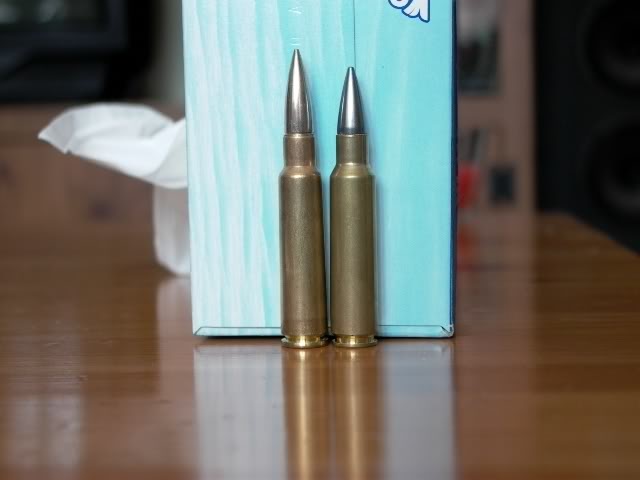
Swiss solved it by the chamber dimensions...here is a GP11 and my fireformed neck sized reloads. Headspace is tight, but the case has lots of room to expand.
Hitzy, how many times can you use the fire formed before full length sizing. looking to try that technique.
Hitzy, how many times can you use the fire formed before full length sizing. looking to try that technique.
Up to 8 and haven't had to yet in my K31. I don't shoot real hot, basically use 308Win data, Varget and 150gr Hornady FMJ. Shoots really well, chrony is around 2700fps.
I think the cartridge doesn't really lend itself to use in austere conditions - most successful military cartridges have a significant taper to them to aid in feeding and extraction.
I also feel the bolt assembly is quite complicated and would get sticky once it was dirty..
Ironically, they both(.303Br & 7.5 Swiss) were sired by the same designer, Swiss Col. Eduard Alexander Rubin, often misnamed as Rubini in British documents
https://sites.google.com/site/britmilammo/-303-inch
https://en.wikipedia.org/wiki/7.5×55mm_Swiss
Last edited:
I'm sure it works perfectly for their exercises and static defence of the home country.Do you know the Swiss still use this ammo in the MG3? And previously in the PE57? There is absolutely nothing wrong with this cartridge or its use in any quality firearm under any conditions.
That is much different from equipping an expeditionary force with long supply lines in desert or jungle environments in a time of war requiring expedient manufacturing.
And I would wager that they only keep these in service because there's no point in throwing away serviceable weapons especially with the supply of GP11 still being produced for the civilian market. They have switched to 5.56mm for almost all of their personal weapons.
At risk of being a bit pedantic, but that first post is NOT Martini Henry, those were a British thing. Rorke's Rift and all that.
Just Martini.
Seems like about every street corner must have had a gun maker, for the number of different Martini actions out there in Euro target rifles.
Just Martini.
Seems like about every street corner must have had a gun maker, for the number of different Martini actions out there in Euro target rifles.
I think the cartridge doesn't really lend itself to use in austere conditions - most successful military cartridges have a significant taper to them to aid in feeding and extraction.
I also feel the bolt assembly is quite complicated and would get sticky once it was dirty..
I have no knowledge of the cartridge, so I can't comment. However, the video Diopter was kind enough to post reinforces my fears about using this action under harsh and dirty conditions. Watching the video, I see an assortment of beautifully-machined parts, finely-fitted to (I assume) close tolerances, and all I can see is that rifle, coated with Flanders mud or Saharan sand-dust (the correct name for which, escapes me at the moment), and a frustrated squaddy trying to kick open the seized bolt. As a rifle, it's an exceptional piece of workmanship. As a battle rifle, I think it would be a problem. It would certainly be a waste of a fine piece of gunsmithing.

I have no knowledge of the cartridge, so I can't comment. However, the video Diopter was kind enough to post reinforces my fears about using this action under harsh and dirty conditions. Watching the video, I see an assortment of beautifully-machined parts, finely-fitted to (I assume) close tolerances, and all I can see is that rifle, coated with Flanders mud or Saharan sand-dust (the correct name for which, escapes me at the moment), and a frustrated squaddy trying to kick open the seized bolt. As a rifle, it's an exceptional piece of workmanship. As a battle rifle, I think it would be a problem. It would certainly be a waste of a fine piece of gunsmithing.
With the accuracy of these rifles, the well trained Swiss can take out the opposing troops a mile away Without getting dirty...
turbo_bird
CGN Ultra frequent flyer
- Location
- Kamloops, BC
I've always thought a k31 would make a cool target rifle action, and for some reason I also think martinis action target rifles are really cool too. I've never had either type of rifle, but someday.
Kristian
Kristian
I really do not see the point of taking a serviceable (and occasionally rare) rifle and purposefully coating it in mud. Hey look, we damaged a rifle by doing something stupid - good job boys.
One would assume any soldier who's life depends on the serviceability of a firearm, would attempt to do some cursory cleaning in the event a their personal firearm gets dunked - prior to attempting to fire.
One would assume any soldier who's life depends on the serviceability of a firearm, would attempt to do some cursory cleaning in the event a their personal firearm gets dunked - prior to attempting to fire.






















