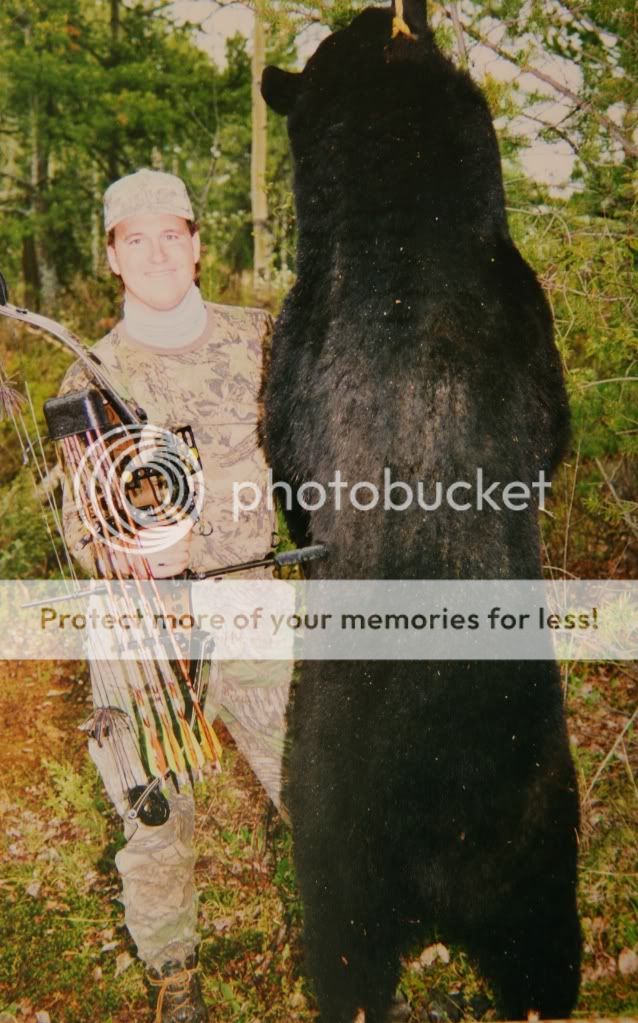
Here is a tutorial that I have posted before... I had the foresight to save it so that I could repost when the question came up again... in this case the experience represented in this post was derived from an area encompassed by a forty mile radius from the OP's home.
A Brief Tutorial on Baiting Black Bears
Black bears are creatures of habit, but not in the same way as whitetail deer. They do not travel highly predictable routes between bedding areas and food sources. Their movement patterns are primarily dictated by specific food sources and wind direction and thermals. Bears tend to bed in random locations, but those which provide them with safe escape routes and consistent thermals for scenting danger. Bears are very random and opportunistic scavengers... more so than top tier predators... that is not to say they won't scarf up a beaver caught away from water or yank a calf moose out of a birthing cow... But in early spring they are largely vegetarian, eating new green growth, grasses and clover and poplar catkins, they move on to sucker runs and scavenging until there are berries available, and then on to grain crops and fruit when that is present. Bears are not above dining on rotting carcasses found in the woods or along roadways. Before denning they will eat the cambium from aspen and birch and continue to scavenge... when they start burning more calories than they are taking in, they go to den... black bears are not, strictly speaking, "hibernators" they are "denners" as the trigger is not photoperiod but food availability. The idea of baiting is to create a food source that allows some predictability in the bear’s movements… this gives you an edge in getting into position to make a quality shot. In many areas, such as thick boreal forest regions, this is the only realistic method of hunting black bears. Baiting is misunderstood by many who have not done it. The perception is that it is taking unfair advantage and is a slam-dunk method, and akin to shooting fish in a barrel. This could not be further from the truth. In WMU’s where baiting is the primary method of hunting bears, the success rate is in the range of 10-15%... similar to regions where other methods, such as spot & stalk, are utilized. Bears are wary creatures with keen senses, they are well aware that humans are associated with the bait sites, and they approach with extreme wariness. Wind is your best friend or worst enemy, as bears rely most heavily on their sense of smell as their primary line of defense.
When positioning bait sites, there are a number of factors that can up the odds of success. The idea is to choose a location that is natural to bear movement, rather than trying to draw them to areas that are convenient for you. The location should have the elements that encourage their frequent and prolonged usage. These elements, in no particular order, are; travel corridor, cover, water source, escape routes and limited human access.
The best tool in positioning your bait site is a good topographical map of 1:50,000 or better scale. If you are searching over a large region as would be the case when hunting large tracts of crown land, the standard 1:50,000 map provides sufficient data for choosing the location. When hunting specific tracts of private land, a 1:20.000 scale map will provide greater detail. There are mapping companies that will customize maps with specific scale and allow you to choose the data you would like included, such as topographic contour lines at any specified interval, creeks and streams, logging roads, clearings and swamp areas etc…
In searching the map, you are looking for natural bottleneck areas between lakes, or saddles in ridges or corridors between terrain features such as steep, rocky mountains and lakes, rivers or clearings. Bears can and do travel wherever they will, but are most likely to follow natural drainages, particularly following creeks and rivers, where food is more likely and cover is plentiful. Bears are disinclined to expose themselves during daylight hours, which is why they often remain unseen despite living in close proximity to human habitation. Once you locate natural corridors, find those that are also adjacent to a water source with excellent (read; “thick”) cover. The location should also allow the bear to approach and flee in multiple directions… BUT, you will preferably position a terrain feature downwind of the prevailing wind direction, that blocks or discourages approach from that direction, ie. A lake, river or pond, or clearing etc… This will give you a significant advantage when you hunt the location only on the prevailing wind, making it less likely that you will be scented. When I was guiding, I had four to eight hunters in camp any given week, and to accommodate those hunters, I had as many as 40-50 stand locations, this allowed options for each hunter regardless of the wind direction. I did not hunt a quality location on a bad wind, there is no surer way to educate the larger, dominant bears than to have them scent a hunter on stand.
Next you are looking for locations that provide reasonable access to you, but discourage access to others (sometimes only a perceived limitation). Most hunters will follow trails to logical jump off points, and will travel a very limited distance from that point before setting up their bait location. One of my favorite tactics was to cross a creek or river to access an area. Few hunters will get out of their trucks or off their quads to wade a river to place a bait… but when you find a route that allows easy fording of the river, the opposite bank opens of an area of limited accessibility to humans and a comfort zone for bruins. The one dilemma with this strategy, is that you may (will) loose the location on occasion during high water flooding, but usually only for a day or two until the levels subside. Another, perhaps unexpected, strategy, is to access a good location that is adjacent to a major highway, but does not have a natural stopping location for vehicles to pull over… bears can exhibit, secure wilderness behaviours, in these locations because there is little evidence or history of human encroachment. If you are forced to hunt where others are hunting, your “ace in the hole,” is to go deeper and bait better. Lots of quality food, deposited regularly, will dramatically improve your odds of success. I once met a father and son, from Ohio, hunting the same location immediately adjacent to a logging road, on successive days. The father expressed, his disappointment for his excited son, and that he realized that they had been “taken” by a shoddy outfitter, on the adjacent BMA. I had just harvested the final bear of our season and had a number of active baits in the area. I told the father to get dropped off as usual the following evening, and that I would meet them there. The next night, I picked up the pair and brought them into one of my stands being frequented by a nice boar… this required quite a hike, fording a creek and crossing a beaver dam. I told the two to make a careful, patient lung shot and that I would see them before dark, to return them to their pick-up location. I had not reached my truck when I heard the shot, half an hour later I returned, to find an exuberant young man… we tracked the 350 pound boar a mere 50 yards… the bear was dressed and a hauled out, and the very tired, but happy father and son deposited at their pick up location an hour early. The man was flabbergasted that I had helped them, and tried to pay me, but I declined and wished them well. That other outfitter overbooked his lodge, had too few baits, located too close together, too close to human activity and baited with too little bait. He had only five juvenile bears taken for the season, for a success rate of 12.5%... Not counting the mature boar the young man had taken from my stand. On the other hand, we had 23 hunters, 100% success rate on mostly good mature bears and three or four real bruisers… tactics, effort and paying attention to detail does matter.
Once you have your location chosen, you need to start baiting… ideally you would have started gathering and storing bait months in advance, there was a time when I had a garage full of 30 cubic foot freezers. Start with a strike bait to get scent spread over a large area. For strike baits, I used a large onion bag full of pork fat. Pound a 10” spike high into a tree, hang the bag and then rope it to the tree, so the bears can’t just run off with the whole bag. I never used barrels when baiting, but if you can only bait occasionally or on weekends, then barrel baiting may be your only means of leaving a sufficient food supply to encourage bears to come regularly and stay in the area. I preferred using onion bags and sealed garbage bags for bread stuffs (to keep them moist and fresh)… tied onto the trees the bears would tear out the bottom with their teeth, spilling the bait onto the ground and forcing them to eat a little at the time and move around, at the same time exposing themselves to a patient, careful shot. Use small pieces of bait, so they cannot run off with a large chunk and spend the last few minutes of legal light dining in a thicket, out of sight. Your goal should be to create competition on the bait. Multiple bears on a location create urgency and leads to bears coming in earlier, rather than after legal hunting hours. Keep in mind that juvenile bears are often the first ones in to feed… waiting will often produce a larger bear. Often the boss bear in the area will set-up somewhere nearby and will monitor activity around the bait. The boss bear will charge in to chase off younger bears. We have had baits where as many as eight or ten bears were running each other off and mock fighting for dominance… this has occasionally led to cubs being treed by boars and can get hairy when the tree they choose for refuge is the one the hunter is in, which happened on enough occasions that it was something we coached our clients to deal with. Gather pork and beef scraps, bread, donuts, fruit, vegetables, cereal, grains, dog food etc… Ideally, you will bait regularly and consistently. For volume, I used a full Trapper Nelson rucksack (5-6 gallons) at each bait location, baiting every second day leading up to the hunt and switching to every day once hunters were in camp. Done right, it is grueling, back-breaking work, your legs and lungs are going to burn and you will sleep very soundly each night… at least the nights that you don’t spend on your hands and knees with a Mini-Mag light in your teeth blood-trailing bruins through cedar and cane swaps.
Once our chosen bait locations prove active, we build a Tee-Pee wall set-up with logs spiked at angles on the backside of the bait tree, creating a crib of sorts, which forces the bears to come around the ends, broadside, exposing their vitals to a properly placed lung shot…this is particularly important for bowhunters, which made up the bulk of our clientele.
Well… that should get you rolling anyway. Good luck.
This spring boar was taken 30 miles from the OP, 540 pounds dressed on farm scales and had a 21 13/16" skull... the bear would have been 700 pounds in the fall.