Temperature Sensitivites and Burn Charts

Zedbra

CGN Ultra frequent flyer
Rating - 100%
45   0   0
Location
Squamish
I've only been reloading now for over a year and have found some good loads for some of my rifles and haven't even started on a few others. However, with the winter months upon us it had me thinking about a few comments I have heard about some powders being sensitive to temperature fluctuations; also seeing other reloaders offering up advice as different powders having similar burn rates.

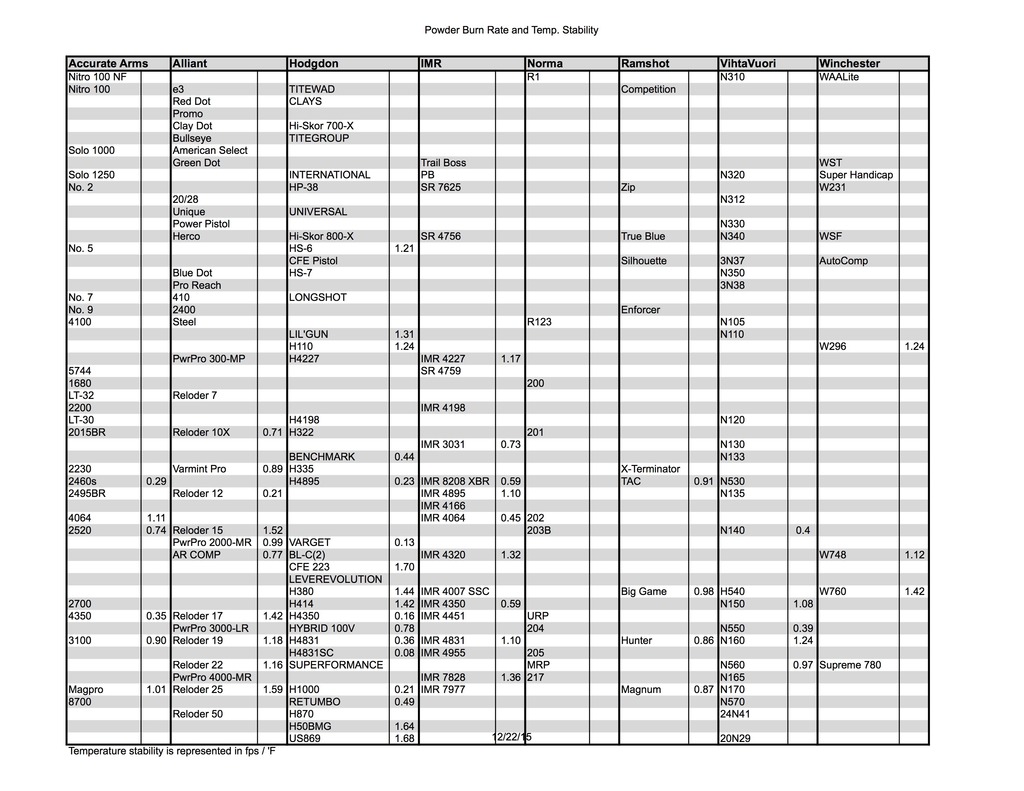
I often worm my loads in the summer, when I get more time to go to the range, but then my hunting is all done in freezing temps, so it has me thinking about this more. So after snooping around and not getting definitive answers - is there a chart that shows which powders are more sensitive to temperature fluctuations? Is there a chart that lists similar powders/burn rates?

Thanks
 
A load developed in the summer, at worst, will be a bit slower in the winter. Unless you are shooting 300 yards or more, it won't matter.

But a load developed in the winter might be too hot in the summer, blowing primers and shooting poorly.

Double base powders tend to be more temp sensitive. For starters, avoid them if it is of concern.
 
Last edited:
A load developed in the summer, at worst, will be a bit slower in the winter. Unless you are shooting 300 yards or more, it won't matter.

But a load developed in the winter might be too hot in the summer, blowing primers and shooting poorly.

Double base powders tend to me more temp sensitive. For starters, avoid them if it is of concern.


This is true but I find with smaller cases such as the 223rem there can be quite a difference at -30C to 30C. My 22 Hornet really has issues with temperature.

One thing I have found with cases medium capacities is that although velocity is only slightly effected, point of impact can vary dramatically. Not just the elevation but windage as well. Not noticeable on a heavy barrel but my model 7s develop all sorts of hiccups when the temps drop to -30C. They behave well down to -20C then they reach the point where they are no longer consistent. Likely has more to do with harmonic changes and bedding than powder though.
 
If you developed a load in the heat of summer and go to use it in the winter, you won't notice much difference unless you are shooting long range, like 300 plus. The danger is when you go the other way. Develop a load when its -10 out and go use it in the blazing heat of summer and you can run into problems. Different powders have different issues with sensitivity too. AN example from personal experience: 223 load with Hornady GMX bullets. 22 gr of IMR4198. Shot great in the cold and I planned on using it to hunt with. At -12 it had a velocity of 3165 average. Out shooting gophers I wanted to try one and it was about 35 degrees. The primer was punched clean through. Put another one over the crony and again, punched primer and velocity over 3300.
 
In addition to ammo temp, ambient air temperature (and the lower humidity of colder temperatures) also affects external ballistics beyond simply reduced muzzle velocity from powder burn at lower temps. Have to consider all of these effects to achieve accurate results at long range.

I ran some .50 BMG handloads recently one chilly day at the range and was very surprised at the difference in muzzle veolocity!
 
The American military uses a lot of double base ball powders and so do I because it meters so well and gives uniform loads. That being said our military switched from double base RL15 to single base IMR-4064 for their long range 7.62x51 sniper ammunition.

Below look at the chart at the link below it shows velocity change in degrees of temp change. Surprisingly the newer CFE 223 is the most sensitive to temp change.

33XPgx3.jpg


Powder Burn Rates and Temp Sensitivity
http://www.65grendel.com/forum/showthread.php?11196-Powder-Burn-Rates-and-Temp-Sensitivity
 
Last edited:
I was talking to the Captain of the US Army rifle team about the ammo they use. He said they use Varget because they make a load that works well in all rifles and it does not do bad things on hot days. It has an excellent reputation of being insensitive to temp.
 
I use Varget in my target 7mm-08 loads and H1000 in my 7mm STW. The Hodgdon powders show little differences at temperature change. If anything, it's probably more due to the cold barrel temp.
 
Back
Top Bottom