
Hi I am relatively new to reloading and am looking for some advice and input. I'd like to know what kind of tests you put your loads through and how you record the data. Right now I'm currently testing the loads and various ranges that I intend to shoot out to and record group sizes while looking for pressure signs. I record this information along with the charge, powder type, primer type, bullet type and weight. I keep all the data in an excel sheet. Doesn't anyone test there loads differently and record any other information? I'm loading and shooting 9mm and .223 but will be progressing into precision loading for .308 in the future so any information and insight from all types of reloading applications would be useful. Thanks in advance.













































You are using an out of date browser. It may not display this or other websites correctly.
You should upgrade or use an alternative browser.
You should upgrade or use an alternative browser.
Testing and Recording Loads
- Thread starter Cobec
- Start date

It looks like you've got most of the basics covered....
One thing I do (especially when testing multiple powder charges in less than ammo box quantities) is identify the different powder charges with different coloured sharpie markers. I start with plain primers, then green, next hotter is blue, then red and black. On the odd occasion where I need more than 5 different loads, I use a combination of colours (green/red, blue/black) to add a couple of charges.....
If the ammo box happens to get spilled / mixed, you will still be able to tell which one is which.
When I shoot the, I've started with one round of each powder charge in order, rather than all the plain ones first, green... etc. I haven't tested the theory that an accumulated fouling would open up the last group, rather than fouling effects being spread out over all the different loads.
One additional thing that some reloaders find useful is a chronograph, but I haven't sprung for one yet.
Stan
One thing I do (especially when testing multiple powder charges in less than ammo box quantities) is identify the different powder charges with different coloured sharpie markers. I start with plain primers, then green, next hotter is blue, then red and black. On the odd occasion where I need more than 5 different loads, I use a combination of colours (green/red, blue/black) to add a couple of charges.....
If the ammo box happens to get spilled / mixed, you will still be able to tell which one is which.
When I shoot the, I've started with one round of each powder charge in order, rather than all the plain ones first, green... etc. I haven't tested the theory that an accumulated fouling would open up the last group, rather than fouling effects being spread out over all the different loads.
One additional thing that some reloaders find useful is a chronograph, but I haven't sprung for one yet.
Stan
Iuse OCW to start with, once I find 2 promising nodes, I will load up enough of those 2 charge weights for 3 groups of each and shoot them at 300. After reviewing the 2 loads at 300 then I will play plus and minus .1 from what looks the best. After determining proper charge I will play with seating depth also at 300.

I am old school and use paper data sheets I photocopy. The sheets go in a 3 ring binder, where there are dividers for each gun (not just each caliber) because each gun tends to be unique.
As you get more guns, you can split you data between binders. I use a dedicated binder for 5.56 and for 308. Then there is a binder for 22 Hornet to 300Mag and another for 7.62x54R to 12 ga.
For pistol I have a large binder for my popular calibers and another for all the less used calibers.
The data sheet and binders look like this:
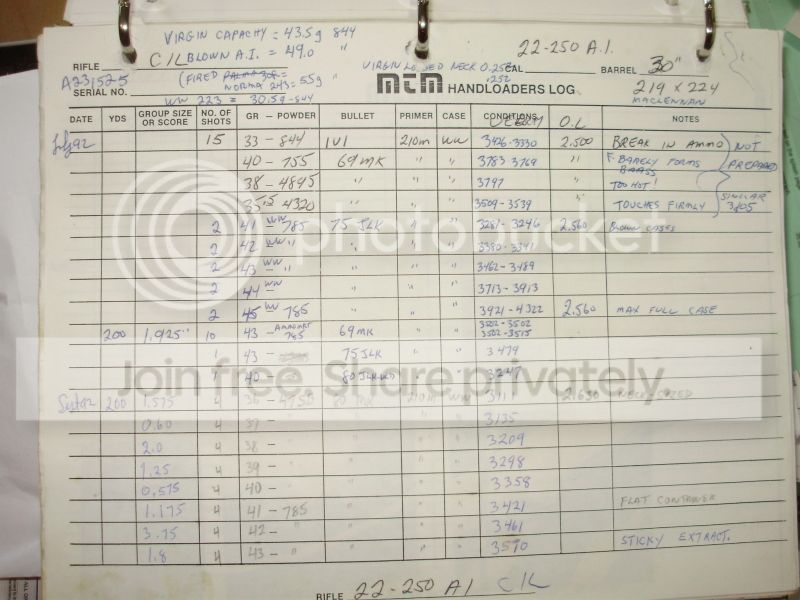
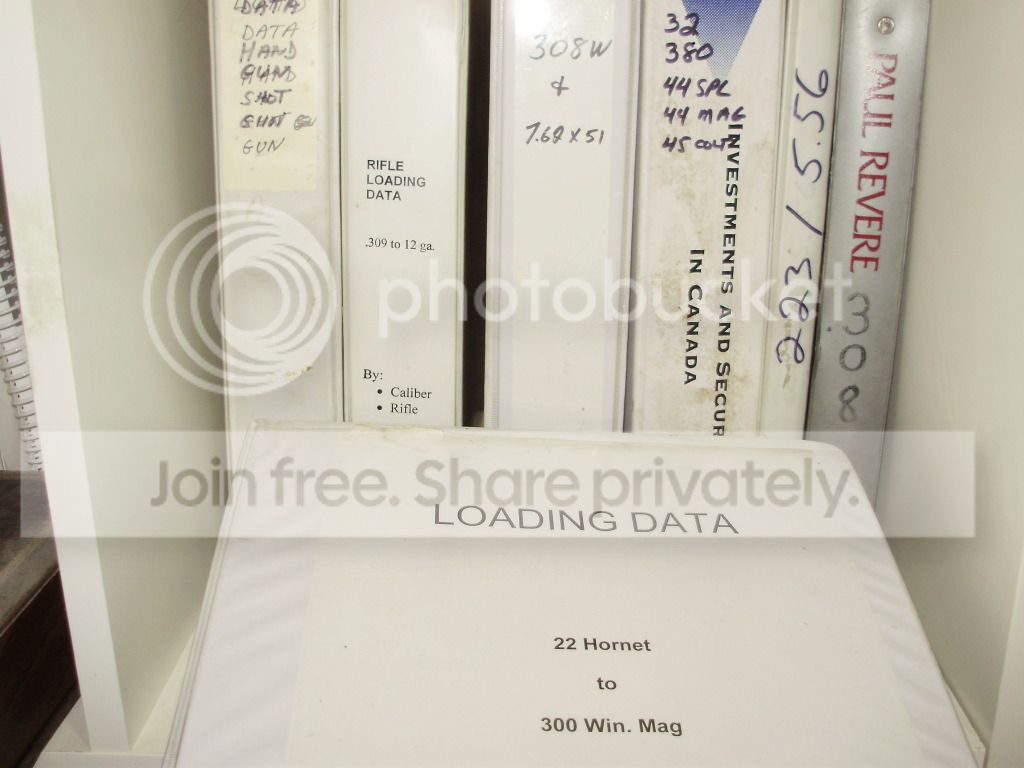
As you get more guns, you can split you data between binders. I use a dedicated binder for 5.56 and for 308. Then there is a binder for 22 Hornet to 300Mag and another for 7.62x54R to 12 ga.
For pistol I have a large binder for my popular calibers and another for all the less used calibers.
The data sheet and binders look like this:

rnbra-shooter
CGN Ultra frequent flyer
- Location
- New Brunswick
The data sheet and binders look like this:
Ack, I remember that rifle; when I started fullbore shooting in '93 I remember you shooting it at various Precision matches. You won quite a few matches with it as I recall, it was quite a laser-cannon, then later in the season it started blowing up bullets on you.


I'm not a terribly over-organized reloader, but I keep a binder or duo-tang for each rifle I own. I print a copy of the manual, and I slug the barrel and record the depths. I make my ladder loads and keep all eight or ten targets in the binder with the OCW and loading specs and bullets I used to achieve this. Fine tuning would be seating depth.

Each rifle I own has its own binder. I record dates, temps, wind, components with lot numbers, seating depth, etc... Along with what you have listed. For rifles I have owned since new I also include round count.


- Location
- West Quebec
It looks like you've got most of the basics covered....
One thing I do (especially when testing multiple powder charges in less than ammo box quantities) is identify the different powder charges with different coloured sharpie markers. I start with plain primers, then green, next hotter is blue, then red and black. On the odd occasion where I need more than 5 different loads, I use a combination of colours (green/red, blue/black) to add a couple of charges.....
If the ammo box happens to get spilled / mixed, you will still be able to tell which one is which.
When I shoot the, I've started with one round of each powder charge in order, rather than all the plain ones first, green... etc. I haven't tested the theory that an accumulated fouling would open up the last group, rather than fouling effects being spread out over all the different loads.
One additional thing that some reloaders find useful is a chronograph, but I haven't sprung for one yet.
Stan
Like the marker idea thanks..

unstableryan
CGN Ultra frequent flyer
- Location
- Beautiful Okanagan Valley
When I have a mixed box I put powder weight on the brass with a sharpie in case it opens up and they spill. I usually only test a powder at a time.

I have 2 notebooks. One has every rifle in it with all of the usual stuff, pet loads etc.
The second has general cartridge tricks that I've learned for every caliber as well as settings for my auto disk measure for every powder.
I find that some of my friends laugh at me with my little book but whatever, I load for 9 calibers now and sometimes I find I forget things so it's way easier to right it down as I do it.
The sharpie trick works great, I started using it after I spilt a box of hand loads that were loaded for testing perposes.
The second has general cartridge tricks that I've learned for every caliber as well as settings for my auto disk measure for every powder.
I find that some of my friends laugh at me with my little book but whatever, I load for 9 calibers now and sometimes I find I forget things so it's way easier to right it down as I do it.
The sharpie trick works great, I started using it after I spilt a box of hand loads that were loaded for testing perposes.
I have a binder for .303Br, dividers per rifle. I have a binder for 7.62x39mm, dividers per rifle. I have a binder that contains 7.62x54R and 8x57mm, dividers per rifle. I have a binder for .308 and .30-06, again with the dividers. I do not have a binder for .243. It is my wife's hunting rake and shoots blue box Federals well enough I don't need to tune it.
Seven years ago, I lost most of my data in a house flooding, amazing how often I want to refer back to it and cannot, although having rounds made up allowed me to reverse engineer most of it. However you maintain your data, keep it safe as well.
Seven years ago, I lost most of my data in a house flooding, amazing how often I want to refer back to it and cannot, although having rounds made up allowed me to reverse engineer most of it. However you maintain your data, keep it safe as well.

- Location
- Prince Albert, Sk
Excel sheet.
Allows you to record more information than you can write on a piece of paper.Also allows you to easily do running tallies and quantities.
As for the ammo, just a sharpie on the side of the case with info(charge weight, powder etc...), it doesn't effect anything, less confusing than colors
Allows you to record more information than you can write on a piece of paper.Also allows you to easily do running tallies and quantities.
As for the ammo, just a sharpie on the side of the case with info(charge weight, powder etc...), it doesn't effect anything, less confusing than colors






















