













































Jean-Baptiste Perrin and the Enigmatic Perrin Revolver
One of the least-known of the French sidearms used during the American civil war was the Perrin revolver. At the time, the US government was in dire need of sidearms, as Colt and Remington could not keep up with demand, and the smaller makers, like Starr, Savage, Pettengill et. al. were simply not equipped to fill the void. US and Confederate ordnance therefore sent emissaries to Europe to scour the continent (and Britain) for suitable weapons, both pistols as well as rifles and muskets. In the early 1860’s the largest manufacturers were Tranter, Adams, Lefaucheux, and Kerr. Thousands of these revolvers, both as percussion as well as cartridge guns were imported by both sides of the conflict (the Confederacy often had to pay in gold, or, in the case of Britain, trade guns for cotton, as the Confederate currency was nearly worthless). Smaller makers, such as Perrin and Pidault-Cordier (Raphael) found their way into military hands by way of agents and wholesalers in America. Marcellus Hartley of Schuyer, Hartley & Graham in New York was the most prominent of US suppliers, while Mitchell & Tyler, Paine & Co., and Trent in Richmond, VA supplied the confederate army with anything that could shoot a bullet.
It is estimated that the US government purchased as many as 550 Perrin revolvers from another agent, Alexis Godillot, at a cost of $20 apiece (Lefaucheux revolvers from Schuyler, Hartley & Graham sold for $15 each, while Colt and Remington received $12 each for their percussion revolvers), an exorbitant amount by 1860’s standards. The Perrin revolver was by no means a common gun. The double-action only mechanism is complicated and unusual, and the design of the gun unmistakable. The proprietary 11mm Perrin cartridge was also impossible to source from anyone other than the French manufacturer. Despite these limitations, few of the Perrins were returned to the US government at the end of the war, and somehow must have found their way into private hands. There are three types of the Perrin known, although within each type a few sub-variants have surfaced as well. The first type can be recognized by the external safety spring to hold back the hammer from the cartridge primer, and the somewhat flimsy loading gate. The second type has the safety spring internally, and a stronger loading gate hinged at the top, and swinging toward the rear. The third type has a top strap, while the earlier types are of open-top construction. Most of the Perrin revolvers are “in the white”, never having been blued or plated, however fancy gold-washed and nickel plated specimens are known to exist.
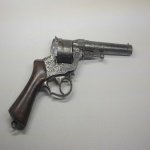
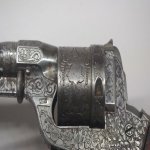
Jean-Baptiste Perrin came from a long line of gun makers, from around the arsenal city of St. Etienne, on the river Loire. Stoeckel lists no fewer than 30 Perrins, all gunmakers, all related, and spanning from 1710 to 1872. The Jean Perrin in question here, would have been the son of another Jean-Baptiste, and lived from 1800 to 1872. While his manufacturing facilities would remain in St. Etienne due to its proximity to the area’s coal mines and steel fabrication, Perrin kept an “atelier” or showroom in Paris. Jean Perrin and (perhaps his brother or cousin) Louis Perrin were granted several patents between 1856 and 1868, the most notable one being the 1859 patent for the revolver in question. It is profusely engraved in a style called “acid etching”, where the metal is coated with an acid-proof compound before being engraved and bathed in acid. The result is a deep relief etch of the surface, which is detailed by hand after the acid treatment. The top of the barrel is marked “J. Perrin a Paris”, partly obliterated by some corrosion. The serial number can be found on the underside of the barrel and on the cylinder. The side of the frame is marked “Perrin & Cie Bte”. The one-piece wood grip is made of rosewood burl, and retains most of the original varnish, and few handling marks. Perrin revolvers are rare today, few having survived the last 160 years…

One of the least-known of the French sidearms used during the American civil war was the Perrin revolver. At the time, the US government was in dire need of sidearms, as Colt and Remington could not keep up with demand, and the smaller makers, like Starr, Savage, Pettengill et. al. were simply not equipped to fill the void. US and Confederate ordnance therefore sent emissaries to Europe to scour the continent (and Britain) for suitable weapons, both pistols as well as rifles and muskets. In the early 1860’s the largest manufacturers were Tranter, Adams, Lefaucheux, and Kerr. Thousands of these revolvers, both as percussion as well as cartridge guns were imported by both sides of the conflict (the Confederacy often had to pay in gold, or, in the case of Britain, trade guns for cotton, as the Confederate currency was nearly worthless). Smaller makers, such as Perrin and Pidault-Cordier (Raphael) found their way into military hands by way of agents and wholesalers in America. Marcellus Hartley of Schuyer, Hartley & Graham in New York was the most prominent of US suppliers, while Mitchell & Tyler, Paine & Co., and Trent in Richmond, VA supplied the confederate army with anything that could shoot a bullet.
It is estimated that the US government purchased as many as 550 Perrin revolvers from another agent, Alexis Godillot, at a cost of $20 apiece (Lefaucheux revolvers from Schuyler, Hartley & Graham sold for $15 each, while Colt and Remington received $12 each for their percussion revolvers), an exorbitant amount by 1860’s standards. The Perrin revolver was by no means a common gun. The double-action only mechanism is complicated and unusual, and the design of the gun unmistakable. The proprietary 11mm Perrin cartridge was also impossible to source from anyone other than the French manufacturer. Despite these limitations, few of the Perrins were returned to the US government at the end of the war, and somehow must have found their way into private hands. There are three types of the Perrin known, although within each type a few sub-variants have surfaced as well. The first type can be recognized by the external safety spring to hold back the hammer from the cartridge primer, and the somewhat flimsy loading gate. The second type has the safety spring internally, and a stronger loading gate hinged at the top, and swinging toward the rear. The third type has a top strap, while the earlier types are of open-top construction. Most of the Perrin revolvers are “in the white”, never having been blued or plated, however fancy gold-washed and nickel plated specimens are known to exist.
Jean-Baptiste Perrin came from a long line of gun makers, from around the arsenal city of St. Etienne, on the river Loire. Stoeckel lists no fewer than 30 Perrins, all gunmakers, all related, and spanning from 1710 to 1872. The Jean Perrin in question here, would have been the son of another Jean-Baptiste, and lived from 1800 to 1872. While his manufacturing facilities would remain in St. Etienne due to its proximity to the area’s coal mines and steel fabrication, Perrin kept an “atelier” or showroom in Paris. Jean Perrin and (perhaps his brother or cousin) Louis Perrin were granted several patents between 1856 and 1868, the most notable one being the 1859 patent for the revolver in question. It is profusely engraved in a style called “acid etching”, where the metal is coated with an acid-proof compound before being engraved and bathed in acid. The result is a deep relief etch of the surface, which is detailed by hand after the acid treatment. The top of the barrel is marked “J. Perrin a Paris”, partly obliterated by some corrosion. The serial number can be found on the underside of the barrel and on the cylinder. The side of the frame is marked “Perrin & Cie Bte”. The one-piece wood grip is made of rosewood burl, and retains most of the original varnish, and few handling marks. Perrin revolvers are rare today, few having survived the last 160 years…
Attachments



Last edited:
























