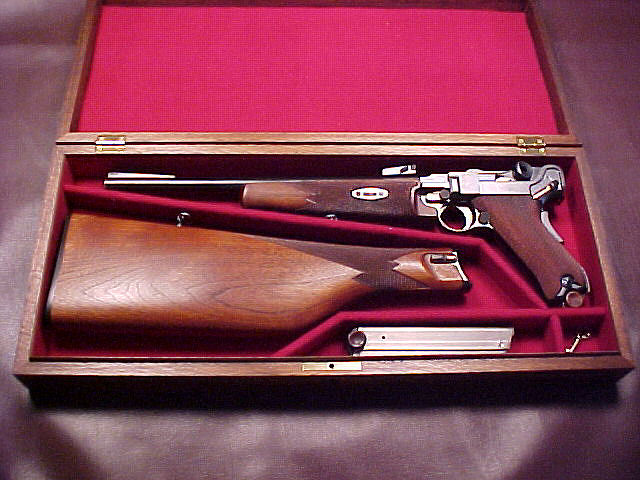
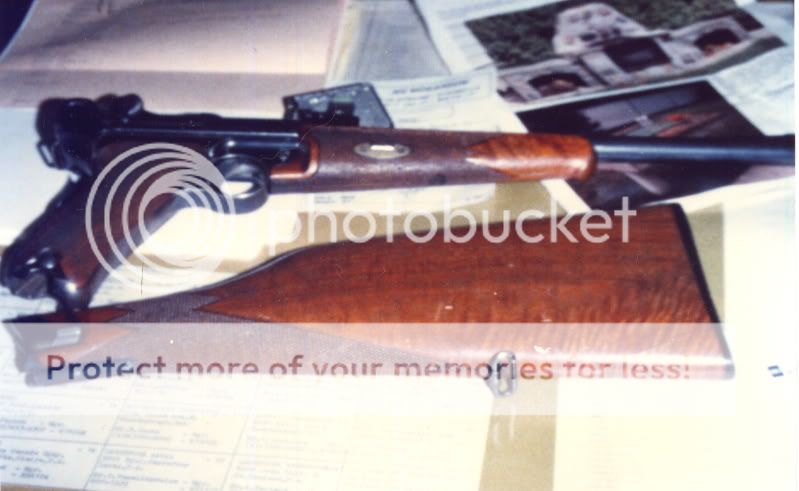
Commercials were in a separate serial range and included commercial 1900s and 1906s, commercial Armys, commercial Navys AND Carbines.
Early Carbine: flat mainspring, dished toggles, drum mag had not yet been invented, would have had a toggle latch as well. The FRAME was different from later guns (slightly longer) and the thing had a spring assist mechanism to help the toggle to function, the recoil of the .30 cartridge not being sufficient to operate the gun reliably. They could be ordered in various grades of finish, also, as well as embellishment. They were the absolute highest grade possible of the pre-War Luger pistol; some were even marked with Georg Luger's own stamp, being assembled under his direct supervision or by him personally.
The purchasers were happy enough with the things. One purchaser, a chap named Wilhelm von Hohenzollern, Deutscher Kaiser, Konig von Pruessen, used his with great success on deer. If you were the King, you could do that, too!
They never were cheap, listing in 1910 at 180 Marks. That got you the gun (with the late-type frame) and ONE magazine: no spares, no spare mags, no dummy mag, no dummy rounds, no cleaning kit, no nice fitted case, no GL stamp. Nice thing is that the stock DID come with it.
In the same catalogue, fully-engraved Martini-Henrys list at 58 Marks, 1888 Mauser Carbines are 54 Marks (yes: THEM!!!), or you can get a Mauser 66/71 Carbine for 12 Marks (ever see one? I sure haven't!), a Gras Carbine with bayonet for 22 Marks, a .52RF Peabody (for your Fenian Raid collection) for 16 Marks, Werndls for 8 Marks, Dreyse Needle-guns for 21 and super-rare Austrian Waenzls for 9 Marks. The VERY latest rifles, the German-type Model 1898 Mausers, were 150 Marks brand new, never a round though them, 100% ORIGINAL finish..... but you could get a substantial discount if you ordered several thousand.
The Canadian Dollar bought you 4 Marks and 25 Pfennige, so that 180-mark Carbine was $42.35..... and gold was $20 an ounce.
They were NEVER cheap.
.














































 Congrats to the buyer, I wish I had that kind of change in my cup holder