The 45/70 at 2 Miles??

scout3006

CGN Regular
Rating - 100%
218   0   0
Location
Chatham, Ontario
Here is a post off of another forum. (The question was originally, "How much oil goes into making a bullet.")

Most American reloading data is in the form of grains. A grain is 1/7000th of a pound. I use 4.5 grains of smokeless powder to propel a 220 grain led bullet in my 1911 A-1 45 caliber automatic pistol. Smokeless powder is made from nitroglycerin and cotton. There is not much petroleum used in the manufacture. I use 70 grains of black powder to propel a 450 grain bullet in my 45/70 1884 Springfield. Black powder is made from potassium nitrate, sulfur and charcoal. No petroleum used in that process either. Here is the real hoot. Black powder is the milder of the two explosives. Having said that, using 70 grains of black powder and a 500 grain lead bullet, the U.S. Army consistently hit targets at two miles with the 45/70 infantry rifle. I consistently get 2 inch groups at a hundred yards with my rifle and it is 117 years old.

This guy is insisting that the 45/70, in it's blackpowder guise and out of a Springfield rifle, is capable of consistently hitting targets at 2 (two!) miles.

He then backs it up with this paper:

http://www.researchpress.co.uk/targets/ballistics/sandyhook.htm

Possible? Not possible? Seems a weeeeee bit far for a 45/70....:pirate:
 
In these firing experiments, two telephones provided with Blake transmitters were used for timing the bullet's flight. One was placed within a few feet of the rifle, to receive and transmit the sound of the shot. The other Blake unit was nearly two miles downrange in the shelterproof, which was located about 30 feet in front of the right edge of the target. At the instant the sound of the discharge was heard over the telephone, a watch ticking fourth-seconds was started. At the sound of the bullet striking target or sand, it was stopped. Average time of flight for the .45-70-500-grain load was 21.2 seconds, With the more powerful .45-80-500-grain cartridge the time-of-flight was 20.8 seconds.

.........wow..... so when you see the puff of smoke you would have a bit of time to get out of the way..... funny how it would be possible for a 500gr bullet to retain much energy with such a long flight time....
 
"being the only person in the world who has hit the 'Bull's-Eye' six feet in diameter at 2,500 yards with three different rifles, and who has ever fired at and hit so small a target as that described in this report at 3,200 yards." is a far cry from "consistently hitting targets at 2 (two!) miles." Considering that you would have difficulty seeing a 6 foot target at 2 miles and that the front sight would completely obscure the target at that range, I doubt there's much consistent about it. Its like the famous Billy Dixon shot. Its hard to say who was more surprised, Billy Dixon or the Indian. That being said, I have no reason to doubt the shots were made and I would hate like Hell to be on the receiving end of mass volley 45/70 fire. Nothing like 500 gr .45 cal bullets raining down on you to spoil your lunch.
 
I trust it did not escape people's notice that consistent hits were 5 out of 80 shots. The sight obscuring the target is not an issue; the shooter would have used a 6 o clock hold. I do find it hard to believe the bullets went so far into the presumably dry sand however. My own experience has been that dry sand will stop a bullet in pretty short order.

cheers mooncoon
 
These guys probably used aperture sights.
You don't have to be able to see the bulls-eye to hit it, you just need to see the outline of the target.
There is no blade to obscure your vision just a hole that you center the target in.
Whatever is in the dead center of the front aperture is getting shot, provided the correct elevation is set on the tang staff.
I talk with people every day on another forum who are shooting at 1000 yards very accurately and one has started a mile shoot on his ranch.
One reason the Billy Dixon shot was such a fluke is because Billy was unsure of the distance.
Wind would be the other factor.
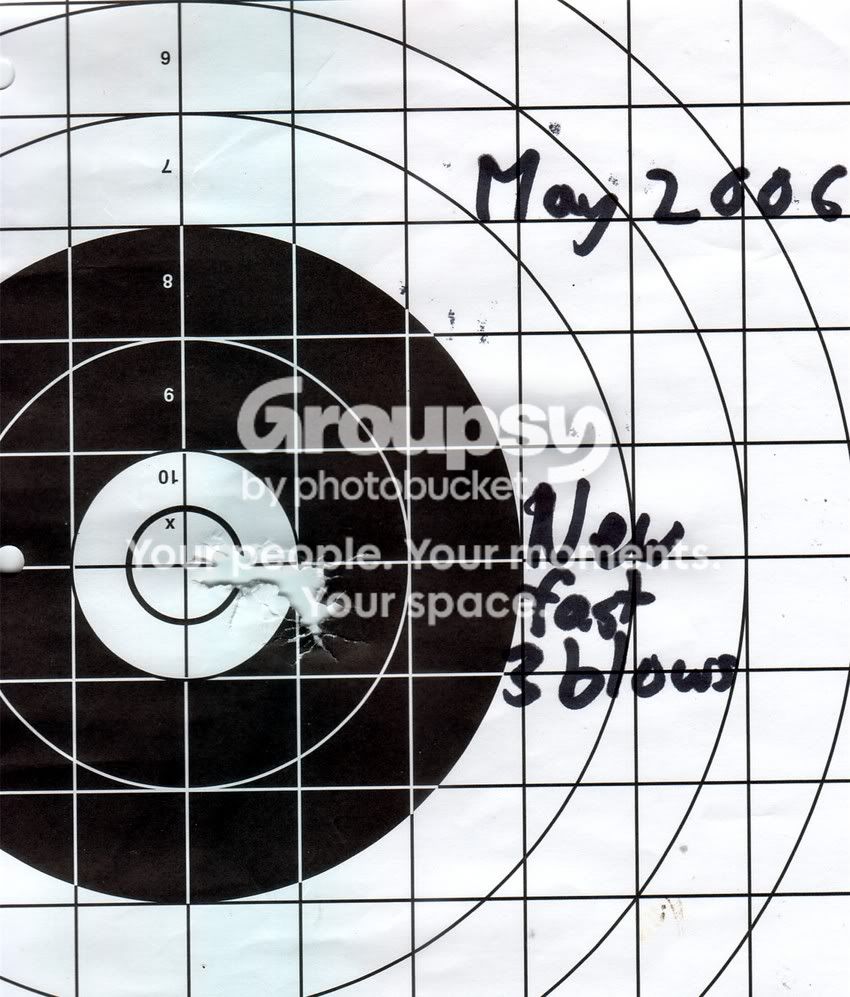
I get 1.5 minute of angle groups with my Shiloh 45-90 all of the time and once I put 5 shots through 1 hole at 100 yards.
45-90May06c.jpg
 
The 45-70's & 45-90's where the original long range rifles - that is a fact.

But TWO MILES....:jerkit: (maybe if the target was a mountain).

Hakx
 
IIRC it was during the Civil War , and the thinking then was if you you lob bullets into the enemy much like the English bowmen did. The targets they were aiming at were 2" thick large boards at 45 degrees on the ground.
 
Billy Dixon was using a borrowed 50/90 Sharps and the distance has since been discussed and argued about, the most likely distance is a recently lazered 1578 yds.
 
Regarding consistency: good black powder loads have a very low extreme spread in velocity, usually much better than smokeless, because of the capacity, compressed loads. Heavy bullets are also a factor; they have more momentum than lighter bullets.
 
Billy Dixon was using a borrowed 50-90 Sharps when he shot that Indian Shaman off his horse at a later measured 1538 yards.
Thats 800 feet shy of a mile.

Scientists have done tests and these old bpcrs can shoot 12000 feet and still be lethal if they actually hit something at that range.
A 700 something grain bullet would have that effect I think.
On the way out to 12000 feet the bullet reached an elevation of 4000 feet high and was coming almost straight down at impact.
Scientists actually mounted a Sharps rifle on a tank carrier and tried to duplicate Dixon's shot.
At first the scientists were skeptical, but when they saw that they could easily hit 10000 feet out, one scientist was able to calculate the angle of the Dixon shot.
They adjusted the carrier mounted gun angle and the bullet struck at just over 1500 yards.
The Dixon legend was proven plausible.
But that Dixon shot was a long time ago, now a Canadian sniper holds the world record at 2430 meters.
We Canadians have the best snipers in the World.
 
Last edited:
45-70

At 1000 yards the 45-70 drops around 38 feet which is one hell of a hold over and is 3/4 of the way up my "long range" vernier sight. To reach out to 3520 yards you would need something like a 16'' tall tang sight, seems a little impractical.
 
From Rifle magazine, Sept 2003 No.209 Pg.67 Authored by Brian Pearce, in May 1879, the US army did testing at Springfield Armoury.

The objective to determine how effective 405 and 500gr cast bullets would be if launched at extreme distances in volley fire.

First tests were done at SA and both zipped through 3" of hardwood at 1500yds.

The test were then moved to the beaches of Sandy Hook,New Jersey - target was a 44 feet X 22 feet high target angled to catch the falling bullets. Made up of 'six layers of spaced one inch hardwood boards'. Angled at various distances so that the bullet would hit it square.

At 2500yds, the 405gr almost went through the target. The 500gr went through and sank 6inches into the dirt.

At 3200yds, the 500gr went through three inches of hardwood.

At 3500yds, went through 1.5". Just shy of two miles

At 3680yds, downward trajectory was estimated at 80degs and went through more then 1". Past two miles

Would still be lethal if you got hit.

Gotta to like them heavy slugs...

Jerry
 
Last edited:
Back
Top Bottom