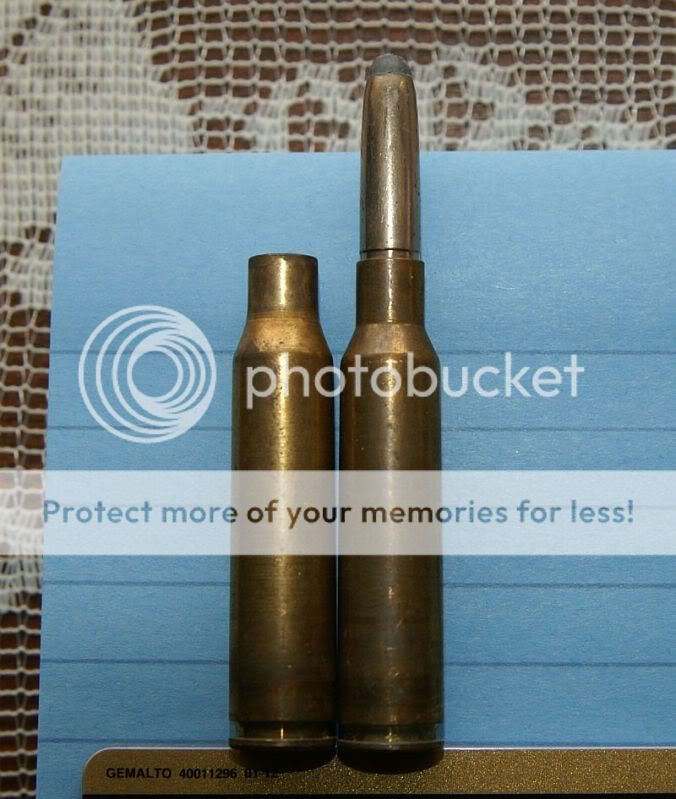
As to the strength of the Eatons Carcano.....about 50 plus years ago a couple of us in Edmonton decided to "blow one up" for giggles. Pulled the bullet on a box of Eatonia carcano ammo and filled the case with bullseye. Tied the rifle to a bren tripod and a long string pulled the trigger. nothing, nada zip. It fired and spit the bullet out the barrel. Second try was again a case full of bullseye, but a bullet (FMJ) in the case backwards and another slug pounded up the barrel about a foot. FIRE !!! Barrel departed the receiver, case disappeared other than some brass stains on the bolt face, which OPENED with a slight bump on the bolt handle. The bolt did not blow open.......... Never found the extractor even after we had covered the entire gun and tripod with a tarp. Ah yes, young and reckless.
PO Ackley did a similar test on several different Carcano rifles to determine their strength and came to the conclusion that the actions were very strong. Easily as strong as any other action of their era.
His decision as to why the Italians loaded it to anemic specs was that it was easier for their troops to handle and gave less wear to the rifles.
Andy, this recent resurrection of this thread, piqued my interest and I read back to the beginning, where you performed your experiment.
I mentioned I had a Carcano carbine chambered for the 8x57 cartridge and used full power 8x57 ammo in it.
You replied that some of your buds in the US cautioned you to use light loads.
I did some checking on these rifles. Even spoke to an old Austrian Hitler Youth member that was issued one of these during the closing days of WWII. He hated it, not because there was anything wrong with it, but because it kicked like a mule, which I can fully attest to.
His name was Eric Grubel and he was from Wein (Vienna). Lives in Hungary now.
He did mention that some of the rifles wouldn't chamber the rounds they were issued, which were on similar enblocs as the 7.5 and 6.5 chambered rifles. It seems that in their hurry, or maybe because of slave labor sabotage, some of the rifles had chambers that weren't deep enough and others were cut to deep.
Just about all of these rifles went to Sudan, where they were used for drill purpose and training. That's why all that I've seen, look beat to hell on the outside, but are almost pristine internally.
During WWII, the Japanese purchased Carcano rifles that were purpose built for their purpose. It was called the Type II.
The Type II Carcano has a Japanese style trigger guard and magazine that doesn't require enblocs and looks just like those on their own Arisaka rifles. The Type II rifles also have a two piece butt, just like the Arisaka.
Here's where the tire hits the road. The Type II rifles are of course chambered for the Japanese standard 6.5x52, with a standard .264 bore. The 6.5x52, with 156 grain bullets, was loaded to 2400 fps by the Japanese. That's appx 200 feet per second faster than the Italian round.