
Does the action type determine how soon you run into pressure issues on reloads? Particularly bolt action vs semi auto(match spec, not mass produced loose tolerance). I assume that since some gas is bled off to cycle the action a semi auto may be more tolerant to hotter loads... But thinking about it a bit more I also question if that is even valid, since the reaction in the cartridge happens well before the gas bleed...













































You are using an out of date browser. It may not display this or other websites correctly.
You should upgrade or use an alternative browser.
You should upgrade or use an alternative browser.
The effect of action on pressure
- Thread starter M16LR.50
- Start date
I assume that since some gas is bled off to cycle the action a semi auto may be more tolerant to hotter loads
Not true! If anything a modern bolt action will tolerate more pressure than a semi auto before something fails.
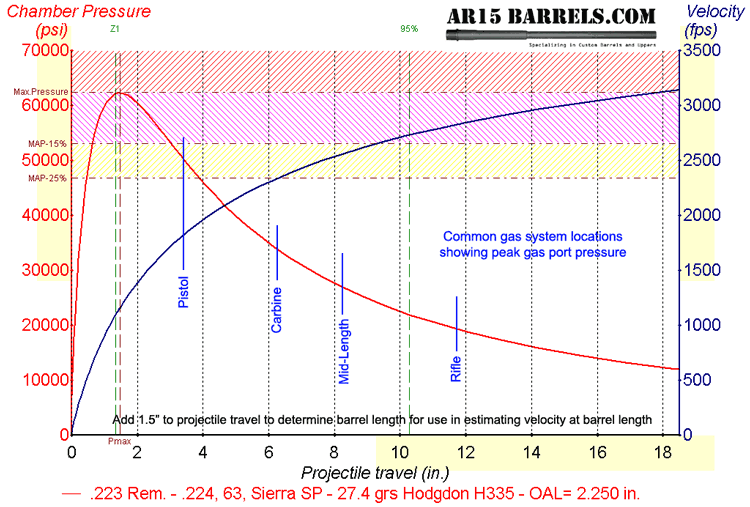
From what I understand, the max pressure is reached at a time when your bullet has only gone about 2-3 inches down the barrel. The gas port is further down the pipe than that, so the pressure has already begun to decrease by the time the bullet passes it. Therefore, the type of action will have no effect on the peak chamber pressure when you fire.
Here's an example of pressure curve I googled:
And an article on the subject:
http://www.mssblog.com/2015/12/18/reloaders-corner-pressure-curves-for-semi-automatic-and-bolt-action-rifles/
Here's an example of pressure curve I googled:
And an article on the subject:
http://www.mssblog.com/2015/12/18/reloaders-corner-pressure-curves-for-semi-automatic-and-bolt-action-rifles/


- Location
- Saskatchewan
YES. with the same cartridge and load, it is reasonable to assume that some actions cannot handle the same amount of pressure that others can. In an example related to your question, in my experience, a .308 win load that may be perfectly fine when fired in several different bolt action rifles like a Sako, Remington or '98 Mauser would show over pressure signs in a rear lock up lever action 99 Savage. I have seen this consistently when comparing the 6 bolt action rifles and three Savage 99 rifles I have loaded for in this cartridge.
I do not load for semi autos, but am aware that there are different pressure specs for some semi auto rifles in .308 so that the pressure curve matches the design spec of the gas operating system. Several reloading manuals specify loads for semi auto gas operated rifles separately. Loads designed for semi autos will nearly always function well in bolt action rifles, the reverse is not always true. Higher than specified pressure in a semi auto may not be a catastrophic case rupture risk, but may affect extraction, and the stress placed on the gas piston and related action parts.
I do not load for semi autos, but am aware that there are different pressure specs for some semi auto rifles in .308 so that the pressure curve matches the design spec of the gas operating system. Several reloading manuals specify loads for semi auto gas operated rifles separately. Loads designed for semi autos will nearly always function well in bolt action rifles, the reverse is not always true. Higher than specified pressure in a semi auto may not be a catastrophic case rupture risk, but may affect extraction, and the stress placed on the gas piston and related action parts.

DONT TRY TO SECOND GUESS THE MANUAL!
Your theory is wrong in several ways.
-The amount of gas bled off is tiny in relation to the total amount.
-the pressure curve has dropped well below max by the time the gas port is exposed (You did correctly comment on this yourself)
-Bolt action lugs are generally beefier than semi actions
Your theory is wrong in several ways.
-The amount of gas bled off is tiny in relation to the total amount.
-the pressure curve has dropped well below max by the time the gas port is exposed (You did correctly comment on this yourself)
-Bolt action lugs are generally beefier than semi actions
Hmmm... Interesting. The pressure curve explains it best... Now, if we throw a more generous chamber spec in there (semi) how does that affect the outcome, since any case expansion would occur rapidly within the 1-2 inches it takes to reach peak pressure? Does it even have any effect at all?
Thanks for the responses...
Also , On the other hand, what can be attributed the scenarios that Longwalker described above?
Thanks for the responses...
Also , On the other hand, what can be attributed the scenarios that Longwalker described above?

The original question asked about "how soon you run into pressure issues on reloads?"
The short answer is "no". Type of action has nothing to do with it. As has been explained , pressure event is over within a few inches of bullet travel.
The longer answer relates to the way the "pressure issues" manifest themselves. In a well made chamber/rifle the round can be way over max -in the proof test range - before showing pressure signs.
In ordinary guns, a little roughness and slop will cause harder bolt lift as a sign. If the gun does not have strong primary extraction, pressure signs start early.
The short answer is "no". Type of action has nothing to do with it. As has been explained , pressure event is over within a few inches of bullet travel.
The longer answer relates to the way the "pressure issues" manifest themselves. In a well made chamber/rifle the round can be way over max -in the proof test range - before showing pressure signs.
In ordinary guns, a little roughness and slop will cause harder bolt lift as a sign. If the gun does not have strong primary extraction, pressure signs start early.

On a AR15 rifle as you can see above the gas port location has a big effect and a carbine takes a bigger pounding than a rifle length gas system. On a over gassed AR15 the bolt can start moving to the rear while there is still pressure in the barrel. Meaning the bolt is starting to rotate while the case head is pressing against the bolt face and you get case head swipes.
On the M1 Grand the gas port is located at the end of the barrel and the bullet leaves the barrel before the bolt begins to move.
Bottom line, hotter loads with a carbine gas system are harder on the rifle. I have a A2 HBAR "rifle" and a 16 inch "carbine" with a "mid-length" gas system I put together and it takes far less of a pounding. And like the M1 Garand slower burning powders will effect port pressure. Therefore the AR15 is more sensitive to reloading and the powders used than a bolt action .223.
Below my practice blasting ammo for my carbine, it is a mild load at just over 2800 fps and the brass lasts a long time and the rims are not chewed up by the extractor.

Our American Military wore out a lot of carbines very quickly in Iraq and Afghanistan and the chamber pressure and gas system were to blame. Meaning the "rifle" gas system is not as hard on the rifle.
On the M1 Grand the gas port is located at the end of the barrel and the bullet leaves the barrel before the bolt begins to move.
Bottom line, hotter loads with a carbine gas system are harder on the rifle. I have a A2 HBAR "rifle" and a 16 inch "carbine" with a "mid-length" gas system I put together and it takes far less of a pounding. And like the M1 Garand slower burning powders will effect port pressure. Therefore the AR15 is more sensitive to reloading and the powders used than a bolt action .223.
Below my practice blasting ammo for my carbine, it is a mild load at just over 2800 fps and the brass lasts a long time and the rims are not chewed up by the extractor.
Our American Military wore out a lot of carbines very quickly in Iraq and Afghanistan and the chamber pressure and gas system were to blame. Meaning the "rifle" gas system is not as hard on the rifle.

On a AR15 rifle as you can see above the gas port location has a big effect and a carbine takes a bigger pounding than a rifle length gas system. On a over gassed AR15 the bolt can start moving to the rear while there is still pressure in the barrel. Meaning the bolt is starting to rotate while the case head is pressing against the bolt face and you get case head swipes.
On the M1 Grand the gas port is located at the end of the barrel and the bullet leaves the barrel before the bolt begins to move.
I just wanted to clarify one point from above, that the bolt carrier on an AR15 also does not begin to move until after the bullet has exited the barrel.

To the OP
Even though a bullet has left the barrel, it doesn't mean the gas pressure has instantaneously returned to zero. Of course the period of time that all this happens in is measured in fractions of a second so it's hard to perceive.
A bolt action unlocks when you decide to unlock it. That's why case head separations are often not that exciting, you may only see a puff of smoke.
A semi-auto unlocks when a specific threshold is met (eg. gas pressure pushes back a carrier and cams open the bolt). But if you have more pressure than you need/want and it can't dissipate or be exhausted before the bolt unlocks.........things can get exciting very quickly
I just wanted to clarify one point from above, that the bolt carrier on an AR15 also does not begin to move until after the bullet has exited the barrel.
*MALICE*
I'm not doubting your word, but it was my understanding that semiautos like the M14/M1A and the M16/AR15 with a mid length gas system can have pressure in the barrel while the bolt moves to the rear. This is the reason that a fired case can end up longer than the chamber and the reason why uncrimped primers can pop out of the primer pocket.
Meaning this remaining pressure can move the case shoulder forward as the bolt moves to the rear and give a false cartridge headspace reading when using case length gauges like the Hornady gauge. This happens more with M14/M1A rifles and bumping the case shoulder .002 to .003 from its fired length may not be enough.
Bottom line, it was my understanding a over gassed rifle can still have pressure in the barrel when the bolt starts moving to the rear. And also why primers can pop out and jam the trigger group if the case has a loose primer pocket.
*MALICE*
I'm not doubting your word, but it was my understanding that semiautos like the M14/M1A and the M16/AR15 with a mid length gas system can have pressure in the barrel while the bolt moves to the rear. This is the reason that a fired case can end up longer than the chamber and the reason why uncrimped primers can pop out of the primer pocket.
Meaning this remaining pressure can move the case shoulder forward as the bolt moves to the rear and give a false cartridge headspace reading when using case length gauges like the Hornady gauge. This happens more with M14/M1A rifles and bumping the case shoulder .002 to .003 from its fired length may not be enough.
Bottom line, it was my understanding a over gassed rifle can still have pressure in the barrel when the bolt starts moving to the rear. And also why primers can pop out and jam the trigger group if the case has a loose primer pocket.
You are absolutely correct in your above assertions.
However, just because the bullet has exited the barrel, doesn't mean the pressure is instantaneously zero. It starts dropping significantly/rapidly but that takes time (an entire firing sequence for a gun happens in split seconds). It seems like instantaneously because people can not perceive time in the fractions of seconds that firing a round takes.
These numbers are just made up but they're only for explanation purposes;
Let's say that when the bullet reaches the end of the barrel there is 20000psi. The bullet is now .1" away from the barrel and that took .1seconds and the barrel pressure has now dropped rapidly to 10000psi. The bullet is now .2" away from the barrel and that took another .1 seconds and the pressure has now dropped to 5000psi.
So as we see, rapidly dropping pressure, but the bullet has left the barrel........and if the breach is now unlocked, the pressure has two escape points.
If the barrel completely unlocked before the bullet had left the barrel, you would have a full gas system full of pressure released into the action.
Think of a silencer/suppressor: Semi autos fitted with them have increased backpressure, thus cycle harder and have increased fouling because even though the bullet has left the gun, the gas pressure has not/can not completely dissipated from the system instantaneously.





















