The Gun Case Thread

I like that Ferney case, don't care much for their website. Those Henry Hollands.........gorgeous. I know where there is a very nice H Holland double percussion for sale, at least it was last year. London Shooter, I have seen one duplicate of that case with the storage in the lid so it isn't unique. It's a nice case but the hardware isn't English, I think the case is probably of European origin - German, Belgian, French, maybe Spanish.
Here is a case that I rebuilt from a wreck, even the wooden frame and lid were broken and missing pieces. If I had realized before I started just how bad it was I probably would have just scrapped it for parts. It required rebuild of the box and lid, extensive leather repairs, reline, wrist strap, case straps, mostly new partitions and a replacement label, the original wasn't salvageable. The leather is not the usual cowhide, I have been told that it is elephant hide!
 
Here is a case that I rebuilt from a wreck, even the wooden frame and lid were broken and missing pieces. If I had realized before I started just how bad it was I probably would have just scrapped it for parts. It required rebuild of the box and lid, extensive leather repairs, reline, wrist strap, case straps, mostly new partitions and a replacement label, the original wasn't salvageable. The leather is not the usual cowhide, I have been told that it is elephant hide!

Nicely done Ashcroft. Your rebuilt case looks fantastic! I recall seeing a bit of a step by step tutorial of a case rebuild on doubleguns. It would be great if we could have something like that on this thread.

Additional Note: I like how you added leather to the breech and receiver face areas. A great idea.
 
Last edited:
Sharp eye VictoryXC. I have had a very few original cases, mostly post 1930 with leather wear patches and they work, seemed a no brainer on a complete rebuild. Mostly my case efforts are restorations of varying complexity, this is the first one that I did a complete rebuild on. Maybe the last, I think it would be no more difficult to build a whole new case from scratch, especially since some of the correct vintage type hardware bits are nearly impossible to source. Unanticipated problems rear their head as you get into the project - warped wood, fragile wood, old glue, missing and rotten stitching, stitching holes ripped out, leather the consistency of cheap cardboard or of sheet metal, oil soaked and stained baize, missing, modified and broken partitions, moth damage, and on and on. If I get a case that is unusable or not practical to repair or refurbish I usually scrap it for parts and material, I save straps, hardware, partitions and blocks, boxes and lids, even baize material. And of course I save old labels, I'll take some pictures of these and post them in this thread later.
 
Pinfire generously gifted me an old case that needs some TLC. It is on my project list and hopefully I can bring it back to life. It is a perfect fit for a small framed 12g I have.
 
Bryon, I would avoid woods like pine or spruce because of the tendency to bleed sap. If the partitions will be covered then the ideal for these parts is basswood and can be sourced air-dried from many local mills. Same family as what would be used in Europe (there would be called Linden, or Limewood). It is lightweight and easy to work but a not a good choice for the parts that will show since in appearance is very plain. Also not going to be as strong as oak or ash. Those two come to mind for the structural parts of a case.
 
To build a new covered case today I would use marine grade fir plywood for the box and lid. All these parts will be covered with leather or cloth so appearance doesn't matter. This material will be very strong, light enough and completely stable. Excellent partitions and blocking can be made from basswood as noted, it's very light, very stable and cuts and shapes easily. Not particularly strong, but strong enough fot this job. I have used #1 or 2 clear pine for partitions with complete satisfaction, strong, stable, light and cuts clean. It grows on trees around here. Of course an all wood tradional case for a muzzleloader or early pinfire was solid oak or mahogany, very difficult to source today in suitable sized pieces, again I would look at oak or mahogany plywood both for stability and availability.
 
To build a new covered case today I would use marine grade fir plywood for the box and lid. All these parts will be covered with leather or cloth so appearance doesn't matter. This material will be very strong, light enough and completely stable. Excellent partitions and blocking can be made from basswood as noted, it's very light, very stable and cuts and shapes easily. Not particularly strong, but strong enough fot this job. I have used #1 or 2 clear pine for partitions with complete satisfaction, strong, stable, light and cuts clean. It grows on trees around here. Of course an all wood tradional case for a muzzleloader or early pinfire was solid oak or mahogany, very difficult to source today in suitable sized pieces, again I would look at oak or mahogany plywood both for stability and availability.


A fellow needs to keep his eyes open for those old stereo entertainment centers. Some of them had some pretty nice wood of varying kinds. Most people that have them have a hard time giving them away. Reminds me, I have one downstairs. Hmmmmmm
 
Gunsaholic, old stereo cabinet wood could be golden, great idea. Maybe an old no longer used gun cabinet that was replaced by a safe as well or kitchen cabinet doors. I should give more detail on the wood I have used, wood species vary across the country. The fir plywood in BC that I am talking about is Douglas Fir, marine grade, has no voids or biscuits and is waterproof. Sitka spruce would be equally good if you can find it. The pine I am talking about ( can be 2x4, 2x6, etc) here is Lodgepole pine, locally called Jackpine, it is kiln dried, and if #2 or better, preferably J Grade clear, it will be very straight, warp, twist and knot free and would normally have no free pitch. A little more expensive than your average building stud but we're only talking about a board or two. Another thought - at one time before molded fiberglass boats became common many beautiful boats were made from molded plywood, mostly mahogany, maple, birch. This would make a great case if you could find some.
 
I was planning on using hardwood although cedar crossed my mind but i wasnt sure about moisture content as my humidors are cedar lined and keep moisture in.
I have 2 ash blanks in my garage right now. Dont know if my buddies planner is big enough to handle them as is. Might be a fun project to keep me busy.
Do you all use the self adhesive baize or do you wrap and glue normal type baize?
 
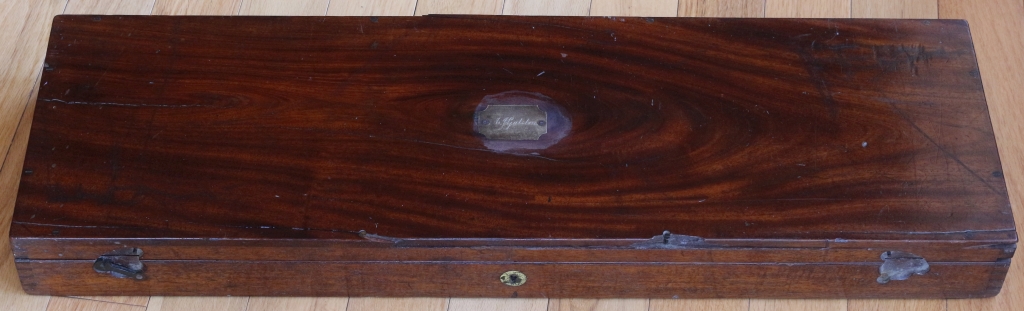
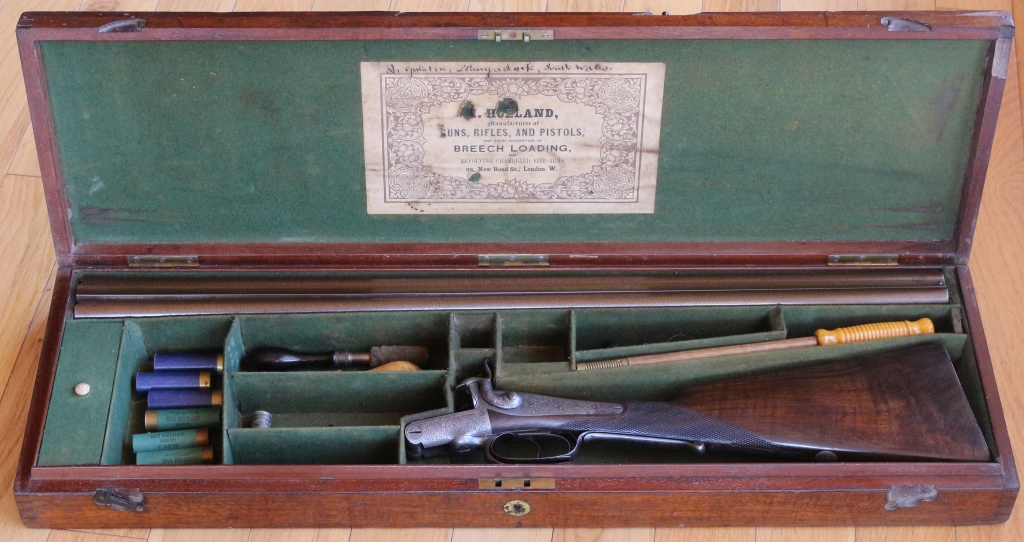
Ashcroft mentioned mahogany being used in early pinfire gunroom cases, and here is one, my last case for this thread, for Harris Holland's number 824.

Vn9LPK0.jpg

buqsjcq.jpg
 
Brybenn, like most Canadian wood species, cedar has many different sub species with different characteristics. Aromatic cedar as used for cigar humidors, bedding storage chests and antique luggage lining is beautiful, light, stable but I don't know how strong it is or where you would find it in usable pieces. To me it appears similar to our native Juniper here, has a strong odour. Yellow cedar from coastal BC and the Queen Charlotte Islands is light, very stable and warp free, straight and strong, plain appearance, somewhat difficult to source. During WW2 it was used for spars, stringers and shaped structural pieces in wings and control surfaces on the Mosquito fighter/bomber and other aircraft. The easily sourced ( in BC) Western Red Cedar is available in different forms like plywood, boards, trim, etc and has almost all the necessary characteristics we need, light, exceptionally stable, easily shaped, no pitch, inexpensive, but one drawback - it is brittle and cracks easily with the grain. I'm thinking of experimenting with this one day.
 
Ashcroft, when it comes to quality softwoods you are spoiled for choices on the west coast. On the other hand we have some of the finest basswood, red oak, white & black ash, black cherry, and hard maple, available anywhere.
Our eastern white pine and white spruce are nearly all from 2nd growth forests. The trees grew not under a dense high canopy but rather with easy access to sunlight. So the wood is not as dense as first growth, and in in comparison a pine saw log has more and bigger knots, more sap pockets. I'm told that a hundred years ago a person in Ontario could cut white cedar suitable for utility poles but those days are long gone. White cedar even in the log naturally has low moisture content and is very stable however not obtainable in logs large enough or solid enough to make lumber. We do have plenty of access to western red cedar though through our lumber yards intended for decks and fencing.
 
We can get red oak and maple here at specialty lumber providers like Windsor Plywood but I've found both to be not vety stable, can be subject to warping and dimension changes with changes in humidity. California Redwood is somewhat similar to Western Red Cedar but a little denser, a little heavier, very stable but I've never used it in a case project. Stabilty and strength are very important for the box and lid, partitions need to be stable, light and easy to shape. Native hardwoods of sawlog size such as Western Broadleaf Maple, Alder and Birch and some fruit trees exist in BC but are little utilised beyond a couple of specialty furniture manufacturers.
I've never heard of self adhesive baize, it sounds interesting. I just use ordinary carpenter's white glue, the amount to use is tricky because you need enough for a good bond but not enough to soak through the cloth.
 
There was some talk earlier regarding the toe under type of small case, here is an original, an E J Churchill patented VC ( Very Compact) from 1959. Funny, doesn't seem that long ago but this case is actually over 60 years old - so is the gun. Features of note -
Unlike almost all other case styles, the gun lays on it's left side, this allows the toe of the stock to slide into the recess under the forward end of the barrels.
There is a leather flap covering the ends of the cleaning rod, preventing forend damage from the cleaning rod. This type of damage is quite common and the cleaning rod on the case is the culprit.
Note the leather corner reinforcements and also leather wear pads in interior contact areas.
Another unusual feature is double latches with no straps.
These cases are very small, very light and very strong. Churchill invented and patented this design, made them in canvas w/ leather trim as well as all leather like this one and were their preferred case for their higher grade guns. Many makers have copied this case, nobody did it better.
 
We can get red oak and maple here at specialty lumber providers like Windsor Plywood but I've found both to be not vety stable, can be subject to warping and dimension changes with changes in humidity. California Redwood is somewhat similar to Western Red Cedar but a little denser, a little heavier, very stable but I've never used it in a case project. Stabilty and strength are very important for the box and lid, partitions need to be stable, light and easy to shape. Native hardwoods of sawlog size such as Western Broadleaf Maple, Alder and Birch and some fruit trees exist in BC but are little utilised beyond a couple of specialty furniture manufacturers.
I've never heard of self adhesive baize, it sounds interesting. I just use ordinary carpenter's white glue, the amount to use is tricky because you need enough for a good bond but not enough to soak through the cloth.

Would balsa wood work? I used it as a kid to make model airplanes---super easy to work with---not very strong but do you really need a strong partition?
 
Modern cases

DSCN2872.jpgThis is an 80's Perazzi case. Not very fancy in comparison to vintage English cases but it is inexpensive and functional. Negrini cases are step up and more pleasing to the eye but I don't haveDSCN2870.jpg one, at least not at the moment.
 

Attachments

  • DSCN2870.jpg
    DSCN2870.jpg
    96.8 KB · Views: 320
  • DSCN2872.jpg
    DSCN2872.jpg
    108.8 KB · Views: 323
Back
Top Bottom