Maybe you're right. The CFO had been surprised (!) by the fact that there were so many different FRT's for the same barrel length. Initially he wrote to me to state that the PSP has a shorter barrel than the P7M8 I used as an argument. I replied that I had two years earlier registered to my name a PSP (restricted) that I had sold in the meantime (to a police officer no less) and he verified that I was correct. I thought that tipped the scales but perhaps he indeed contacted the importer. Who knows? It's just points to yet another wacko aspect of the FRT system since PSP and P7 were always made with the same factory standard barrel length, so why so many different FRT's I don't know.Just to reiterate my earlier post - be careful with the PSP & P7 as +/- 1mm will change their classification - if you have access to the FRT then can see that PSP is prohibited, the P7 prohibited (105mm) or restricted (106 & 107mm), and the P7/M8 is Prohibited (105mm) or Restricted (106, 107, 120mm). Different reference numbers for each configuration.
Generally a verifier is involved to change the classification but perhaps your letter prompted the CFO & exporter to communicate, remeasure the barrel and thus change the classification.














































You are using an out of date browser. It may not display this or other websites correctly.
You should upgrade or use an alternative browser.
You should upgrade or use an alternative browser.
The Heckler & Koch PSP and P7M8 in pictures
- Thread starter ghostie
- Start date


Originally Posted by lineofsight
Just to reiterate my earlier post - be careful with the PSP & P7 as +/- 1mm will change their classification - if you have access to the FRT then can see that PSP is prohibited, the P7 prohibited (105mm) or restricted (106 & 107mm), and the P7/M8 is Prohibited (105mm) or Restricted (106, 107, 120mm). Different reference numbers for each configuration.
I think all this stems from some confusion in the beginning when some people tried to classify the P7 as prohib while others went with restricted because the barrel is exactly 105mm. To my knowledge this has been cleared up and all these guns are officially classed as being restricted.
I have an ex-Polizei PSP that is registered as Restricted.

blackacres
Regular
- Location
- Mount Hope, Ontario
Great post with lots of photos comparying a P7 PSP to the P7 M8. I've admired these little grip cockers for some time.
I had the pleasure to shoot a P7 PSP a couple of weeks ago, a fellow gun member at our range let me try his out.
I own two HK's already, so it looks like I'll be adding another HK to the family once I find one in nice shape.
Thanks for the informative post.
I had the pleasure to shoot a P7 PSP a couple of weeks ago, a fellow gun member at our range let me try his out.
I own two HK's already, so it looks like I'll be adding another HK to the family once I find one in nice shape.
Thanks for the informative post.


Hope that the white dot in the sight does not come off this time......
Yah, no kidding. Terry is referring to the fact that one of the white dots on the rear sight of my old PSP flew off when shooting it a few years back. Couldn't find it at the range. Mind you, this was an ex-Polizei gun that had some miles on it.
Terry, I never see you and your wife at the range any more. What days do you go? Or are you all TMSA now? Or just busy selling kayaks?
With the P7 guns, generally I find they are easy to shoot accurately, but there are a couple of weird things with them:
- I find that, like GLOCK, trying to really "finesse" the trigger (taking it up to the break point and then applying just enough pressure to release the striker) won't result in accurate shooting. Just holding the gun steady and thinking in terms of pulling (or squeezing, or however you think of it) straight through is the way to go. I find that I can pull the gun to the right sometimes if I try and finesse it too much.
- The reset is weird compared to most semi-automatic pistols in that the break point is closer to the starting point (resting point) of the trigger than it is to the extreme opposite end of the trigger's range of movement (after the gun has fired). This is the reverse of most guns, where you take the trigger up to the break point - fire it - and then just let it out just enough so that it resets - fire again - repeat, etc. With the P7 guns, I have found that it works better to think in terms of basically let it go all the way out as if you took your finger off the trigger all together, and then just tensing it up to the break-point - which is right near where the resting (untouched) trigger is anyway - break the next shot - let it all the way out with your finger still on it - tense it up to the break point - break the next shot, repeat, etc.
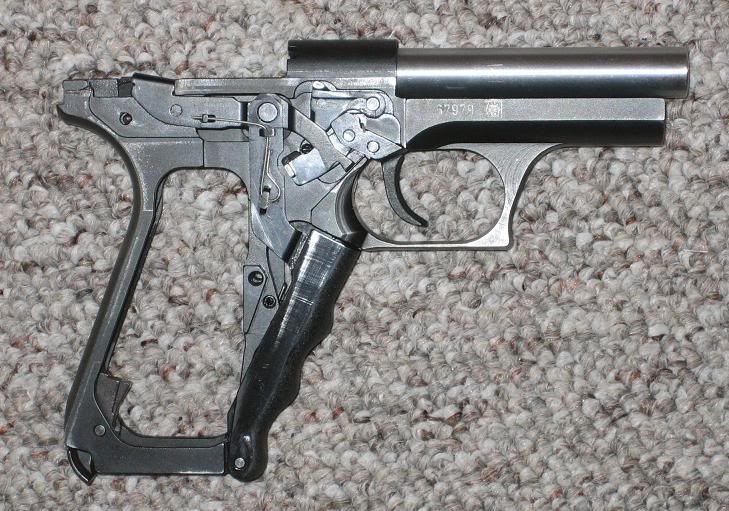
But when you get used to it, it fires a surprising number of shots that are right bullseye on what you are aiming for... and I mean right dead centre. As long as you aren't moving the gun with your hands, there is no real movement in the system... no hammer, no real moving parts. If you look at that photo of the right side of the stripped PSP, you will see that the squeeze cocker is attached to a little piece of metal that sticks up above the frame of the gun. When the grip is squeezed, that piece is moved back into the rearward (cocked) position. It pushes back against that flat notch on the striker - and when you pull the trigger, the piece that the squeeze cocker is holding back drops straight down - releasing the striker. The action of the slide re-sets the system. So, as long as you are keeping a steady grip on the squeeze cocker, the only movement is that little piece dropping straight down as the trigger is pulled. It is a fixed barrel. Nothing unlocks and locks up again. The slide doesn't move that much to begin with, and web of your hand is right under the plane of the barrel (very low bore axis). So they have an inherent accuracy to them.
It is an interesting system. There are a few downsides, especially for people used to shooting other guns. It is not the perfect gun for everyone by any means. You can short-stroke the trigger due to what I have set out above. Some people (like my girlfriend) don't like holding the squeeze-cocker all the time, and think that it distracts them from their shooting. Some people don't like the heat and the fouling inherent in this system, and it is only 8 rounds (13 on a double stack, in free countries at least).
I have not had this problem with the P7s I have now, but I had a problem once, which I think was due to a detail strip combined with an over-oiling of the squeeze-cocker parts, on one I used to have. If too much oil combined with fouling gets on that part at the top of the squeeze-cocking system (that I have been talking about, the part that cocks the striker) it can get stuck in the downward (fired) position.... in which case the gun is "dead in the water" and there is no tap-rack-bang procedure to get it going again. You would have to take it apart and clean it properly. At this point in my firearms life, I tend to be of the view that detail stripping should be avoid as much as possible, but if you are going to take the squeeze-cocker apart and clean it... don't oil it. Just just a silicone cloth AT THE MOST. A normal cloth would be o.k. too.
I thought I remember hearing somewhere that the New Jersey State Police (the P7s most famous customer on this side of the Atlantic) got rid of the P7s or phased them out of something like that due to a failure that almost cost a State Trooper his life. I never heard the full story, but I always wondered if it was because of this idea of the cocking piece getting stuck in the down position. Anybody know? Any link to the story out of gun mag or anything?
Now, don't get me wrong... the guns are practically indestructible as far as I can see. They are solid metal little tanks... and as long as they are not over oiled or over fouled, I am hard pressed to see what could go wrong with them.
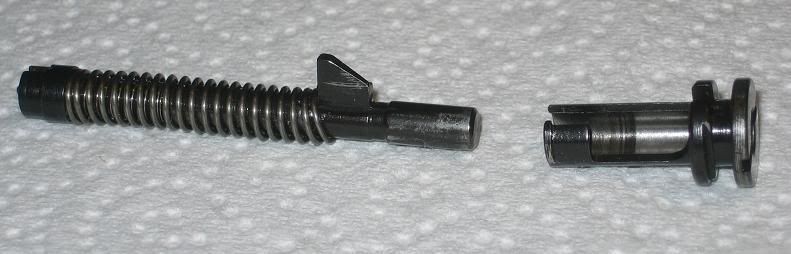
The first shot shows the cocking piece at the top of the squeeze-cocking mechanism. The other shot shows the part is pushes against on the striker:


Is it true that the PSP's trigger will melt in a firefight? Because I'm in firefights all the time and it's a great concern!
Seriously, good post except for the warning. Geez!
No the trigger is fine, the area above it starts to warm up...then gets hot. Thats why the M8 has that little heat shield above the area. Unless your doing alot of shooting its not noticeable that it gets hot...2-3 mags are no problem.
Or wear Nomex gloves...


Everyone that enjoys and appreciates pistols and their design owes it to themselves to own one of these (at the very least for a little whole).
Had one, loved it for a bit and then sold it as it became a safe queen. I think if I was to ever be in a position to need or have the option of carrying, I'd pick the M8. Fantastic little pistols!
Had one, loved it for a bit and then sold it as it became a safe queen. I think if I was to ever be in a position to need or have the option of carrying, I'd pick the M8. Fantastic little pistols!
Is it true that the PSP's trigger will melt in a firefight?
I specifcially ran two mags through mine the other day and then felt the frame to see if it was getting hot. I could barely feel any temperature difference. I think you'd have to shoot quite a few rounds to get the thing hot to the point where it became an issue.
.. .....Recently I picked up this amazing NIB PSP from 1980 ("IA" date code). ....
ghostie; really appreciate this thread as I have one from Armtac on its way.
But I am somewhat confused by the term NIB for a PSP. I have always been under the impression that all PSPs are factory refurbished, one way or another. Are there actually Police H7s (PSP) that have not been fired since new?
ghostie; really appreciate this thread as I have one from Armtac on its way.
But I am somewhat confused by the term NIB for a PSP. I have always been under the impression that all PSPs are factory refurbished, one way or another. Are there actually Police H7s (PSP) that have not been fired since new?
It is a bit hard to believe, isn't it? A non police, non-refurb P7 PSP made in 1980 still in the box with a manual in German and the second mag still in a plastic bag. That is what I meant by "hard to believe that treasures like this still exist in Canada". A guy was selling it on the EE this summer. He says it has never been fired and my examination of it would tend to suggest that he is correct.
I still haven't fired it myself...
 ... although I plan to use it. I don't want to deprive this gun of the purpose for which it was made forever!
 But, yah, that is not a police gun or a refurb.... that is a gun that was imported to the United States at the very, very beginning of the civilian P7 imports... and made its way to Canada at some point. What a little treasure! I can't believe nobody snapped this up before me. When I sent my "I'll take it" the seller said I would be making 4-5 tire kickers very unhappy. You snooze you lose.






















