the spank
CGN Ultra frequent flyer
- Location
- Planet Earth Wearing My Tinfoil Hat
Let me start off by saying…
In 1986 shortly after I took up registered trap I attended a shoot at the Hamilton Gun Club with a squad of friends from my then home club, the North Bay Skeet & Trap Club. After signing up for the shoot one of my squad mates, a trap shooter of some high regard at the time and I are walking out the front door to go assemble our guns and gear to get ready. High above the door hanging on the wall is a colour picture of a female shooter probably in her mid to late 70’s dressed in her shooting vest and holding what I as a young (22 yrs of age) new to all things trap 1100T Remington trap shooter thought was one of the ugliest guns I’d ever seen. I commented to my squad mate about “that ugly gun” the lady in the picture was holding and I’ll never forget him saying with a mix of surprise and reverence in his voice “that's an Ithaca 5E Knick, the best trap gun ever made, they are the King of trap guns!". I recall not saying anything more about it but kind of scoffed in my mind.
Thinking back now 40 years later that statement coming from a gentleman who had shot much of his ATA career with a Model 12 Pigeon Grade Trap and had retired it to the gun safe in 1985 to shoot a Perazzi MX8 combo he had acquired at the Grand American the previous shooting season was not untrue.
I no longer think that gun is ugly in any way, shape or form and in fact I think they are a gun of absolute beautiful craftsmanship and aesthetics and I fully appreciate and understand today what my friend meant by that bold statement "The King of Trap Guns".
Ithaca SBT...The King of Trap Guns
In days past, all the great American gunmakers produced trap guns, including Parker, L.C. Smith and A.H Fox but one outlasted them all and stands alone, the Ithaca single barrel trap.
The Ithaca single barrel trap was introduced in 1914 and continued until production ceased with the last example leaving the factory floor in 1980. By the end, it cost more to make an Ithaca Knick SBT than they could sell them for. The last dozen Ithaca trap guns went to Jaqua’s in Ohio, long a specialist in fine guns, particularly trap guns.
The history of the Ithaca trap gun can be divided into two distinct phases. The first, from 1914 to 1921, was the era of the “Flues,” designed by Emile Flues; the second, the “Knick,” began in 1922 and lasted until the end. The models remained the same, and looked much the same, but the Knick, designed by Frank Knickerbocker, had different internals. The Knick was noted for being stronger than the Flues, but when it came to durability, the Flues was no slouch. Of course, standards of durability are different for trap guns, which are expected to routinely deliver upwards of 250,000 plus trouble-free shots during their lifetime.
In his book, The American Single Barrel Trap Gun, author Frank Conley examines various myths about the Flues versus the Knick, including the widespread belief that the Flues is not safe with modern shotshells. Exactly how this got started is anyone’s guess, but it simply isn’t true.
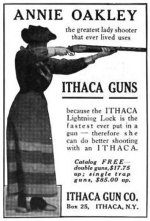
Notable users of the Ithaca include Annie Oakley and Theodore Roosevelt. Miss Oakley broke 98/100 for the first time with an Ithaca. Not bad company to be in.
1916 Ithaca Ad shows Annie Oakley with her Ithaca Flues SBT
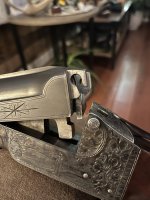
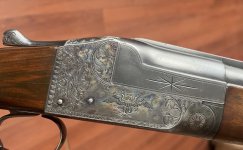
Handsomely engraved beefy receiver with crossbolt lockup of a 1917 4E Flues.
In 1922 the Ithaca Gun Co. introduced the most iconic trap gun ever invented and the one most valued by collectors and shooters alike to this day, the Knickerbocker or “Knick” Single Barrel Trap Gun.
In production from 1922 until the last Knick left the factory in 1982 a total of 5740 were produced.
By 1935 the Knick had won the Grand American Handicap six times, by 1976 it was responsible for over 25% of the total wins at the Grand American and has been the most well-known single barrel trap gun in American history.
Make no mistake, there are few shotguns, modern or vintage, that can come to the traps with the patterns, shooting characteristics and brute strength that has been seen in the Ithaca Knick.
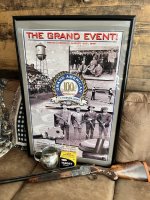
The game the Ithaca SBT was designed for and dominated for many years.
Both the Flues and Knick were offered in a variety of grades beginning with the entry level Victory Grade, a factory spec'd over the shelf affordable gun originally aimed at targeting the market of soldiers returning from the trenches of WW1. After the Victory Grade the lineup started with fully optioned and customer specified customizable grades beginning with the 4E, the most abundantly produced of all the grades. From the 4E on up through the 5E,6E,7E and Sousa Special, all were handsomely hand engraved, the various grades separated by more elaborate engravings which could be had with silver inlays in earlier production models and gold inlays in later production models. Stocks were made of beautifully figured American Walnut and the higher the grade the more extensive the checkering patterns and coverage were. Many also featured ebony tipped forends. Stocks could be had with a straight grip which was very popular in the earlier guns, a prince of wales grip which was the least produced and the full pistol grip which became the predominant grip of the later models. Barrels could be had in 30", 32" or 34" of which the 34” has become the most desirable with collectors. The 32" were the most commonly produced.
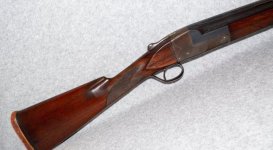
The Entry Level Victory Grade Knick
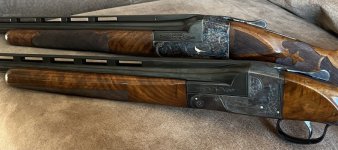
A 4E Knick (front) & 5E Knick(back). Note the silver inlays of the early model 5E. Later models were furnished with gold inlays.
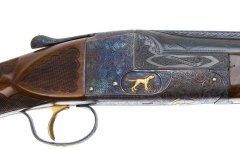
An extremely rare 7E Knick
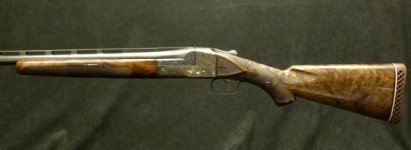
The rarest Knick of them all, the Sousa Grade named after the famous composer, conductor and extremely accomplished trap shooter John Philip Sousa.
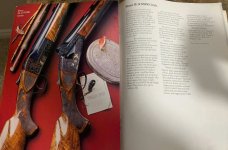
Exactly what year Ithaca quit cataloguing the Knick I am unsure of but a picture sent to me by a friend of a 1978 Ithaca catalog featured a two page layout offering the Knick in two grades. A 5E and a grade called the $5000 grade which coincidentally was also the retail price of that grade model that year, over $28,000 dollars in 2026!
1978 Ithaca Catalog featuring the 5E & $5000 grades still being offered.
By the time of its demise, however, the Ithaca looked decidedly old-fashioned. Among the changes to the trap world were the rise of the over-and-under gun, which allowed a shooter to use the same gun for 16-yard, handicap, and doubles. From this grew the "combo" gun, an o/u with a single barrel for singles and handicap and a set of double barrels for shooting doubles. In the trapshooters never ending quest for reduced felt recoil the un-single barrel came along, a single barrel designed to fit to and be fired from the underbarrel portion of the o/u frame. Aside from the un-singles even allegedly conventional guns have adopted adjustable stocks that look like something out of Rube Goldberg with adjustable ribs, methods of varying weight and balance, adjustable trigger assemblies, and a range of interchangeable chokes that defy belief.
After Perazzi’s shooter won gold at the Mexico City Olympics in 1968 with their MX8, the Perazzi became “the gun” for any shooter with pretensions to the top rungs and it may not be a coincidence that Ithaca was the first company to import Perazzi shotguns into the USA and Canada starting in 1973.
Still, for lovers of fine guns there is nothing quite like an Ithaca from the golden age and there are still many Knicks and Flues out there in superb condition still highly sought after by both collectors and vintage gun shooting enthusiasts alike and at todays current market prices are a bargain given their heritage and quality especially when compared to many other classic collectibles whose namesake alone adds tremendous value. Should you get the chance to shoot one or better yet own one, do not turn it down. You will be rewarded with a trapshooting experience you’ll never forget turning clay targets to boiling balls of soot with a gun in your hands made by the hands of craftsmen of a bygone era that took great pride in a job well done to produce the best product one could make.
In 1986 shortly after I took up registered trap I attended a shoot at the Hamilton Gun Club with a squad of friends from my then home club, the North Bay Skeet & Trap Club. After signing up for the shoot one of my squad mates, a trap shooter of some high regard at the time and I are walking out the front door to go assemble our guns and gear to get ready. High above the door hanging on the wall is a colour picture of a female shooter probably in her mid to late 70’s dressed in her shooting vest and holding what I as a young (22 yrs of age) new to all things trap 1100T Remington trap shooter thought was one of the ugliest guns I’d ever seen. I commented to my squad mate about “that ugly gun” the lady in the picture was holding and I’ll never forget him saying with a mix of surprise and reverence in his voice “that's an Ithaca 5E Knick, the best trap gun ever made, they are the King of trap guns!". I recall not saying anything more about it but kind of scoffed in my mind.
Thinking back now 40 years later that statement coming from a gentleman who had shot much of his ATA career with a Model 12 Pigeon Grade Trap and had retired it to the gun safe in 1985 to shoot a Perazzi MX8 combo he had acquired at the Grand American the previous shooting season was not untrue.
I no longer think that gun is ugly in any way, shape or form and in fact I think they are a gun of absolute beautiful craftsmanship and aesthetics and I fully appreciate and understand today what my friend meant by that bold statement "The King of Trap Guns".
Ithaca SBT...The King of Trap Guns
In days past, all the great American gunmakers produced trap guns, including Parker, L.C. Smith and A.H Fox but one outlasted them all and stands alone, the Ithaca single barrel trap.
The Ithaca single barrel trap was introduced in 1914 and continued until production ceased with the last example leaving the factory floor in 1980. By the end, it cost more to make an Ithaca Knick SBT than they could sell them for. The last dozen Ithaca trap guns went to Jaqua’s in Ohio, long a specialist in fine guns, particularly trap guns.
The history of the Ithaca trap gun can be divided into two distinct phases. The first, from 1914 to 1921, was the era of the “Flues,” designed by Emile Flues; the second, the “Knick,” began in 1922 and lasted until the end. The models remained the same, and looked much the same, but the Knick, designed by Frank Knickerbocker, had different internals. The Knick was noted for being stronger than the Flues, but when it came to durability, the Flues was no slouch. Of course, standards of durability are different for trap guns, which are expected to routinely deliver upwards of 250,000 plus trouble-free shots during their lifetime.
In his book, The American Single Barrel Trap Gun, author Frank Conley examines various myths about the Flues versus the Knick, including the widespread belief that the Flues is not safe with modern shotshells. Exactly how this got started is anyone’s guess, but it simply isn’t true.
Notable users of the Ithaca include Annie Oakley and Theodore Roosevelt. Miss Oakley broke 98/100 for the first time with an Ithaca. Not bad company to be in.
1916 Ithaca Ad shows Annie Oakley with her Ithaca Flues SBT
Handsomely engraved beefy receiver with crossbolt lockup of a 1917 4E Flues.
In 1922 the Ithaca Gun Co. introduced the most iconic trap gun ever invented and the one most valued by collectors and shooters alike to this day, the Knickerbocker or “Knick” Single Barrel Trap Gun.
In production from 1922 until the last Knick left the factory in 1982 a total of 5740 were produced.
By 1935 the Knick had won the Grand American Handicap six times, by 1976 it was responsible for over 25% of the total wins at the Grand American and has been the most well-known single barrel trap gun in American history.
Make no mistake, there are few shotguns, modern or vintage, that can come to the traps with the patterns, shooting characteristics and brute strength that has been seen in the Ithaca Knick.
The game the Ithaca SBT was designed for and dominated for many years.
Both the Flues and Knick were offered in a variety of grades beginning with the entry level Victory Grade, a factory spec'd over the shelf affordable gun originally aimed at targeting the market of soldiers returning from the trenches of WW1. After the Victory Grade the lineup started with fully optioned and customer specified customizable grades beginning with the 4E, the most abundantly produced of all the grades. From the 4E on up through the 5E,6E,7E and Sousa Special, all were handsomely hand engraved, the various grades separated by more elaborate engravings which could be had with silver inlays in earlier production models and gold inlays in later production models. Stocks were made of beautifully figured American Walnut and the higher the grade the more extensive the checkering patterns and coverage were. Many also featured ebony tipped forends. Stocks could be had with a straight grip which was very popular in the earlier guns, a prince of wales grip which was the least produced and the full pistol grip which became the predominant grip of the later models. Barrels could be had in 30", 32" or 34" of which the 34” has become the most desirable with collectors. The 32" were the most commonly produced.
The Entry Level Victory Grade Knick
A 4E Knick (front) & 5E Knick(back). Note the silver inlays of the early model 5E. Later models were furnished with gold inlays.
An extremely rare 7E Knick
The rarest Knick of them all, the Sousa Grade named after the famous composer, conductor and extremely accomplished trap shooter John Philip Sousa.
Exactly what year Ithaca quit cataloguing the Knick I am unsure of but a picture sent to me by a friend of a 1978 Ithaca catalog featured a two page layout offering the Knick in two grades. A 5E and a grade called the $5000 grade which coincidentally was also the retail price of that grade model that year, over $28,000 dollars in 2026!
1978 Ithaca Catalog featuring the 5E & $5000 grades still being offered.
By the time of its demise, however, the Ithaca looked decidedly old-fashioned. Among the changes to the trap world were the rise of the over-and-under gun, which allowed a shooter to use the same gun for 16-yard, handicap, and doubles. From this grew the "combo" gun, an o/u with a single barrel for singles and handicap and a set of double barrels for shooting doubles. In the trapshooters never ending quest for reduced felt recoil the un-single barrel came along, a single barrel designed to fit to and be fired from the underbarrel portion of the o/u frame. Aside from the un-singles even allegedly conventional guns have adopted adjustable stocks that look like something out of Rube Goldberg with adjustable ribs, methods of varying weight and balance, adjustable trigger assemblies, and a range of interchangeable chokes that defy belief.
After Perazzi’s shooter won gold at the Mexico City Olympics in 1968 with their MX8, the Perazzi became “the gun” for any shooter with pretensions to the top rungs and it may not be a coincidence that Ithaca was the first company to import Perazzi shotguns into the USA and Canada starting in 1973.
Still, for lovers of fine guns there is nothing quite like an Ithaca from the golden age and there are still many Knicks and Flues out there in superb condition still highly sought after by both collectors and vintage gun shooting enthusiasts alike and at todays current market prices are a bargain given their heritage and quality especially when compared to many other classic collectibles whose namesake alone adds tremendous value. Should you get the chance to shoot one or better yet own one, do not turn it down. You will be rewarded with a trapshooting experience you’ll never forget turning clay targets to boiling balls of soot with a gun in your hands made by the hands of craftsmen of a bygone era that took great pride in a job well done to produce the best product one could make.
Last edited: