












































You are using an out of date browser. It may not display this or other websites correctly.
You should upgrade or use an alternative browser.
You should upgrade or use an alternative browser.
The Right Tool: Following up a Wounded Wood Bison bull with a Double Rifle (Article)
- Thread starter Ardent
- Start date


Oh yes. "extreme exercise" indeed. As to my native ancestors who hunted them with stone tipped arrows and lances, kudos to them. I doubt very much it was pretty or noble though. And a little earlier, according to some, they managed to kill off all the mammoths. Which boggles my mind. - dan
Wow that's a huge animal! Im just wondering; how did they use to hunt bison before the availability of such rifle power? I'm pretty sure bow&arrow use to be the tool of choice a few centuries ago..
So really were talking about shot-drop performance?
Btw excuse this young buck, I've never hunted anything bigger than moose.
Prior to the horse, jumps and pounds were used. Some groups farmed as well before getting the horse, and then abandoned agriculture. Once horses were available, lances were used. Trade guns were used by riding up alongside of the buffalo and shooting it from a few feet. This was seriously dangerous work, full out on horseback and from distances measured in feet. Probably one of the reasons that David Thompson noted women outnumber men 3:1.
The "Buffalo Hunters", used large caliber rifles and did not try to stamped them as that would spread the carcasses out.

Republic of Alberta
CGN Ultra frequent flyer
- Location
- ,location, location
Oh yes. "extreme exercise" indeed. As to my native ancestors who hunted them with stone tipped arrows and lances, kudos to them. I doubt very much it was pretty or noble though. And a little earlier, according to some, they managed to kill off all the mammoths. Which boggles my mind. - dan
This is way off topic but google "Clovis Point" to see the wicked ass stone points they used to use on woolly mammoths. A large number of those points have been found with mammoth carcases.

Ardent
CGN Ultra frequent flyer
This is way off topic but google "Clovis Point" to see the wicked ass stone points they used to use on woolly mammoths. A large number of those points have been found with mammoth carcases.
Interesting tidbit about Clovis points, the most northern example ever located was found at a cave just outside Fort St John, BC. They were the epitome of Stone Age weapon technology, and far more finely manufactured than later stone points; a lost art. The Clovis point in the Charlie Lake cave outside Fort St John dates to around 10,500 years ago as I understand it, and was a revelation in archaeology as it proved there may have been an ice free corridor during that portion of the ice age, even that far north. The point was to my understanding, the only Clovis point found in Canada, the technology apparently developing far further south. They were notoriously difficult to manufacture, on an archaeology project I volunteered on as a university student I worked with a modern flint knapper (stone tool maker) who was highly experienced and assisted on digs in the area, and experimented with the processes used in making the points. It is my understanding that at the time, the Clovis point still wasn't possible for him. It should also be noted that the point was found in conjunction with Bison bones, in the Charlie Lake cave. On the same dig I mentioned, I found a couple broken points dating from 4,500-7,000 years ago approximately, and they were of far cruder design and manufacture despite being far more recent. I will attempt to find my old pics of the largest of the points, as they too would have been from the Bison hunting era. It is my non-scientific opinion the Clovis point, as perfect as the stone point became again in my opinion, represented hunters facing far harsher conditions, including mammoths potentially, and thus the height go the technology. Later game became abundant as the ice retreated, smaller, and less dangerous and the sophistication was lost.
Republic of Alberta
CGN Ultra frequent flyer
- Location
- ,location, location
Cool!
Ardent
CGN Ultra frequent flyer
This was the "Right Tool" 4,500-7,000 years before present.  I found it on the dig I volunteered on mentioned in the previous post, it is a fragment and broken off in the middle. Note how crude it is compared to a Clovis point that is another 5,000 or more years older than this, the Clovis technology was lost. I found a couple more pieces and another vitreous basalt biface like this one, but slightly more finely crafted, I'll see if I can't dig pics of those out. Maybe even write a new article on that, as there's lots to be said there, and still very much "Hunting and Sporting Arms".
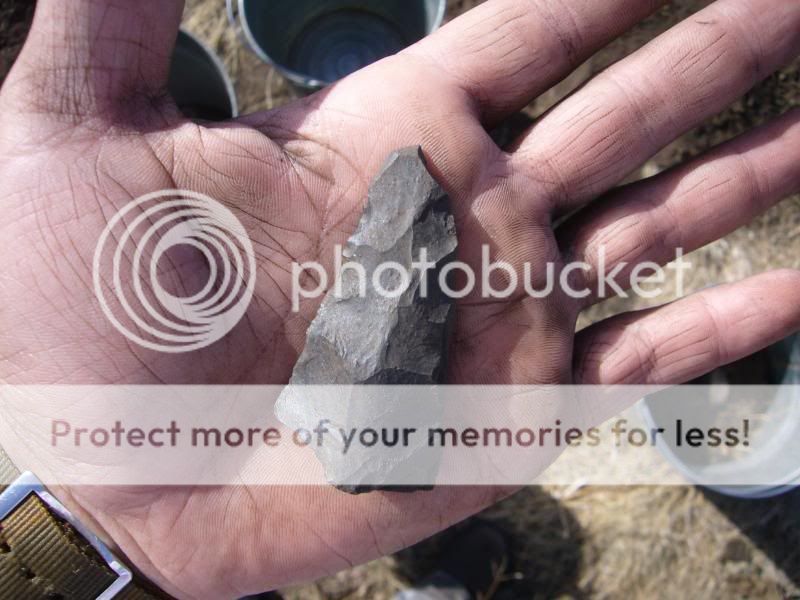
I found it on the dig I volunteered on mentioned in the previous post, it is a fragment and broken off in the middle. Note how crude it is compared to a Clovis point that is another 5,000 or more years older than this, the Clovis technology was lost. I found a couple more pieces and another vitreous basalt biface like this one, but slightly more finely crafted, I'll see if I can't dig pics of those out. Maybe even write a new article on that, as there's lots to be said there, and still very much "Hunting and Sporting Arms".
This is all very interesting. I have seen three Bison killed with 7mm magnums. I have killed two and my dad has killed one. 7mm bullets of proper construction don't bounce off buffalo hearts and holes in Buffalo hearts kill them dead.
I have a friend who killed two cape buffalo very dead with 160 grain partitions shot from his 7X57. In the heart.
Many different kinds of animals, when poorly hit, can travel a long long ways.
I have a friend who killed two cape buffalo very dead with 160 grain partitions shot from his 7X57. In the heart.
Many different kinds of animals, when poorly hit, can travel a long long ways.
This is all very interesting. I have seen three Bison killed with 7mm magnums. I have killed two and my dad has killed one. 7mm bullets of proper construction don't bounce off buffalo hearts and holes in Buffalo hearts kill them dead.
I have a friend who killed two cape buffalo very dead with 160 grain partitions shot from his 7X57. In the heart.
Many different kinds of animals, when poorly hit, can travel a long long ways.
I remember Finn Aagaard writing about his friend killing a Cape Buffalo with a 22 Hornet.
Ardent
CGN Ultra frequent flyer
This is all very interesting. I have seen three Bison killed with 7mm magnums. I have killed two and my dad has killed one. 7mm bullets of proper construction don't bounce off buffalo hearts and holes in Buffalo hearts kill them dead.
I have a friend who killed two cape buffalo very dead with 160 grain partitions shot from his 7X57. In the heart.
Many different kinds of animals, when poorly hit, can travel a long long ways.
I saw it being skinned, problem was cheap cup and cores, in a speedy cartridge like the 7mag. They penetrated less than a foot on the neck shot, potentially as little as 8", and the shot that had a chance to reach the heart punctured the rib cage, but clearly didn't make it home. The choice of bullets regardless what we read on the internet makes a big difference.
I saw it being skinned, problem was cheap cup and cores, in a speedy cartridge like the 7mag. They penetrated less than a foot on the neck shot, potentially as little as 8", and the shot that had a chance to reach the heart punctured the rib cage, but clearly didn't make it home. The choice of bullets regardless what we read on the internet makes a big difference.
Ya think?

browning525
Member
- Location
- Brooks, AB
Great read, well titled!
I have had the good fortune of having drawn a bison tag for northern Alberta (first year available). Those beasts are real tanks. Their body structure, although bovine in category, is so different from a "beef" animal, they can be deceiving when looking for proper shot placement. "Heart" shots can be misplaced by shooting too low, due to the thickness of the brisket bone (first-hand experience with this one). I was finally able to but my bull down by aiming "dead-center" and actually clipped the underside of the spine, dropping him in his tracks. The spine and "feather bones" (the large bones off of the spine that go into the "hump") are actually a third of the body thickness. I shot my bull with my Merkel 150.1 sxs in 9.3x74r. After he ran away following the first shot, I really questioned weather I had enough gun too!
Being a butcher by trade, I am a little bit anal about body structure, etc, and I was lucky enough that we were able to winch the bull whole, out to the road and then winch the gutted carcass onto a flatbed trailer. Just so you can appreciate the size of these critters, the dressed animal weighed 1050 lbs on my certified scales. That is as much or more than the average elk or moose, live on the hoof! The head weighed 162 lbs, and the whole hide weighed in at 168 lbs. It took three of us to pull the guts out. Fealt like a 500 lb bale of wet hay!
The big bulls are tough! Not just tough to put down, but I mean "chewy" tough! When thinking about first nations, and how they managed to kill bison, just remember that they weren't after horns. They targetted the cows and calves, more for the eating quality,as well as being a bit easier to kill. The hide on my bulls robe, came back shaved, and still weighs aprox 40 lbs. The cow and calf robes would be way more supple and versatile to work with. FWIW
I have had the good fortune of having drawn a bison tag for northern Alberta (first year available). Those beasts are real tanks. Their body structure, although bovine in category, is so different from a "beef" animal, they can be deceiving when looking for proper shot placement. "Heart" shots can be misplaced by shooting too low, due to the thickness of the brisket bone (first-hand experience with this one). I was finally able to but my bull down by aiming "dead-center" and actually clipped the underside of the spine, dropping him in his tracks. The spine and "feather bones" (the large bones off of the spine that go into the "hump") are actually a third of the body thickness. I shot my bull with my Merkel 150.1 sxs in 9.3x74r. After he ran away following the first shot, I really questioned weather I had enough gun too!
Being a butcher by trade, I am a little bit anal about body structure, etc, and I was lucky enough that we were able to winch the bull whole, out to the road and then winch the gutted carcass onto a flatbed trailer. Just so you can appreciate the size of these critters, the dressed animal weighed 1050 lbs on my certified scales. That is as much or more than the average elk or moose, live on the hoof! The head weighed 162 lbs, and the whole hide weighed in at 168 lbs. It took three of us to pull the guts out. Fealt like a 500 lb bale of wet hay!
The big bulls are tough! Not just tough to put down, but I mean "chewy" tough! When thinking about first nations, and how they managed to kill bison, just remember that they weren't after horns. They targetted the cows and calves, more for the eating quality,as well as being a bit easier to kill. The hide on my bulls robe, came back shaved, and still weighs aprox 40 lbs. The cow and calf robes would be way more supple and versatile to work with. FWIW
Ardent
CGN Ultra frequent flyer
Very good post and echoes my experiences with them. I've stood over Bison gut piles and marvelled at how there was as much, and likely more, animal matter there than any deer I've shot. The hides feel like a leaded tarp. Interesting on the head, the CO's who responded stated literally the exact same figure for weight on one they had recovered when asked if they had ever weighed a head. One has to remember 170lbs is what an average, 20 year old male human weighs, and they feel even heavier of course in person because they're awkward. And that's just the head, come to think of it that's about the weight of a eastern whitetail deer too.
Again like any animal and as I state in the article, they can be taken by a perfectly placed .270. One little bit off, if his leg moves, you name it and things go bad faster than any animal on this continent due to their sheer size. Like you say, they can be the size of two moose together, even three 600lb elk. A coworker ranched them as well, Plains of course, and has shot more than any of us ever will. He has some stories including nearly getting killed when he's shot piles of them and it didn't go quite as planned.
Again like any animal and as I state in the article, they can be taken by a perfectly placed .270. One little bit off, if his leg moves, you name it and things go bad faster than any animal on this continent due to their sheer size. Like you say, they can be the size of two moose together, even three 600lb elk. A coworker ranched them as well, Plains of course, and has shot more than any of us ever will. He has some stories including nearly getting killed when he's shot piles of them and it didn't go quite as planned.

Great read, well titled!
I have had the good fortune of having drawn a bison tag for northern Alberta (first year available). Those beasts are real tanks. Their body structure, although bovine in category, is so different from a "beef" animal, they can be deceiving when looking for proper shot placement. "Heart" shots can be misplaced by shooting too low, due to the thickness of the brisket bone (first-hand experience with this one). I was finally able to but my bull down by aiming "dead-center" and actually clipped the underside of the spine, dropping him in his tracks. The spine and "feather bones" (the large bones off of the spine that go into the "hump") are actually a third of the body thickness. I shot my bull with my Merkel 150.1 sxs in 9.3x74r. After he ran away following the first shot, I really questioned weather I had enough gun too!
Being a butcher by trade, I am a little bit anal about body structure, etc, and I was lucky enough that we were able to winch the bull whole, out to the road and then winch the gutted carcass onto a flatbed trailer. Just so you can appreciate the size of these critters, the dressed animal weighed 1050 lbs on my certified scales. That is as much or more than the average elk or moose, live on the hoof! The head weighed 162 lbs, and the whole hide weighed in at 168 lbs. It took three of us to pull the guts out. Fealt like a 500 lb bale of wet hay!
The big bulls are tough! Not just tough to put down, but I mean "chewy" tough! When thinking about first nations, and how they managed to kill bison, just remember that they weren't after horns. They targetted the cows and calves, more for the eating quality,as well as being a bit easier to kill. The hide on my bulls robe, came back shaved, and still weighs aprox 40 lbs. The cow and calf robes would be way more supple and versatile to work with. FWIW
goddamn.. that's crazy!






















