Especially with a SxS and the paper shells of the day, roll crimps, over shot wads, no shot cup & all !

Yes I would say he was a top 10 shooter in his day!
Forums
>
History Buffs
>
William H. "Silent Billy" Heer
HistoryBuff
Mega Poster
W. H. “Silent Billy” Heer
HISTORY BUFF HALL OF FAME INDUCTEE
Overlooked for induction into the Trapshooting Hall of Fame, Billy Heer has been in the History Buff Hall of Fame for many years now. He was one of those smooth “crack shots” who shot from the other side (southpaw) and always placed among the top scores.
Here are a few of Mr. Heer’s accomplishments :
WILLIAM Henry HEER
Concordia, Cornstalk County, Kansas
AUG1873, Kansas – 07 DEC1945, Guthrie, OK
Southpaw Shooter
Kansas State Champion (Schmelzer Trophy) (1899)
Union Metallic Cartridge Company Shooter Salesman (1903-1918)
U. M. C. Southern Exhibition Squad Member w/ Thomas A. Marshall,
Rolla O. Heikes, Charles W. Budd & Hubby (1902)
Won Schmelzer Trophy (1902)
President of Kansas State Sportsmen’s Association (1903)
Kansas State Champion (1903)
Member of the Indians Organization
Winner of Sunny South Target Trophy (1904)
1904 G. A. H. Consolation Handicap Winner (1904) 98x100
High Gun at New York State Shoot (1905)
Professional Winner of Kansas State Sportsmen’s tournament (1906)
Highest Yearly Average (96.3 on 14,055 targets) 1906
U. M. C. Southern Exhibition Squad Member w/Annie Oakley, Thomas A. Marshall,
George W. Maxwell, Col. Anthony & Frank Butler (1908)
Interstate Association’s Professional High Average Leader (1910) .9775
High Average at Wichita Tournament (1911)
Interstate Association’s Professional High Average Leader (1913) .9741
Retired from Shooting at the End of the 1913 Season
Secretary Guthrie Gun Club ( 1917)
Returned to Amateur Status (1917)
Amateur Average Leader (1917)
National Amateur Champion of the United States (1918) 98x100 +20 s/o
Won $4,000 In Liberty Bonds in 500-Target Match With Frank Troeh (1918) 472 to 469
2nd on List of High Amateur Averages With .9775 (1921)
Oklahoma State Champion (1922) 199x200
Prairie Zone 16-Yard Singles Champion (1922) 199x200
Member of Prairie Zone Team for G. A. H. Tournament (1922)
New 5-Man Team Squad Record with Troeh, Wheeler, Etchen & Miller (1922) 990x1000
Led State (Oklahoma) With Highest Average (1927) .9622
Guns Used: Left-handed
Remington SxS
Remington pump gun S.L. 31OCT1908p.15
On May 19th, 1905 he broke 100 straight at Perry, Oklahoma . . . his twelfth “century” for the year. At that time there were very few shooters capable of breaking an occasional 100-straight.
So, why the name “Silent Billy?” As you can imagine, there have been many stories brandished about his nickname. One story offers this reason:
“W. H. Heer, sometimes dubbed "Silent Billy Heer," because of the small
amount of shouting he does.”
However, I believe the following account given after Mr. Heer won the Grand American Consolation Handicap in 1904 is more likely to show the reason for his assigned moniker :
“Mr. Heer was right in his element in the wind, and being left-handed he
caught it all in the back and the dust did not sift into his eyes. He pounded
into 98, a grand piece of shooting under the prevailing conditions, and was
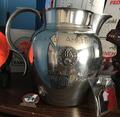
presented with a silver stein for family use. In his presentation speech Irby
Bennett said that Mr. Heer came from the only State which boasted of a
woman who carried a hatchet. He said that while the other Kansas smasher
used an axe, this one used a shotgun, and the smashing was much more
creditable. It also paid William Henry about $100 in cash. In replying to
President Bennett Mr. Heer made a lengthy speech (for him), saying a few
words to himself, and "I thank you" in a slightly louder tone.”
An article titled “Old Champions vs. New” which discussed the shooting careers of Capt. Adam H. Bogardus, Dr. W. F. Carver, Ed Tinker, Ira Paine and Abe Kleinman, the writer expressed the following viewpoint about the new generation of top shots :
”As to the relative merits of American marksmanship thirty years ago and the
present decade our readers can take their choice. Crosby’s, Gilbert’s Heer’s,
Elliott’s and Heikes’ records will go down to fame and posterity by reason of
"Sporting Life’s" famous trap shooting Reviews.”
Wm. R. Crosby, Fred Gilbert, J. A. R. Elliott and Rolla O. (Pop) Heikes (1969) as well as Capt. A. H. Bogardus and Dr. W. F. Carver were all inducted the first year of the Trapshooting Hall of Fame (1969).
In August 1913, Sporting Life reported the names of shooters holding high averages for the current year.
Mr. William R. Crosby was among the first group of shooters to be inducted in the Trapshooting Hall of Fame in 1969.
Sportsmen’s Review gave readers and update on Billy Heer in May 1917. Apparently he had not shot much over the past few years.
Trap Notes
Billy Heer appeared in the limelight at the Pawnee, Okla., shoot a few days
ago after a few years rest. Of course he took all the boys to the trimming to the
tune of 194 out of 200. Doesn’t look as though “Silent William” was suffering
from lack of practice.
Peter P. Carney, editor of National Sports Syndicate, wrote this :
“Silent Billy” Heer, after three years’ absence from the trapshooting game,
has returned. On his first appearance at the traps – at Pawnee, Ok. – he broke
194 out of 200 targets. The layoff hasn’t dimmed Heer’s eyesight one whit.”
In 1917, he returned to shooting as an amateur. So, how well did he shoot?
ONE-TIME ‘PRO’ WINS AS AMATEUR
W. H. Heer Leads Interstate Trap Shooters for 1917 After
Being Allowed to Drop Professionalism
A one-time professional trapshooter, William H. Heer, of Guthrie, Okla., is the winner of the amateur high average trophy of the Interstate Association, for the season of 1917. During the season just closed he shot at 2,050 clay birds, of which he broke 1,997, giving him an average of .9741, which was six points above his nearest competitor, W. Henderson, of Lexington, Ky.
Heer won the official high average in 1910 and again in 1913. In 1910 his average was .9776 and in 1913 it was .9730. Trapshooting rules provide that a man who is a professional and desires to again become an amateur must retire from competition for three years—that is, provided that his average was better than ninety per cent. Heer retired from competition after the 1913 season, returning in 1917 as an amateur.
The professional high man is Lester German, of Aberdeen, Md., who twenty years ago pitched the Memphis Southern League team to champions, and afterward pitched for the New York Nationals before entering the trapshooting game as a professional.
And the above W. Henderson, of Lexington, Kentucky, well he’s none other than Woolfolk Henderson, “The Kentucky Wonder,” Kentucky’s live bird and target champion, enshrined in the Trapshooting Hall of Fame in 1970.
Also remember that name . . . . . . Lester Stanley German . . . . . you will be hearing more about him soon.
At the 34th annual (1918) tournament of the Sportsmen’s Association of the Northwest a match between Frank Troeh and Billy Heer was the feature. George D. Baker, president of the Association challenged “Silent Bill” to shoot a match with Mr. Troeh, who Mr. Baker was backing. After hearing of the challenge, two men backed Mr. Heer and both sides put up $2,000 in Liberty Bonds as forfeit money. The match was on the 500 target program shot over 3 days. Here’s the written account of challenge match as written :
The result of the first day’s shooting was somewhat dark for the backers of Heer. Out of the first 75 targets Billy allowed seven to ride peacefully on, and missed another out of the final 25, making 92 out of 100.
Troeh was right there on the first 75 targets, missing only one, but he also missed four out of the last string, giving him 95 out of 100. As will be seen, Troeh had a favorable lead over his contemporary.
On the second day Billy evened the matters, scattering 187 out of 200, compared to 184 for Troeh. Thus the two centers of attraction finished nose to nose.
Now came the test of nerves, grit, and determination. Billy showed that he was a strong uphill plugger, coming stronger at every shot. Heer missed by six out of his 200 quota, going out with 194, while Troeh finished with 191.
Hurrah for Bill!! He again proved his right to the title, “Best shot in the U. S. A.”
As Heer won the Interstate Association’s state amateur championship in Oklahoma, and Troeh won the same honor in his state, they will have the pleasure of crossing swords once again at the 1918 G. A. H.
Chan. M. Powers, of Decatur, Ill., acted as referee and the judge for Heer was E. A. Woodward; for Troeh, G. A. Conklin.
Each contestants performance was as follows :
1st day 2nd day 3d day Ttl.
100 200 200 500
W. H. Heer . . . . . . . . . . . . . . . .
92 187 194 473
F. M. Troeh . . . . . . . . . . . . . . .
95 184 191 470
[ SPORTSMEN’S REVIEW, July 6, 1918, page 16 ]
Remember the referee’s name Chan. M. Powers “Chauncey” for he’s another you will be hearing about in the future.
Oh, almost forgot . . . . . Frank M. Troeh was inducted in the Trapshooting Hall of Fame in 1970. The Mr. E. A. Woodward the judge for the match was actually E. F. Woodward, of Houston, Texas, 1973 Inductee.
ANSWERS TO NIMRODS
Question: What was the result of the race between Billy Heer and Frank M. Troeh, on 500 targets recently shot. Was much money bet on results?
Indianapolis, Ind. JOHN HARRINGTON.
Answer: The race was won by Mr. Heer, by a margin of three birds, the race was shot under adverse conditions and scores were not up to their average. It was estimated by those present that approximately $50,000 was bet on the outcome of the race. It was rumored that Troeh will again challenge. Almost the entire amount wagered was in Liberty Bonds as was the stakes in the main event.
[ THE HARRISBURG TELEGRAPH, (Harrisburg, Pennsylvania), July 16, 1918, page 11 ]
Mr. Heer had another good year in 1918.
HEER GAINS TRAPS TITLE
Guthrie Expert Wins Amateur Grand American Shoot
Chicago, Aug. 6. – William H. Heer, Guthrie, Okla., a former professional trapshooter, won the amateur championship of the United States at single targets today in the grand American trapshooting tournament.
Frank Troeh of Vancouver, Wash., a former champion at single targets, won the national amateur championship at doubles, and A. R. Chezik, champion of North Dakota, won the Chicago overture.
Heer and Fred S. Tomlin of Penns Grove, N. J., each broke 98 targets, and on the shoot-off at twenty targets Tomlin missed his third target, while Heer broke all the twenty thrown him.
Fred S. Tomlin was inducted in the Trapshooting Hall of Fame in 1973.
The Ogden (Utah) Standard-Examiner wrote :
AT THE TRAPS
Just to top off the shoot there will be a special prize for the high shooter in the squad to be comprised of Frank Troeh, Billy Heer, Woolfolk Henderson, Mark Arie and Frank Wright – the five best trapshots in the United States. That’s the kind of a shoot it is going to be at Clarkston (Mississippi) on May 11, 12 and 13.
[ THE OGDEN STANDARD-EXAMINER, (Ogden, Utah), May 9, 1920, page 27 ]
Mr. Heer is the only name in the above article who is not in the Trapshooting Hall of Fame.
I'll give the details of Mr. Heer's final shooting years in the future. He was one of our "greats" who sadly, most people have never heard about.
Feel free to add to the story if you've heard of Billy Heer.
Enjoy Our History !
BRAD DYSINGER
Moderator