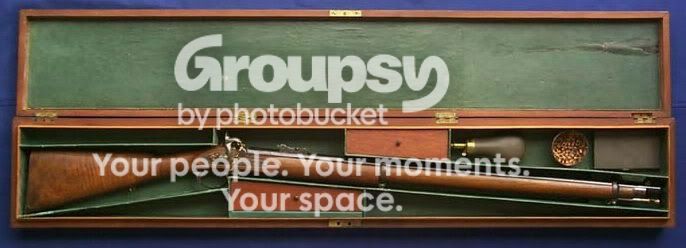
I am very familar with Thomas Turner Guns as I have owned a few in the past and have seen a number of ones similar to the one you are looking at. There was even one on EE about a year ago that a friend of mine had for sale. A lot of gunsmiths of that era would take a military patern rifle like yours, 1853 Pattern and work with them to achieve a good target shooter.
I was trying to point out that TT did a lot work on guns of the period for target shooters. The sniders are just an example of a comerical rifle that was worked on like yours.
Quote "Thomas Turner did the finish work on British single shot sporters for many of the British retailers.
Quote "Thomas Turner also did a lot of percussion Enfields for the Confederate government, so it's a prized name among Enfield collectors in the US.
Here is one very similar to yours that just sold.
English Match Rifles
In the mid-1850s match rifle shooting at long ranges—in some cases up to a thousand yards—became quite popular in Britain, and a number of manufacturers (e.g. Turner, Rigby, Henry, Nuthall) produced high-quality rifles to fill the need. These included civilian versions of the Whitworth, such as the Beasley, as well as other rifles using licensed copies of Whitworth's patented hexagonal bore. Other innovative designs were used as well, and unlike the heavy target rifles common in the United States, the British match rifles weighed no more than a service musket. A number of these rifles made their way across the Atlantic and into the hands of Confederate sharpshooters.
Other sharpshooter's rifles came from the Volunteer Rifle Corps, a British militia organization organized in the late 1850s. Many Volunteers, who provided their own weapons, bought rifles with interchangeable barrels—one in standard .577 caliber for drill and another .45 caliber "small-bore" barrel for match shooting. When Whitehall mandated the use of the regulation P53 Enfield in 1862 many Volunteers sold their old rifle to Confederate buyers.
The most widely used match rifle was the Kerr, made by the London Armoury Company. This finely crafted rifle outwardly resembled the Enfield—just about all the parts were interchangeable—but fired a .446 caliber bullet through a 37-inch barrel that featured a patented, six-groove progressive rifling system. While extremely accurate its shorter, somewhat lighter bullet lacked the carrying power of the Whitworth at very long ranges. The ten-pound Kerr used a rear sight similar to the standard Enfield ladder and an adjustable globe sight on the front.
Most Civil War Kerrs were used in the western theater by the Army of Tennessee. The Kentucky brigade received eleven from "an English admirer," and Cleburne's division at one time deployed a forty-six-man sharpshooter corps that boasted thirty Whitworth and sixteen Kerr rifles. Many of the Kerr sharpshooters appear to have shot the cylindrical Whitworth round in battle, likely improving its long-range performance.
Another sharpshooter's match rifle, the Turner (shown above), was imported in small numbers. Manufactured by Thomas Turner of Birmingham, these beautiful hand-crafted .451 caliber rifles resembled the Kerr. Some versions used Turner's patented five-groove rifling, and others, such as the one shown here, came with the Whitworth hexagonal bore. Some Confederate sharpshooters also used the Nuthall, which also looked much like the P53 Enfield, the Daw, the Jacob's, and the Lancaster. Just how many of these rifles came into the South is impossible to say, but they were few.
This one is even closer to yours that just sold.
http://www.damonmills.com/images/PS%2036/Turner%203199.htm