
My 6.5x55 Lapua brass has been resized 4 times and the neck is getting so tight that I have to force the bullets in when I seat. A few copper jacket were shaved in the process. I resize/decap, then trim my brass to Lapua specs then chamfer and debur. My question is how do I fix this? Do I need to anneal, use a neck turning tool or something else? I noticed my accuracy suffered from this neck tension issue because it is also not consistent. Thank you for the help.













































You are using an out of date browser. It may not display this or other websites correctly.
You should upgrade or use an alternative browser.
You should upgrade or use an alternative browser.
Tighter neck tension after each sizing
- Thread starter Dake21
- Start date
I have new 308 Lapua brass too right out of the box that's stupid tight. Tried resizing the necks with a couple different dies. Made no difference.
Going to anneal after fire forming and hopefully it gets better.
I had the same thing - it wrecked groups and gave crazy ES/SD numbers.
An anneal and expander mandrel did wonders.
I had the same thing - it wrecked groups and gave crazy ES/SD numbers.
An anneal and expander mandrel did wonders.
What do you recommend for an expander. The groups do suck. My Hornady brass groups far better.


My 6.5x55 Lapua brass has been resized 4 times and the neck is getting so tight that I have to force the bullets in when I seat. A few copper jacket were shaved in the process. I resize/decap, then trim my brass to Lapua specs then chamfer and debur. My question is how do I fix this? Do I need to anneal, use a neck turning tool or something else? I noticed my accuracy suffered from this neck tension issue because it is also not consistent. Thank you for the help.
What dies are you using?

- Location
- The Conservative part of Ontario
Brass flows forward with each cycle, so thickness at the neck is a natural occurrence, along with lengthening, and work hardening. Annealing will allow that thicker brass to be drawn forward and trimmed when you resize. An alternate is outside neck turning, but with hardening taking place you're going to end up annealing anyway.

I also ask what type and make dies are you using and what diameter is the neck reduced to after sizing and is the neck being expanded.
I ask this because in over 48 years of reloading I have never annealed any of my cases and never had a problem seating bullets with a standard full length die.
I ask this because in over 48 years of reloading I have never annealed any of my cases and never had a problem seating bullets with a standard full length die.
Fired brass when sized usually springs the neck out or open. When I anneal, I am able to match my Lee collet mandrel much better. The case neck won’t spring away as much. When I anneal I can take out the mandrel from the die, and grab the just neck sized brass, ( Redding bumped ) put my finger over the primer area and can insert the mandrel and give it a small push in, it will bounce up from the air being compressed inside the case.
My brass are loaded and I have a picture below with copper shavings in the case mouth.
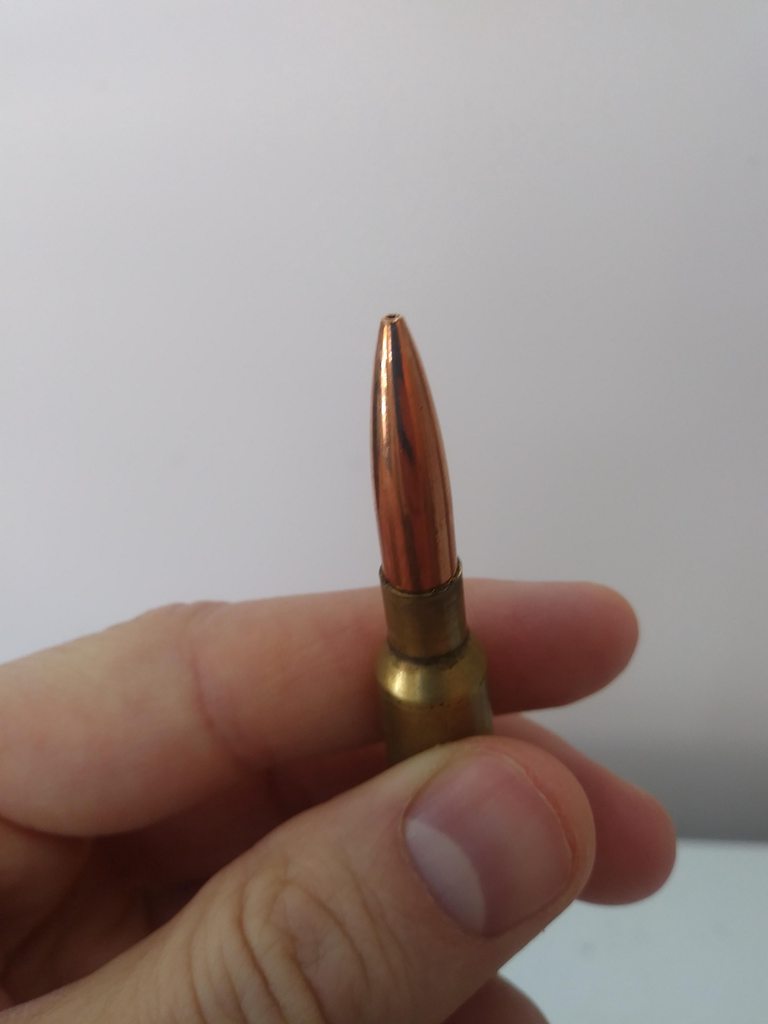
I bought a hand trimmer (Hornady) with a softer angle to help with the shaving but that doesn't solve the problem of the tight necks and shaving still happens on a few brass. After firing the neck are so tight the bullet won't drop freely and I bet it has enough tension to hold it in place. I use standard Redding dies bought new and the rifle is a Tikka Varmint. The neck appears thicker after trimming/chamfer/deburring than it use to be.
Here is my train of thoughts: The neck becomes thicker because the brass flows forward with each firing. The brass flowing forward makes the neck thicker which increase neck tension. Even so I wonder why doesn't the FL die fix it? It worked fine when the brass was new and for the couple first loading? Could the brass be too hard to be worked properly, so I need to anneal it? Do I need the neck turning tool to remove excess material on the neck? Is it both, or something else? I've never had this happen to me with other cartridges (like 308, 30-30 and 223) and I'm sure many people reload without a neck turning tool and annealing machine. So I'm a bit puzzled here.
I bought a hand trimmer (Hornady) with a softer angle to help with the shaving but that doesn't solve the problem of the tight necks and shaving still happens on a few brass. After firing the neck are so tight the bullet won't drop freely and I bet it has enough tension to hold it in place. I use standard Redding dies bought new and the rifle is a Tikka Varmint. The neck appears thicker after trimming/chamfer/deburring than it use to be.
Here is my train of thoughts: The neck becomes thicker because the brass flows forward with each firing. The brass flowing forward makes the neck thicker which increase neck tension. Even so I wonder why doesn't the FL die fix it? It worked fine when the brass was new and for the couple first loading? Could the brass be too hard to be worked properly, so I need to anneal it? Do I need the neck turning tool to remove excess material on the neck? Is it both, or something else? I've never had this happen to me with other cartridges (like 308, 30-30 and 223) and I'm sure many people reload without a neck turning tool and annealing machine. So I'm a bit puzzled here.

huntingfamily
CGN Regular
- Location
- In the fields and forests
Could have a tight chamber and may require outside neck turning. This is my case with a custom 338-06 and Lapua brass.
- Location
- The Conservative part of Ontario
If you have trimmed your cases, or cases are new, did you remember to chamfer them? That slight chamfer can make a hell of a difference.
It's been years since I reloaded 6.5X55, but I don't remember ever having to anneal those cases. Never used Lapau brass though.
I do remember the expander ball getting harder to pull through over time, so probably a like issue that annealing would have solved. The dies I used for it back then were Lee.
It's been years since I reloaded 6.5X55, but I don't remember ever having to anneal those cases. Never used Lapau brass though.
I do remember the expander ball getting harder to pull through over time, so probably a like issue that annealing would have solved. The dies I used for it back then were Lee.
Last edited:
Again, what type die are you using, standard full length with expander, full length bushing die without a expander, neck sizing die etc.
It is my experience if the inside of the case neck is not deburred properly it will increase seating effort and scrape copper off the bullet. Especially if you are wet tumbling and have peened case mouths.
A VLD deburring tool increases the chamfer angle and eases seating.
Again I had your same problem after wet tumbling and not deburring theinside of the case mouth enough. I switched to the VLD tool and the problem was solved.
Case necks that are "NOT" annealed will spring back "MORE" after sizing and have less neck tension. And annealed cases will spring back less after sizing because the brass is softer.
And one more time, what type sizing dies are you using and what type seater die are you using. If you are getting copper on one side of the bullet it means the bullets are not seating straight.
It is my experience if the inside of the case neck is not deburred properly it will increase seating effort and scrape copper off the bullet. Especially if you are wet tumbling and have peened case mouths.
A VLD deburring tool increases the chamfer angle and eases seating.
Again I had your same problem after wet tumbling and not deburring theinside of the case mouth enough. I switched to the VLD tool and the problem was solved.
Case necks that are "NOT" annealed will spring back "MORE" after sizing and have less neck tension. And annealed cases will spring back less after sizing because the brass is softer.
And one more time, what type sizing dies are you using and what type seater die are you using. If you are getting copper on one side of the bullet it means the bullets are not seating straight.
I'd give Redding a call and explain what's happening. You might have an undersize expander ball. It's a stretch, but possible. They should be able to tell you what the ball size is supposed to be.
Unless the brass is crazy hard and springy, the expander ball should return the inside of the neck to the proper dimension after the die resizes it.
Do you have any unfired Lapua brass to get some comparison measurements on neck thickness?
A tight chamber might account for the bullet not sliding into a fired case, but a FL die should bring the case back to standard dimensions, at least where the neck inside diameter is concerned.
It's a different cartridge, but I have a 6.5 Creedmoor RCBS FL die, I can measure the dia of the expander ball if you like. I think the 6.5 x 55 also uses a .264" bullet?
This is going to sound like an idiot suggestion, but check the diameter of the bullets you loaded. It's possible the wrong ones got put in the box at the factory. Which bullet are you using?
Unless the brass is crazy hard and springy, the expander ball should return the inside of the neck to the proper dimension after the die resizes it.
Do you have any unfired Lapua brass to get some comparison measurements on neck thickness?
A tight chamber might account for the bullet not sliding into a fired case, but a FL die should bring the case back to standard dimensions, at least where the neck inside diameter is concerned.
It's a different cartridge, but I have a 6.5 Creedmoor RCBS FL die, I can measure the dia of the expander ball if you like. I think the 6.5 x 55 also uses a .264" bullet?
This is going to sound like an idiot suggestion, but check the diameter of the bullets you loaded. It's possible the wrong ones got put in the box at the factory. Which bullet are you using?
I don't the tools to measure a chamber.
The die I use are Redding 6.5mm x 55 Swedish #7 and it says on the box series A. On the FL die it says 6.5x55 S.M. FL7Q. The expander ball on it measures .262'' I use the die as it is intended with the expander ball and I grease it with Redding imperial wax. The seating die says S.M.ST7Q Those dies are standard and were the most basic one I could find from Redding.
I used to use the Lee tool but the angles were too sharp so I switched to the Hornady. I do about two turns to chamfer my case. Maybe I'm not chamfering enough but that doesn't really change the neck tightness. I have to use more strenght than I'm used to to seat the bullet.
I use Lapua scenar 139gr and they measured .264.
I have some fired brass and the inside diameter measures .264. The neck thickness varies from .012 to .015 but most of them seems to sit at .0135
The die I use are Redding 6.5mm x 55 Swedish #7 and it says on the box series A. On the FL die it says 6.5x55 S.M. FL7Q. The expander ball on it measures .262'' I use the die as it is intended with the expander ball and I grease it with Redding imperial wax. The seating die says S.M.ST7Q Those dies are standard and were the most basic one I could find from Redding.
I used to use the Lee tool but the angles were too sharp so I switched to the Hornady. I do about two turns to chamfer my case. Maybe I'm not chamfering enough but that doesn't really change the neck tightness. I have to use more strenght than I'm used to to seat the bullet.
I use Lapua scenar 139gr and they measured .264.
I have some fired brass and the inside diameter measures .264. The neck thickness varies from .012 to .015 but most of them seems to sit at .0135
Good answers.. I'm as baffled as you are. Annealing might help. I looked at a Primal Rights video on YouTube to get an idea of how much to anneal. It's a bit of a black art, be careful.
It does make a noticeable difference in seating effort for me, but even the tightest ones don't take much.
I'll check my expander ball size when I get home, but .262 sounds about right if the brass doesn't spring back much.
Have you had any necks split? I'm not sure how common that is with 6.5 x 55.
It does make a noticeable difference in seating effort for me, but even the tightest ones don't take much.
I'll check my expander ball size when I get home, but .262 sounds about right if the brass doesn't spring back much.
Have you had any necks split? I'm not sure how common that is with 6.5 x 55.
My expander ball in the RCBS FL 6.5 CM die is also 0.262", my neck thickness on 3x and 4x fired and resized Lapua brass is anywhere from 0.012"-0.014"
I don't have a ball micrometer to measure wall thickness, so that's going to be close if not exact.
Using the inside measuring jaws on my caliper, I'm getting an inside neck diameter of 0.262"-0.263" on my prepped brass.
I don't have a ball micrometer to measure wall thickness, so that's going to be close if not exact.
Using the inside measuring jaws on my caliper, I'm getting an inside neck diameter of 0.262"-0.263" on my prepped brass.
- Location
- The Conservative part of Ontario
Here's something remotely possible. Take your dies apart and clean them. I note in your pic that the case isn't nice and shiny. There's a small chance that some sort of build up in the sizing die is causing your cases to be undersized.





















