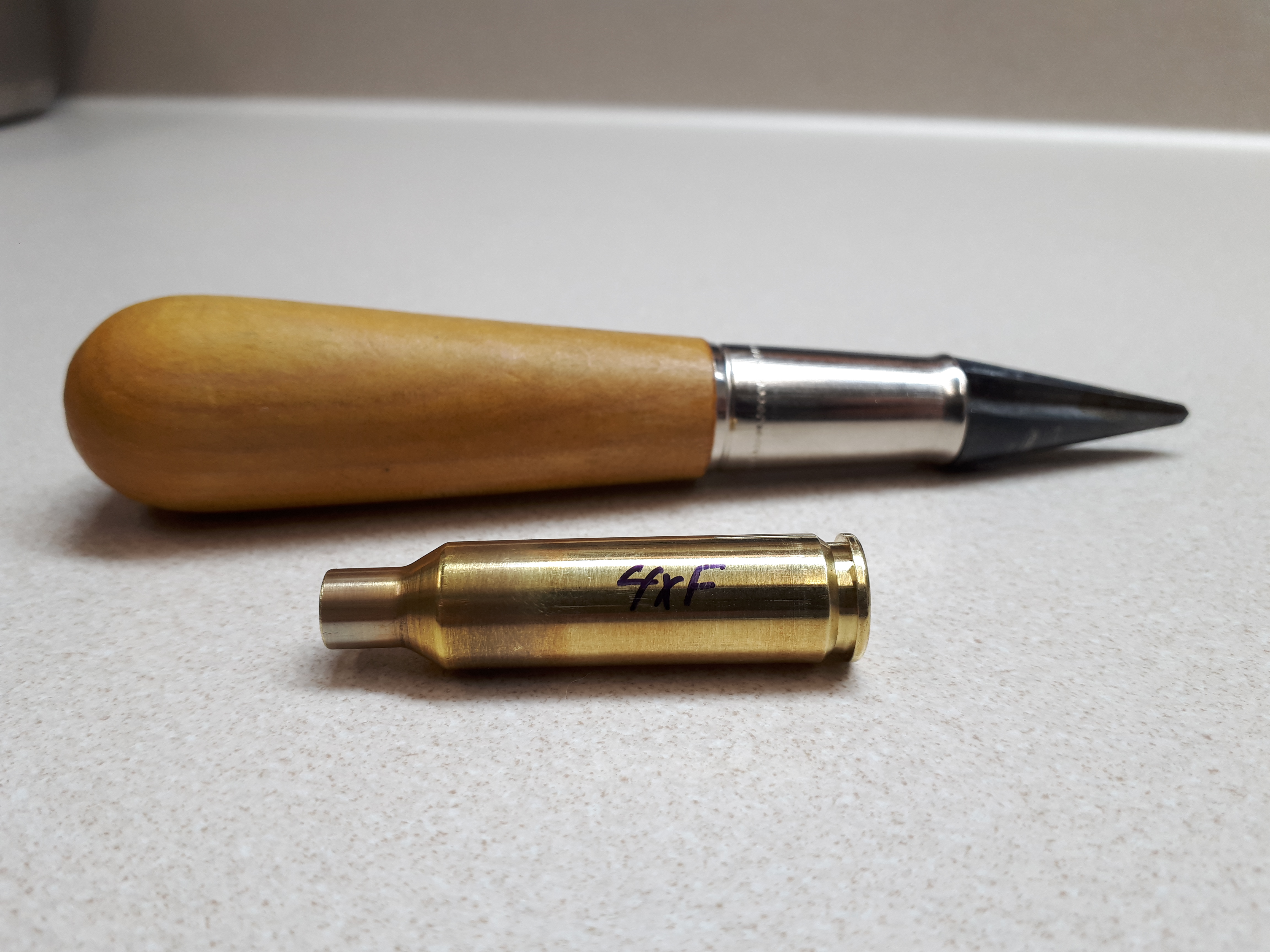
Tighter neck tension after each sizing

If you don’t wanna spead a bunch of money get a salt bath annealer. Even if it doesn’t fix the problems it’s still a good investment.
My guess is: a standard full length die normally sizes the neck way undersize and then the the expander brings it back to size. This extra brass movement is going to workharden the brass quicker and it’s probably spring back to much off the expander. Another suggestion is to try a lee collet die. It will work the brass way less and is supper simple to use and last one I bought was just north of 30$.
Just my two cents.
Joe
 
That loaded round, looks terrible. (Excluding the scraped copper) Is it just the picture? It looks like the case was almost roll cramped in or something.
 
I think I'll buy a propane torch at canadian tire and try to anneal them on the cheap first to see if it improves neck tension. I dont feel like spending hundreds on a set up just yet.
 
I think I'll buy a propane torch at canadian tire and try to anneal them on the cheap first to see if it improves neck tension. I dont feel like spending hundreds on a set up just yet.

One of the ammo companies (Hornady maybe?) used to sell a flame annealing kit, but they're now discontinued, probably for liability reasons.
 
Before you buy any new equipment you need to look at the case mouth with a good magnifying glass. Shaving copper off the bullet when seating means you have a sharp edge inside the case mouth, and possibly bullet tilting during seating.

If the case mouth is not chamfered/tapered enough the case mouth can end up thicker than the rest of the neck. Meaning the donut bulge that is being mentioned just might be at the case mouth and why you are shaving copper off the bullet.

I do not think you have a annealing problem, my bet is the problem is at the case mouth or the seating die. And if the expander is locked down off center it can pull the necks off center. Meaning a rough edge inside the case mouth and possibly tilted bullets during seating or both.
 
Can I remove too much when chamfering? Maybe I am too gentle on chamfering after all.

I'd say you want to have at least 50% of the wall thickness or more remaining after both sides are chamfered, but as long as the sharp edge is gone it should be fine.
I can usually see a shiny smooth ring inside the neck after chamfering. I use a tapered hole reamer instead of a proper chamfering tool, it's angle is much the same as a VLD type deburring tool.
 
Can I remove too much when chamfering? Maybe I am too gentle on chamfering after all.

With most full length dies and using the expander if the case neck is not chamfered and beveled enough the case neck will have a bulge on the outside of the case mouth. And normally you can see this with the naked eye.

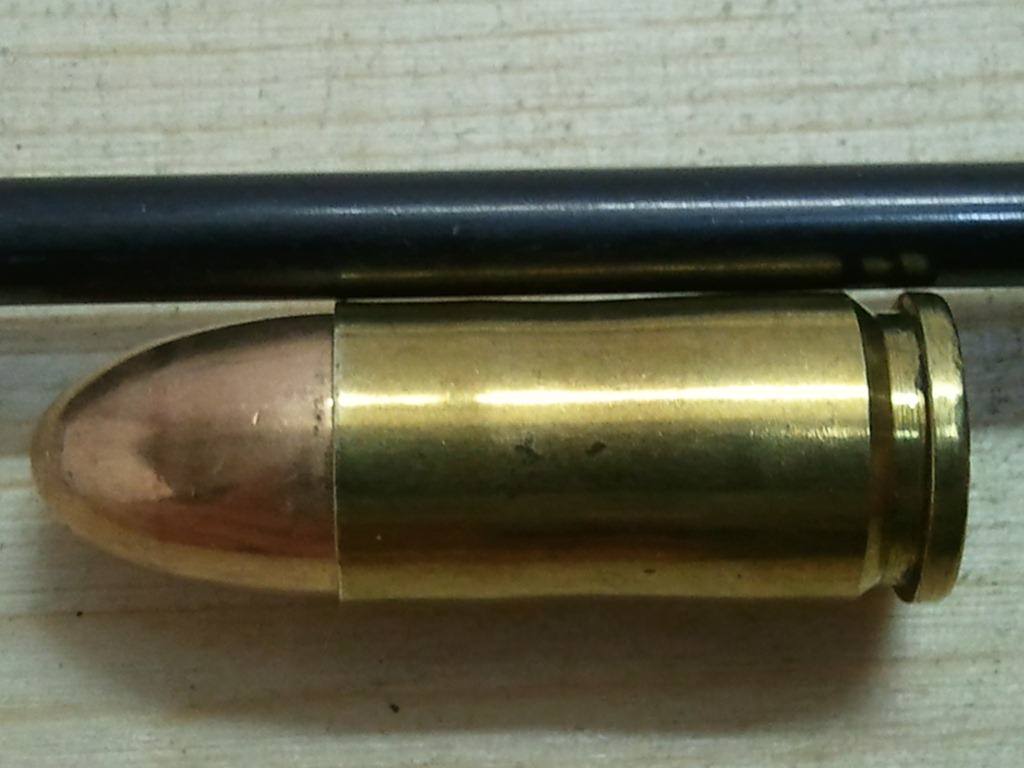
Below is a pistol case that has not been taper crimped, but if you put a straight edge on your case neck and see daylight behind the case mouth you have a problem. Meaning the case mouth is thicker than the area below it. The expander pushes the excess to the outside of the case mouth but some of it remains inside the case mouth. And if there is a sharp edge it will scrape copper off the bullet.

And again in over 48 years of reloading I have never annealed a single cartridge case. Lack of annealing will cause more brass spring back and more bullet grip. But if the case mouth is chamfered and beveled enough it will not scrape copper off the bullet.

pRVen2j.jpg


Below is a VLD inside neck Chamfer/Reamer that aids bullet seating because of its longer taper.

160407-216536


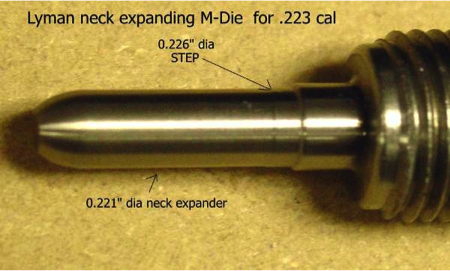
Below is a Lyman type "M" expander and many AR15 shooters use this expander. Please note the main part of the expander is .003 smaller than bullet diameter. And the case mouth is bumped onto the .226 step of the expander. This aids straight inline seating and prevents scraping any copper off the bullet due to its increased diameter.

ohIUcpd.png
 
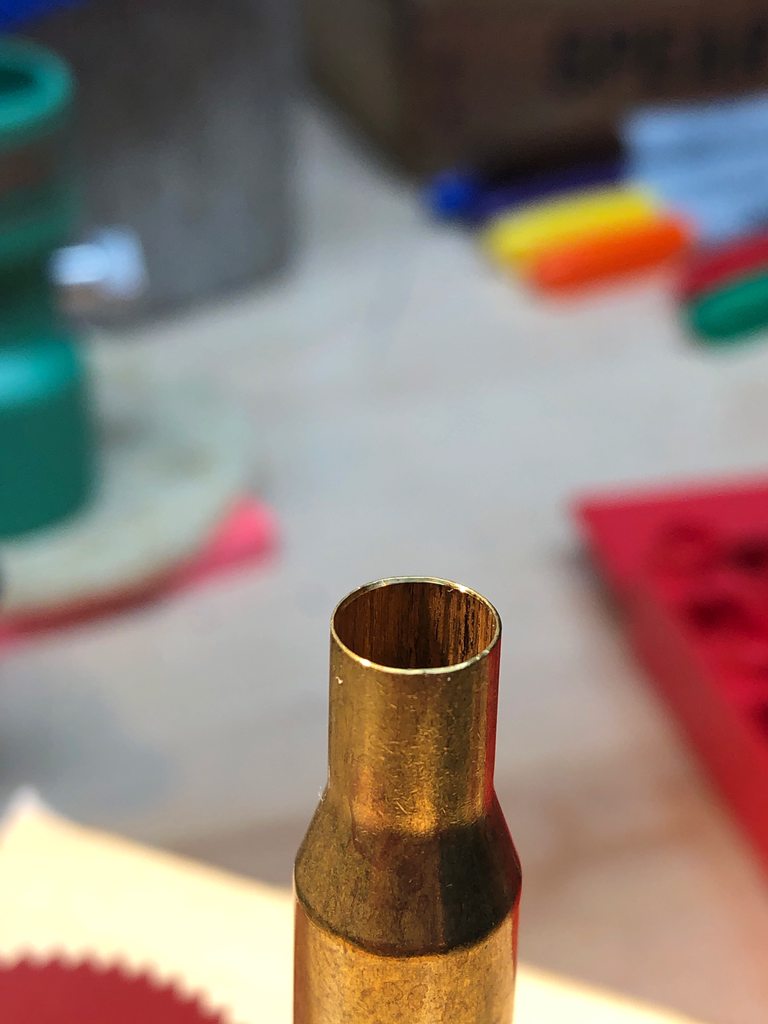
I’m running the RCBS chamfer tool. No problems. The VLD one looks nice though. I will take a picture of a new Nosler custom brass.
 
New 270 win Nosler Custom, untouched.

TTTMnb5h.jpg


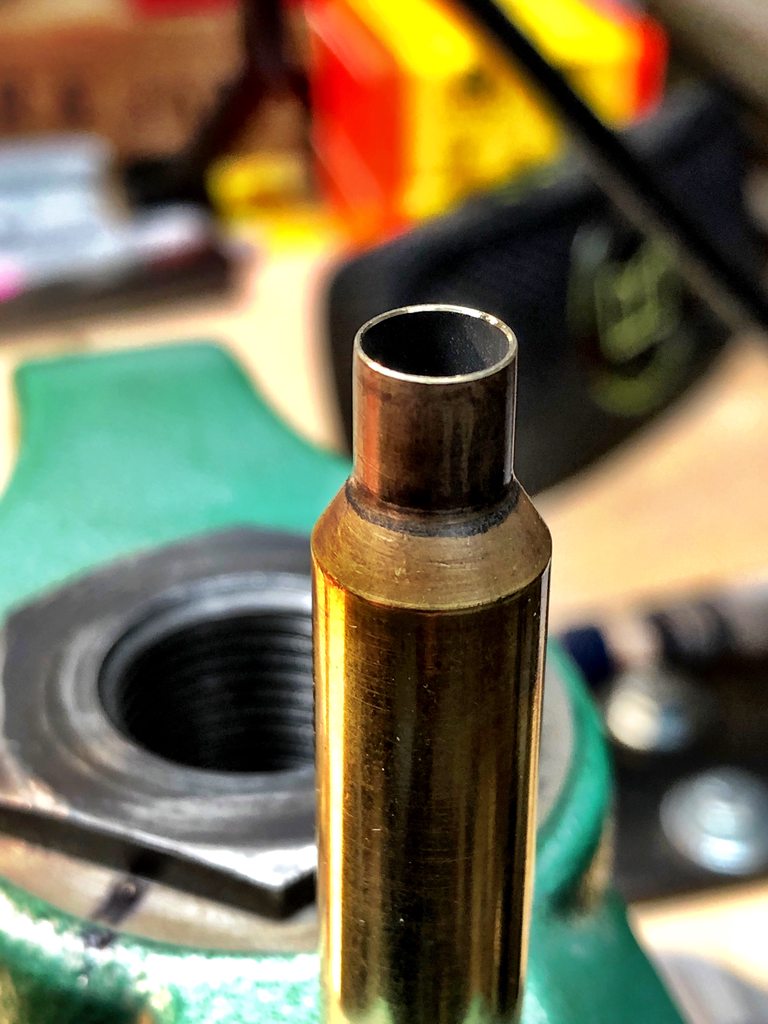
6.5 Creed with RCBS chamfer tool. Ignore the dirty case, I just grabbed a fired one and chamfered it.

YqV1Kgeh.jpg


Hard to get a quality cell phone picture. Should have used the Canon I guess.
 
After firing the neck are so tight the bullet won't drop freely.....
Lapua brass has thicker brass necks, if you can’t push in a bullet buy hand after firing the brass is to thick for the chamber. Tight chamber and thick brass. Measure the thickness of your brass in the neck. I run into this all the time making 7-08 brass out of lake city 308. Or lapua 308 to 708. I outside turn the necks as a 308, then size to 708 and anneal. Turning at 308 trims the neck to just below the shoulder when sized to 708.... no donut and fire forms right out. Brass life is excellent going on 15-20 firings. This is for a tight chambered M70. Neck turning and annealing...... fun stuff.
 
Measure your outside diameter of you fired brass too. Gives an indication of what your chamber dimensions are. You want about .003-004 of an inch clearence between neck wall and chamber if my memory is working???? I believe I have to get neck thickness to 015 to chamber in my 7-08. Not at home or I’d check my book
 
Try a VLD chamfer tool, and dont be shy about using it. I’ve seen instances where seating pressure went from stupidly high to slicker than snot with just that one change. Many of the standsrd tools are 45 degrees, and the bevel cut is quite abruot and sharp. A 22 degree is a day and night difference.
 
This is what I use for inside deburring, primarily because I was too cheap to spend $30+ on the RCBS tool when I already had this on hand. A bonus is the shallow cutting angle.

DLPrI2I.jpg


The brass is 4x fired and freshly annealed 6.5 CM. I anneal before I resize, have always done that.
I tried getting a pic of the inside chamfer, the camera isn't so good for that.
 
With most full length dies and using the expander if the case neck is not chamfered and beveled enough the case neck will have a bulge on the outside of the case mouth. And normally you can see this with the naked eye.

Below is a pistol case that has not been taper crimped, but if you put a straight edge on your case neck and see daylight behind the case mouth you have a problem. Meaning the case mouth is thicker than the area below it. The expander pushes the excess to the outside of the case mouth but some of it remains inside the case mouth. And if there is a sharp edge it will scrape copper off the bullet. . . .


pRVen2j.jpg

I disagree, this is condition is normal for straight wall pistol and revolver reloads. The resizing die reduces the diameter of the case body, but cannot reduce the diameter of the case web. When the bullet is seated, it is larger than the resized case body, which is why we must first expand the case neck, therefore when the bullet is seated, the resulting hour glass shape is normal, and is easily detected against a straight edge.
 
I disagree, this is condition is normal for straight wall pistol and revolver reloads. The resizing die reduces the diameter of the case body, but cannot reduce the diameter of the case web. When the bullet is seated, it is larger than the resized case body, which is why we must first expand the case neck, therefore when the bullet is seated, the resulting hour glass shape is normal, and is easily detected against a straight edge.

You are disagreeing about something I didn't even say, I told the OP to lay a straight edge on his case neck and see if the cases are bulged at the case mouth and not laying flat on the neck. And in the photo the bulge at the case mouth is keeping the straight edge from laying flat.

With most full length dies and using the expander if the case neck is not chamfered and beveled enough the case neck will have a bulge on the outside of the case mouth. And normally you can see this with the naked eye.

Below is a pistol case that has not been taper crimped, but if you put a straight edge on your case neck and see daylight behind the case mouth you have a problem. Meaning the case mouth is thicker than the area below it. The expander pushes the excess to the outside of the case mouth but some of it remains inside the case mouth. And if there is a sharp edge it will scrape copper off the bullet.
 
Last edited:
The common chamfer tool is a somewhat abrupt angle. I have switched to using a tapered reamer to chamfer case mouths.

A tapered reamer costs about $5.00 on ebay. For large volumes of cases, I stick it in my electril drill.
 
Back
Top Bottom